Key Takeaways
By reading this blog, you will understand:
- Whether Shopify Plus allows custom payment methods.
- How custom payment methods work on Shopify Plus.
- The difference between standard Shopify payments and Shopify Plus flexibility.
- When your business actually needs custom payment logic.
- How to strategically launch a Shopify store infrastructure with better payment control.
For many brands, the moment they decide to launch Shopify store operations marks a new phase of growth. But when that launch happens on Shopify Plus, the stakes — and the strategy — change entirely.
Over the years, we’ve seen scaling ecommerce businesses approach Shopify Plus with two very different mindsets. Some treat it as an upgraded version of Shopify and focus primarily on design and migration. Others recognise it for what it really is: a foundation for sustained, high-volume growth.
The difference shows up quickly.
As brands expand into new markets, layer in complex promotions, integrate ERP and fulfillment systems, or manage hybrid B2B and DTC models, operational pressure increases. What worked at $1M rarely works at $20M. Shopify Plus isn’t about adding features. It’s about removing constraints before they slow you down.
This guide breaks down what truly changes when launching on Shopify Plus — and how premium merchants should approach it from day one.
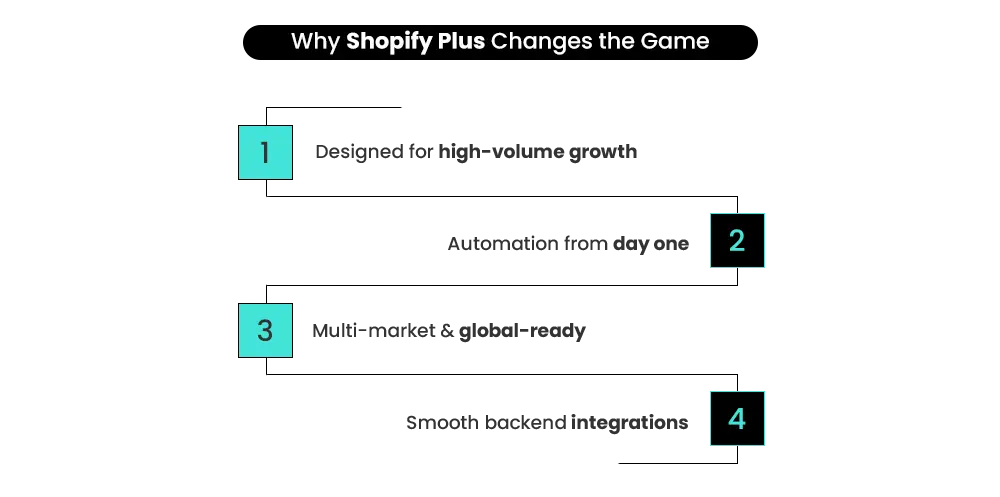
Shopify vs Shopify Plus: What Actually Changes at Launch?
When brands decide to launch Shopify store operations, the assumption is often that Shopify Plus is simply a higher-tier subscription. In practice, the difference becomes visible the moment implementation begins. If you’re still evaluating plans, read our other blog, “Shopify vs Shopify Plus: Pricing, Features & When to Upgrade”, for a detailed comparison before making your decision.
Build Your Shopify Store From Scratch With Mastroke
Launch faster with Mastroke, an official Shopify Partner. We build structured stores with conversion-first design, clean setup, and features built to scale!!
A standard Shopify launch prioritizes speed and simplicity. The focus is on storefront design, product setup, payment gateways, and essential integrations. It works well for growing brands that need efficiency when they launch Shopify store operations without structural complexity.
A Shopify Plus launch, however, is built around scale and operational depth. From day one, enterprise merchants must plan automation workflows, backend integrations, multi-market architecture, checkout extensibility, and API capacity before they launch Shopify store infrastructure. The goal is not just to go live — it is to launch Shopify store systems that can absorb aggressive growth without friction.
The distinction is strategic, not cosmetic.
Area |
Standard Shopify |
Shopify Plus |
| Launch Focus | Speed & simplicity | Scalability & architecture |
| Checkout | Limited customization | Advanced extensibility |
| Automation | Basic workflows | Enterprise-grade automation |
| API Limits | Standard | Higher throughput |
| Multi-Store | Manual setup | Structured multi-market support |
At scale, these differences determine whether growth feels manageable — or operationally expensive.
Launch Timeline Comparison
Standard Shopify Launch vs Shopify Plus Launch
One of the most overlooked differences in a Shopify Plus launch is timeline complexity. While both launches aim for go-live, the structure behind them differs significantly.
| Phase | Standard Shopify Launch | Shopify Plus Launch |
| Discovery | Business goals & theme planning | Enterprise architecture & capacity planning |
| Setup | Product uploads & app installs | Infrastructure + automation blueprint |
| Integrations | Basic app connections | ERP, OMS, WMS deep integration mapping |
| Checkout | Limited customization | Advanced checkout extensibility |
| Testing | Functional QA | Load testing + traffic stress validation |
| Go Live | Direct public launch | Soft launch + phased performance validation |
A standard Shopify store can launch within 2–4 weeks. A full Shopify Plus implementation may take 6–12+ weeks, depending on complexity, integrations, and global expansion plans.
The difference is not speed. It is structural readiness.
What’s Different When You Launch Shopify Store Operations on Shopify Plus?
When brands launch Shopify store operations on standard plans, the focus is storefront functionality. When executing a Shopify Plus setup, the focus shifts to scalable infrastructure.
Key differences include:
- Higher API throughput for complex integrations
- Enterprise-grade automation framework
- Native B2B capabilities
- Multi-store architecture for global expansion
- Advanced checkout extensibility
- Organizational governance controls
You are not just launching a storefront. You are launching enterprise commerce infrastructure.
Enterprise Infrastructure from Day One
When enterprise brands prepare to launch Shopify store operations on Shopify Plus, infrastructure planning does not begin at go-live. It begins with architecture.
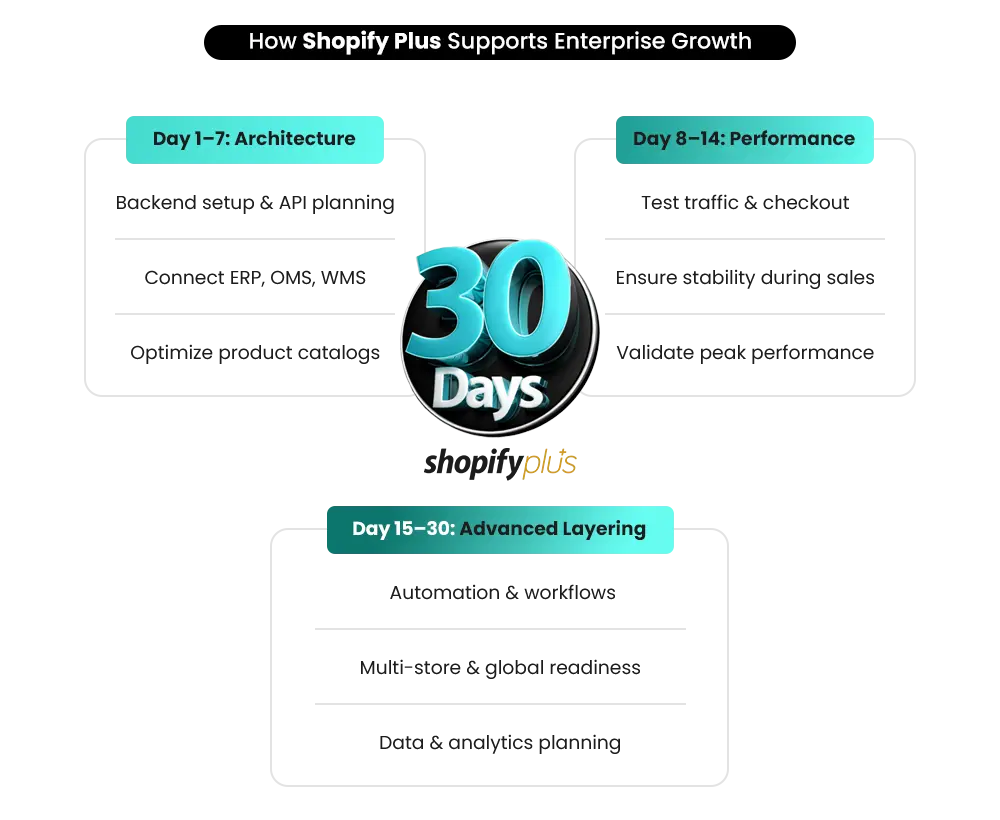
Below is how a scalable implementation typically unfolds.
Day 1–7: Architecture & Capacity Planning
The first phase focuses on defining the backend structure before any storefront customization begins.
Key priorities include:
- Evaluating API rate limits and projected integration load
- Mapping ERP, OMS, and WMS integration requirements
- Planning data flow between marketing, finance, and fulfillment systems
- Assessing high-SKU catalog structure and database performance
Unlike standard setups, Shopify Plus prov̄ides higher API throughput, allowing complex integrations without throttling performance. This becomes critical when synchronizing large product catalogs or real-time inventory across multiple systems.
Day 8–14: Performance & Scalability Validation
Once architecture is defined, stress planning begins.
Enterprise merchants must prepare for:
- High-traffic resilience during campaigns
- Flash-sale and product-drop stability
- Bandwidth allocation under peak demand
- Check the checkout performance during traffic spikes
Shopify Plus infrastructure is designed to absorb significant traffic surges without manual scaling. However, validating performance assumptions before launch Shopify store prevents costly downtime.
Day 15–30: Advanced Infrastructure Layering
In the final phase before go-live, strategic flexibility is layered in:
- Automation framework design
- Multi-store or multi-market structuring
- Headless or composable commerce compatibility (if required)
- Data architecture planning for analytics and reporting
At this level, launching is no longer about storefront readiness. It is about ensuring the system can evolve as the business scales.
Enterprise infrastructure is not reactive. It is intentional — from day one.
Checkout Architecture as a Revenue Engine
For enterprise brands, checkout is not a confirmation page — it is a controlled revenue environment. When you launch Shopify store infrastructure on Shopify Plus, checkout becomes programmable, measurable, and strategically optimized.
1. Checkout Extensibility
Shopify Plus enables advanced checkout customization through native extensibility. Brands can modify layout components, introduce dynamic messaging, and align checkout UX with conversion strategy — without compromising platform stability.
2. Shopify Functions & Custom Logic
With Shopify Functions, business rules move server-side. This allows dynamic pricing logic, conditional shipping methods, and complex discount calculations to operate seamlessly — which is critical when you launch Shopify store at scale or during high-traffic campaigns.
3. Advanced Promotions & Discount Control
Enterprise merchants often require layered promotional strategies. Shopify Plus supports segmented pricing, volume discounts, campaign-triggered offers, and structured promotion stacking without relying on fragile third-party scripts.
4. Subscription & B2B Capabilities
Recurring revenue models, net payment terms, company-specific pricing, and tax validation workflows can be embedded directly into the checkout experience — essential for hybrid DTC and B2B operations.
5. Regional Payment & Conversion Optimization
Geo-based payment routing, local currency prioritization, and infrastructure-level performance optimization ensure checkout remains stable, fast, and frictionless — even during flash sales or product drops.
At scale, checkout is no longer operational. It is strategic.
Automation as a Strategy When You Launch Shopify Store — Not a Post-Launch Fix
One of the biggest mistakes scaling brands make when they launch Shopify store infrastructure is treating automation as an afterthought. On Shopify Plus, automation is not a feature — it is a framework.
Shopify Flow allows businesses to automate tagging, risk assessment, inventory triggers, customer segmentation, and internal notifications the moment specific events occur. Instead of manually reviewing high-value orders or monitoring stock levels, workflows operate in the background from day one.
With Launchpad, campaign orchestration becomes controlled and predictable. Flash sales, product drops, and pricing adjustments can be scheduled and executed without operational chaos.
Automated order routing ensures the right fulfillment center processes the order, while fraud detection logic minimizes chargeback exposure before it escalates. When automation is designed before go-live, operational complexity does not multiply as revenue grows. It scales intelligently — without increasing headcount at the same pace.
For a deeper dive into implementation strategies, also read our blog, “Shopify Plus Automation: Practical Ways to Automate Store Operations.”
Building a Scalable Global Commerce Framework
Global expansion isn’t a luxury — it’s a growth engine. Launching a Shopify store infrastructure on Shopify Plus means thinking beyond a single storefront and designing for international scale from day one.
1. Expansion Store Architecture
- Create multiple regional storefronts under one Shopify Plus account
- Centralized oversight with local autonomy for marketing, products, and pricing
2. Localization Essentials
- Multi-currency & multi-language setup for seamless customer experiences
- Regional pricing & merchandising to account for local purchasing behavior
- Domain strategy & geo-routing to automatically direct users to the right storefront
3. Operational Backbone
- Market-specific inventory allocation to prevent stockouts or overselling
- International tax compliance integrated into checkout and backend systems
- Centralized vs distributed management: choose control or local agility depending on scale
Key Takeaway: Success in global e-commerce is more than translation. It’s about creating an ecosystem where local storefronts feel native, operations stay manageable, and scaling doesn’t break your infrastructure. Shopify Plus provides the tools, but architecture and planning are everything.
Unified B2B & DTC — One Platform, Infinite Possibilities
Managing B2B and DTC operations separately is a headache. Shopify Plus lets you unify both under a single, powerful platform, giving you full control without the operational chaos. Company accounts with role-based access make it easy to assign permissions, streamline approvals, and ensure that every team member and partner sees only what they need.
Custom price lists and advanced buyer segmentation ensure your wholesale clients see pricing and offers tailored to them, while volume-based structures reward bulk purchases. Net payment terms and automated invoicing workflows simplify accounting, keeping cash flow smooth across multiple storefronts.
Wholesale portals allow your B2B clients to place orders independently, without impacting your DTC experience, while your teams manage everything centrally.
The biggest win?
Unified commerce reduces operational friction, keeps data clean, and frees your teams to focus on growth, customer experience, and scaling globally — all without juggling multiple systems or platforms.
Governance, Security & Enterprise Support — Trust at Scale
Scaling a Shopify Plus store isn’t just about features—it’s about confidence. Enterprise-grade governance and rock-solid support ensure your operations run smoothly while protecting your brand’s integrity. Here’s how Shopify Plus keeps you in control:
Dedicated Merchant Success Manager
Every Shopify Plus merchant gets a strategic partner. Your Merchant Success Manager isn’t just support—they’re a guide for growth, helping you optimize workflows, troubleshoot issues, and plan long-term expansions.
24/7 Priority Support
Downtime? Not on your watch. With round-the-clock priority support, issues get resolved fast, keeping your stores operational and your customers happy, no matter the time zone.
Role-Based Permissions & Access Control
Control who sees what. Assign team roles with precision, ensuring sensitive data stays secure while your staff can access exactly what they need to do their jobs efficiently.
Organizational Oversight Across Stores
Manage multiple stores effortlessly. Centralized dashboards provide visibility over operations, orders, and performance metrics, keeping your enterprise in sync.
Platform Reliability & Risk Mitigation
Shopify Plus ensures uptime, compliance, and enterprise-grade stability, so you can focus on growth, not firefighting.
Data, Reporting & Analytics Architecture — Insights That Scale
For enterprise merchants, data isn’t just numbers—it’s strategic intelligence. Shopify Plus enables centralized reporting across multiple stores, consolidating fragmented data environments into a unified dashboard. Integration with BI and analytics platforms ensures actionable insights, from customer behavior to operational KPIs.
Advanced forecasting and performance monitoring allow proactive decision-making, while customer data consolidation provides a single source of truth across DTC and B2B operations. Built-in data governance and compliance tools safeguard sensitive information, ensuring regulatory adherence while empowering teams to optimize revenue, streamline operations, and scale confidently in a complex multi-store ecosystem.
The 6-Step Framework to Launch Shopify Store on Plus — From Concept to Commerce
Launching a Shopify Plus store isn’t just hitting “Go Live.” It’s about executing a precision-engineered plan that scales, converts, and delights from day one. Here’s how top enterprise brands do it:
Step 1: Market Validation & Business Case Alignment
Before building, ensure your audience, pricing, and value proposition align with real-world demand. Test, iterate, and confirm ROI potential.
Step 2: Technical Architecture Planning
Design the backbone of your store—API capabilities, integrations, high-traffic handling, and scalable infrastructure. Think of it as building a commerce superhighway.
Step 3: Integration Mapping
Connect ERP, OMS, WMS, payments, and apps with surgical precision. Every data touchpoint should sync seamlessly to prevent operational bottlenecks.
Step 4: Automation Blueprint Design
Define workflows with Shopify Flow and Launchpad before launch. Automate order routing, fraud detection, segmentation, and inventory updates to minimize manual intervention.
Step 5: Controlled Staging & QA Testing
Stress-test your store, workflows, and payment paths. Catch bugs, verify performance, and ensure UX is flawless.
Step 6: Soft Launch & Performance Validation
Release to a subset of users. Monitor traffic spikes, conversion metrics, and system reliability before scaling globally.
This structured approach transforms a launch Shopify store from a risky experiment into a strategic, revenue-driving enterprise event.
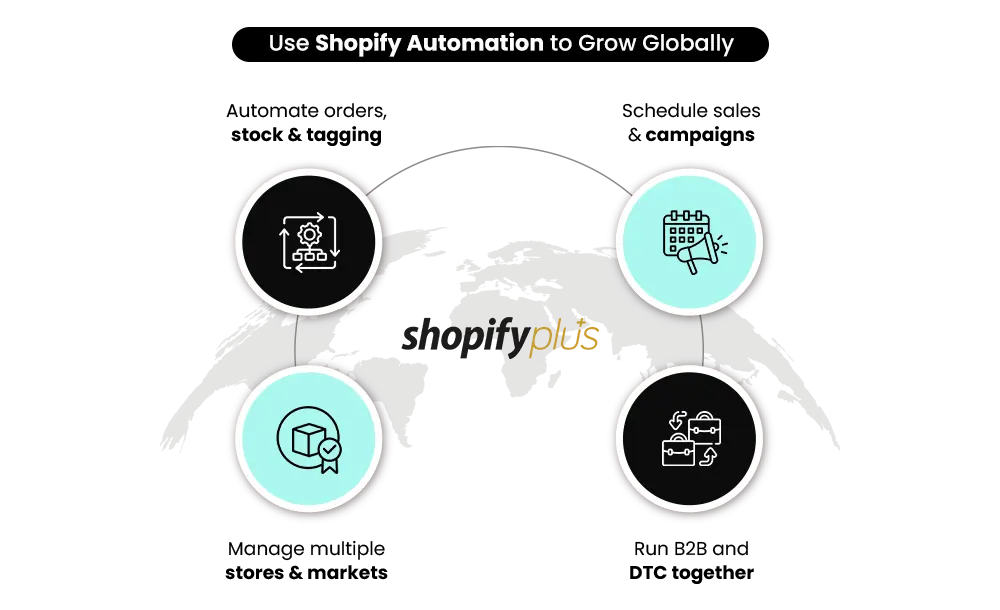
Cost vs ROI — The Enterprise Equation
Investing in Shopify Plus is more than a license fee—it’s a strategic move for scalable growth. For enterprise merchants, understanding the balance between upfront investment and long-term returns is critical.
Let’s break down the economics.
Automation and operational efficiency significantly reduce overhead. By minimizing manual processes in orders, inventory, and customer workflows, teams can focus on growth rather than firefighting. Similarly, built-in integrations reduce the need for expensive custom development that traditional platforms often demand.
Checkout optimization drives conversion uplift, while multi-store architecture enables revenue from global markets. Over time, the platform’s stability and scalability translate into savings that compound as your business grows.
Here’s a snapshot of the enterprise ROI considerations:
| Cost/Investment Area | Impact / ROI |
| Platform License | Predictable subscription fee for enterprise-grade features |
| Automation | Reduced operational costs, faster fulfillment, fewer errors |
| Custom Development | Savings from pre-built integrations and Shopify Functions |
| Checkout Optimization | Increased conversion rates and average order value |
| Multi-Store & Global Expansion | Incremental revenue from new markets with minimal additional infrastructure cost |
| Long-Term Scalability | Future-proof infrastructure reduces the total cost of ownership |
In short, Shopify Plus transforms costs into strategic investment, aligning platform spend with tangible operational and revenue gains—making it the smart choice for premium, high-growth merchants.
When Shopify Plus Is Not the Right Fit
While Shopify Plus is a powerhouse platform for enterprise growth, it’s not the perfect fit for every business. Knowing when to hold off can save both time and money and prevent overcomplicating operations.
Reason 1: Early-stage brands below enterprise thresholds
If your revenue is still modest or you’re testing product-market fit, Shopify Plus may be overkill. The cost and complexity might outweigh immediate benefits.
Reason 2: Low operational complexity businesses
Brands with few SKUs, a single storefront, or simple workflows don’t need multi-store architecture, advanced automation, or B2B features.
Reason 3: No multi-store or international roadmap
Merchants with no plans for multiple stores, global expansion, or localized pricing can get by with standard Shopify.
Reason 4: Teams without automation readiness
If your team isn’t experienced with workflows, integrations, or advanced Shopify tools, Plus features could go underutilized.
Reason 5: Budget-constrained startups
Shopify Plus is a premium investment. Startups with tight budgets should carefully evaluate ROI before committing.
What Most Shopify Plus Launch Guides Miss?
Most Shopify Plus launch guides focus on what to do rather than how to think strategically before hitting “launch.” This is where many brands stumble—and where careful planning can give you a real edge. The foundation of a successful store starts with architectural planning. Before investing time in themes or design, your backend structure, APIs, and integrations must be solid, ensuring smooth scaling as your business grows.
Equally important is designing automation workflows before your store goes live. Mapping Shopify Flow, Launchpad campaigns, and inventory or order routing early prevents costly rework and reduces operational friction from day one. Internal team readiness is often overlooked; your staff must understand processes, integration points, and system workflows to leverage the platform effectively.
Finally, selecting the right strategic partners and avoiding shortcuts in integration ensures you don’t accumulate technical debt. A carefully planned Shopify Plus launch creates a foundation that’s robust, scalable, and designed for growth rather than quick fixes.
Common Shopify Plus Launch Mistakes
Even experienced teams make critical errors during a Shopify Plus migration or first-time Plus launch.
1. Over-Customizing Too Early
Heavy custom development before validating workflows increases technical debt and slows performance.
2. Ignoring Automation
Failing to configure Shopify Flow and Launchpad before go-live creates operational bottlenecks as order volume grows.
3. Underestimating Integration Complexity
ERP, OMS, WMS, and BI integrations require structured mapping. Treating them as plug-and-play often leads to data sync failures.
4. Skipping Load Testing
Traffic spikes during campaigns can break checkout and backend systems if stress testing is skipped.
5. Treating Shopify Plus Like Standard Shopify
Enterprise infrastructure requires enterprise planning. A Shopify Plus launch demands architecture-first thinking.
Conclusion
Launching a Shopify Plus store isn’t just about opening another online shop—it’s about building a scalable, future-ready commerce infrastructure. From advanced automation to multi-store management, B2B and DTC integration, and global readiness, every element is designed to support growth, efficiency, and operational excellence. The most successful enterprise brands don’t treat a launch as a one-off project—they engineer it as a strategic foundation for long-term success.
With the right planning, architecture, and execution, your Shopify Plus store becomes more than a storefront—it’s a revenue engine, a platform for innovation, and a global sales powerhouse. By thinking beyond simple deployment, focusing on automation, governance, and international capabilities, brands can reduce operational risks, optimize conversions, and achieve true scalability.
If you’re planning a Shopify Plus launch in the next 90 days, infrastructure planning should begin before theme development. Partner with Mastroke today and turn your vision into a high-performing, globally optimized store built to scale.
Build your dream Shopify store today
Bring your vision to life with Mastroke, an official Shopify Partner. We design and develop high-converting, scalable Shopify stores with clean structure and future-ready features—built to grow with your business.
FAQs
1. What Is Shopify Plus?
Shopify Plus is the enterprise version of Shopify designed for high-growth and high-volume merchants. It offers advanced automation, checkout extensibility, multi-store management, higher API limits, and dedicated enterprise support.
2. What’s the Difference Between Shopify and Shopify Plus?
The difference lies in scalability and infrastructure. Standard Shopify serves small to mid-sized businesses with simpler needs. Shopify Plus provides enterprise-grade automation, advanced integrations, multi-store architecture, higher API limits, and customizable checkout capabilities built for large-scale operations.
3. What Changes at Launch With Shopify Plus?
Launching on Shopify Plus requires a more strategic approach compared to standard Shopify. Key differences include:
Infrastructure planning before theme development
- Integration mapping before go-live
- Automation configuration before scaling
- Load testing for high-traffic resilience
- Governance and access control setup
Unlike standard Shopify, a Shopify Plus launch focuses on long-term scalability, performance, and operational readiness — not just storefront setup.
4. Is Shopify Plus Worth It?
Shopify Plus is worth it for enterprise brands that require scalability, global commerce infrastructure, automation, and advanced checkout control. For early-stage brands with simpler needs, standard Shopify may be sufficient.
5. When Should You Upgrade to Shopify Plus?
- You should consider upgrading when:
- Traffic volume increases significantly
- Automation needs grow
- Multi-store or international expansion begins
- ERP or complex integrations become necessary
- B2B and DTC operations need to be unified
If growth starts stressing your current infrastructure, it’s time to evaluate Plus.
6. Can Shopify Plus Support Both B2B and DTC in One Ecosystem?
Yes. Shopify Plus allows you to run wholesale (B2B) and direct-to-consumer (DTC) operations within a single ecosystem. Features like company accounts, volume pricing, custom catalogs, and unified workflows make management seamless.
7. Does Shopify Plus Improve Checkout Conversions?
Yes. Shopify Plus offers checkout extensibility, advanced discount logic, subscription integration, regional payment routing, and custom checkout flows — all of which can significantly improve conversion rates.