This blog post explains Shopify Plus as an enterprise-grade e-commerce platform designed for high-growth businesses that have outgrown standard Shopify's capabilities. It covers the key features, scaling challenges that trigger the need for an upgrade, and how Shopify Plus addresses complex operational requirements.
At some point, the store that got you here stops being enough to get you where you’re going. Orders are up, campaigns are getting more complex, your team is managing more markets — and the cracks start to show. Checkout slows during peak traffic. Integrations break under load. Manual workflows that used to take minutes now eat hours.
Shopify Plus features are built for exactly this stage. It’s Shopify’s enterprise-grade platform — designed for high-growth brands that need more than a storefront. More control over checkout. You get automation that actually scales. The infrastructure to handle flash sales without dropping a single order.
This guide covers what Shopify Plus is, which features matter for enterprise operations, what it costs, and how to decide whether it’s the right move for your business right now.
Enterprise Ecommerce
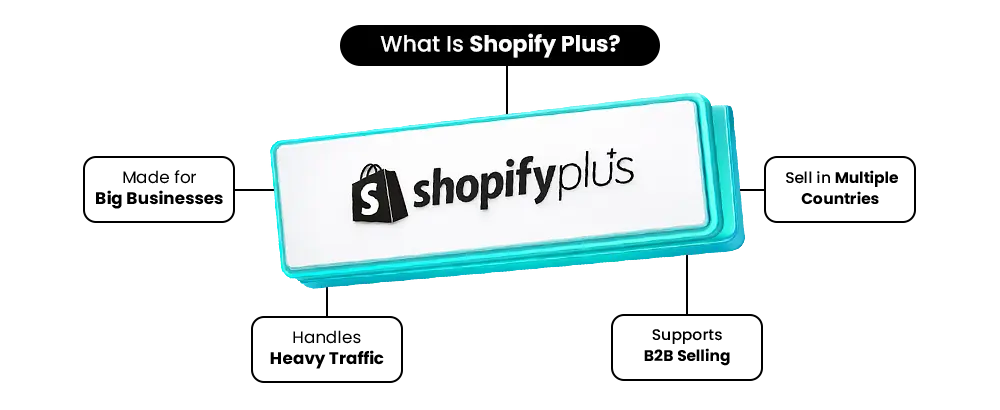
What Is Shopify Plus?
Shopify Plus is the enterprise version of Shopify, built for high-volume brands and fast-growing businesses. While standard Shopify plans handle the core needs of smaller stores well, Shopify Plus gives enterprise teams the infrastructure, flexibility, and control that complex operations require.
The difference becomes visible as businesses scale. Standard plans give you a strong e-commerce foundation. Shopify Plus gives you the ability to customize checkout logic, automate backend workflows, manage multiple storefronts from one admin, and connect deeply with ERP and CRM systems — without performance tradeoffs.
According to Shopify, brands typically consider upgrading once they consistently hit around $80,000 in monthly revenue. That’s roughly the threshold where the platform’s enterprise features start delivering measurable return on the investment.
Enterprise Growth Needs More Than a Standard Store
Shopify Plus works best when the business has genuinely outgrown manual systems, limited checkout flexibility, and disconnected operations. Mastroke helps enterprise brands plan migrations, streamline integrations, and build Shopify Plus setups designed for long-term scale — not short-term patches.
Scaling Challenges
Why Standard Shopify Eventually Falls Short
This isn’t a criticism of standard Shopify — it’s a great platform for stores at the right stage. But there’s a point where operational complexity outpaces what a standard plan can handle cleanly.
It usually shows up gradually. Your team starts patching gaps manually: handling inventory updates by hand, pushing last-minute promotions through developer support, managing region-specific pricing by editing theme code. None of it is a crisis on its own. But together, it starts slowing the business down.
Here’s what that pattern looks like in practice:
- Campaign launches that require developer involvement for minor checkout changes
- Traffic spikes during sales that create checkout slowdowns or errors
- Fragmented data across disconnected tools, delaying decisions
- International expansion held back by pricing and tax complexity
- Integration failures between Shopify and ERP or CRM systems
These aren’t growing pains you push through. They’re signals that the platform needs to grow with you. That’s what Shopify Plus is designed for — not to replace what’s working, but to remove the ceiling on what’s possible.
For a deeper look at how enterprise brands approach their full integration stack, the Shopify Plus Integrations guide covers what works and what to avoid.
Enterprise Features
Core Shopify Plus Features That Drive Enterprise Growth
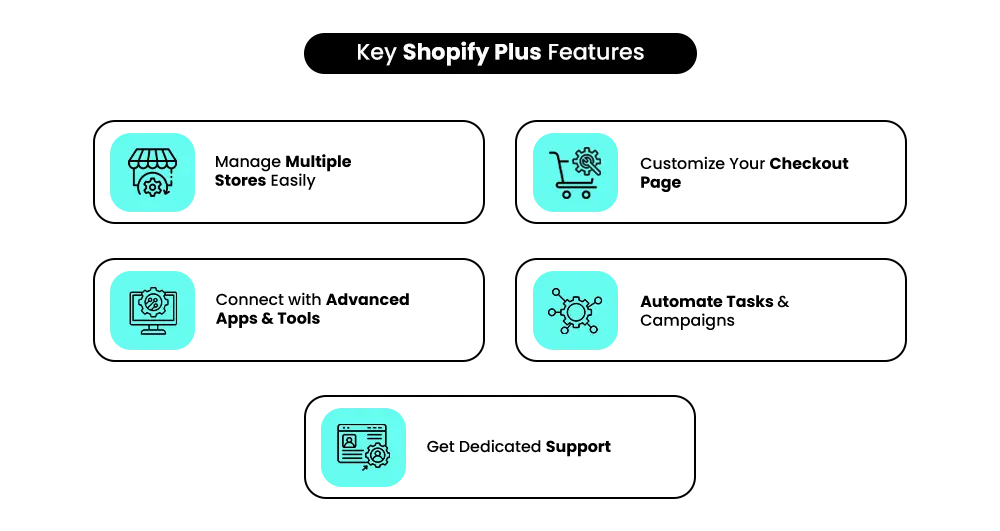
These aren’t just feature upgrades. Each one addresses a specific operational challenge that enterprise brands face at scale.
Infrastructure Built for High Traffic
Shopify Plus includes unlimited bandwidth and a global CDN. When your flash sale hits and 10,000 people land on your product page at the same time, the store stays fast and the checkout stays open. Shopify’s infrastructure can handle up to 6,000 checkouts per minute — a figure that matters when a campaign goes viral and you have one shot to capture the revenue.
Standard plans run on shared infrastructure — at high volume, that’s a meaningful difference.
Advanced Checkout Customization and Extensibility
On standard Shopify, checkout is largely fixed. On Shopify Plus, you get access to Checkout Extensibility and Shopify Functions — which means your team can actually build what the business needs.
That includes custom shipping logic, dynamic discount rules, region-specific checkout flows, and payment method changes — all without touching core platform code. Marketing teams can move faster. Developers aren’t bottlenecked on every campaign.
This is one of the highest-value Shopify Plus features for enterprise brands, because checkout performance directly affects revenue.
Higher API Limits and Headless Commerce
Enterprise operations connect a lot of systems — ERP, CRM, PIM, marketing automation, warehouse management. Standard plans have API rate limits that start to restrict how smoothly these integrations run at high transaction volumes.
Shopify Plus raises those limits significantly. And for brands that want complete control over the front-end experience, headless commerce allows a fully custom storefront while keeping Shopify’s backend for orders, inventory, and payments. You get flexibility without rebuilding your operational foundation.
To see how ERP connections specifically work within a Shopify Plus setup, the Shopify Plus ERP Integration Guide walks through what works in practice.
Shopify Flow, Launchpad, and Shopify Functions
Automation at enterprise scale isn’t a nice-to-have — it’s what keeps operations from requiring a larger team every time volume grows.
- Shopify Flow automates backend workflows — customer tagging, fraud flagging, inventory alerts, team notifications — using trigger-condition-action logic with no coding required
- Launchpad lets you schedule product drops, flash sales, and campaign activations in advance, including price changes and theme updates that go live and revert automatically
- Shopify Functions allows custom logic for discounts, shipping, and payment rules at the backend level — enabling complex pricing scenarios that standard discount tools can’t handle
Together, these reduce the manual work that otherwise scales linearly with order volume.
Multi-Store and Multi-Currency Management
Shopify Plus gives enterprise brands an organization admin — a centralized dashboard where you manage multiple expansion stores across regions. Each store can have its own currency, language, pricing, and checkout experience while being managed from one place.
B2B and Wholesale Functionality
Shopify Plus natively supports B2B and wholesale operations — custom pricing catalogs, volume discounts, net payment terms, and gated storefronts for wholesale buyers. Brands running both DTC and B2B channels can manage both from the same platform, which reduces the need for separate systems or workarounds.
Level 1 PCI Compliance and Security Infrastructure
Enterprise brands process large volumes of customer payment data. Shopify Plus maintains Level 1 PCI DSS compliance — the highest certification level — along with secure payment processing, fraud analysis tools, and a managed hosting environment. Security is handled at the platform level, not something your team needs to maintain separately.
Dedicated Merchant Success Program
Shopify Plus merchants get a dedicated Merchant Success Manager and priority support access. For enterprise teams, this means faster issue resolution when something breaks during a campaign, and a strategic partner who knows your account and can help you plan platform rollouts, migrations, and feature implementations.
Struggling With Complex Shopify Operations?
From ERP sync issues to disconnected backend systems, Mastroke helps enterprise Shopify brands build integrations that stay stable as order volume grows.
Scaling Challenges
Why Standard Shopify Eventually Falls Short
This isn’t a criticism of standard Shopify — it’s a great platform for stores at the right stage. But there’s a point where operational complexity outpaces what a standard plan can handle cleanly.
It usually shows up gradually. Your team starts patching gaps manually: handling inventory updates by hand, pushing last-minute promotions through developer support, managing region-specific pricing by editing theme code. None of it is a crisis on its own. But together, it starts slowing the business down.
Here’s what that pattern looks like in practice:
- Campaign launches that require developer involvement for minor checkout changes
- Traffic spikes during sales that create checkout slowdowns or errors
- Fragmented data across disconnected tools, delaying decisions
- International expansion held back by pricing and tax complexity
- Integration failures between Shopify and ERP or CRM systems
These aren’t growing pains you push through. They’re signals that the platform needs to grow with you. That’s what Shopify Plus is designed for — not to replace what’s working, but to remove the ceiling on what’s possible.
For a deeper look at how enterprise brands approach their full integration stack, the Shopify Plus Integrations guide covers what works and what to avoid.
Enterprise Features
Core Shopify Plus Features That Drive Enterprise Growth
These aren’t just feature upgrades. Each one addresses a specific operational challenge that enterprise brands face at scale.
Infrastructure Built for High Traffic
Shopify Plus includes unlimited bandwidth and a global CDN. When your flash sale hits and 10,000 people land on your product page at the same time, the store stays fast and the checkout stays open. Shopify’s infrastructure can handle up to 6,000 checkouts per minute — a figure that matters when a campaign goes viral and you have one shot to capture the revenue.
Standard plans run on shared infrastructure — at high volume, that’s a meaningful difference.
Advanced Checkout Customization and Extensibility
On standard Shopify, checkout is largely fixed. On Shopify Plus, you get access to Checkout Extensibility and Shopify Functions — which means your team can actually build what the business needs.
That includes custom shipping logic, dynamic discount rules, region-specific checkout flows, and payment method changes — all without touching core platform code. Marketing teams can move faster. Developers aren’t bottlenecked on every campaign.
This is one of the highest-value Shopify Plus features for enterprise brands, because checkout performance directly affects revenue.
Higher API Limits and Headless Commerce
Enterprise operations connect a lot of systems — ERP, CRM, PIM, marketing automation, warehouse management. Standard plans have API rate limits that start to restrict how smoothly these integrations run at high transaction volumes.
Shopify Plus raises those limits significantly. And for brands that want complete control over the front-end experience, headless commerce allows a fully custom storefront while keeping Shopify’s backend for orders, inventory, and payments. You get flexibility without rebuilding your operational foundation.
To see how ERP connections specifically work within a Shopify Plus setup, the Shopify Plus ERP Integration Guide walks through what works in practice.
Shopify Flow, Launchpad, and Shopify Functions
Automation at enterprise scale isn’t a nice-to-have — it’s what keeps operations from requiring a larger team every time volume grows.
- Shopify Flow automates backend workflows — customer tagging, fraud flagging, inventory alerts, team notifications — using trigger-condition-action logic with no coding required
- Launchpad lets you schedule product drops, flash sales, and campaign activations in advance, including price changes and theme updates that go live and revert automatically
- Shopify Functions allows custom logic for discounts, shipping, and payment rules at the backend level — enabling complex pricing scenarios that standard discount tools can’t handle
Together, these reduce the manual work that otherwise scales linearly with order volume.
Multi-Store and Multi-Currency Management
Shopify Plus gives enterprise brands an organization admin — a centralized dashboard where you manage multiple expansion stores across regions. Each store can have its own currency, language, pricing, and checkout experience while being managed from one place.
B2B and Wholesale Functionality
Shopify Plus natively supports B2B and wholesale operations — custom pricing catalogs, volume discounts, net payment terms, and gated storefronts for wholesale buyers. Brands running both DTC and B2B channels can manage both from the same platform, which reduces the need for separate systems or workarounds.
Level 1 PCI Compliance and Security Infrastructure
Enterprise brands process large volumes of customer payment data. Shopify Plus maintains Level 1 PCI DSS compliance — the highest certification level — along with secure payment processing, fraud analysis tools, and a managed hosting environment. Security is handled at the platform level, not something your team needs to maintain separately.
Dedicated Merchant Success Program
Shopify Plus merchants get a dedicated Merchant Success Manager and priority support access. For enterprise teams, this means faster issue resolution when something breaks during a campaign, and a strategic partner who knows your account and can help you plan platform rollouts, migrations, and feature implementations.
Platform Comparison
How Shopify Plus Compares to Other Enterprise Platforms
Enterprise brands typically evaluate Shopify Plus alongside Magento (Adobe Commerce), BigCommerce Enterprise, and Salesforce Commerce Cloud. The primary differences come down to ownership model, time to market, and how much ongoing technical maintenance the platform requires from your team.
| Platform | Hosting & Maintenance | Time to Market | Customization | Complexity |
|---|---|---|---|---|
| Shopify Plus | Fully managed SaaS | Fast | High via APIs and headless | Moderate |
| Magento (Adobe Commerce) | Self-managed or cloud | Slower | Very high | High |
| BigCommerce Enterprise | SaaS | Moderate | High | Moderate |
| Salesforce Commerce Cloud | Managed | Slower | High | High |
The tradeoff is real: platforms like Magento allow deeper backend customization, but that depth comes with infrastructure ownership, ongoing maintenance, and significant developer dependency. Shopify Plus gives enterprise teams a managed environment with high flexibility through APIs — without requiring a dedicated IT team to keep the platform running.
Shopify Plus Agency
When Does a Shopify Plus Agency Make Sense?
Shopify Plus gives you the tools. What you do with them depends on how they’re implemented.
Many enterprise brands underutilize the platform because they configure it the same way they’d approach a standard Shopify setup. The architecture decisions made during implementation — how checkout is structured, which systems integrate and how, how automation is layered — affect performance and flexibility for years.
Complex integrations
Connecting ERP, CRM, PIM, and marketing automation systems to Shopify Plus requires proper API architecture. Done incorrectly, integrations break under load or create data sync issues that only surface during peak periods — exactly when you can’t afford them.
Migration from another platform
Moving from Magento, Salesforce, or a custom-built system involves data migration, SEO preservation, redirects, checkout rebuild, and backend configuration. Each of these can go wrong in ways that aren’t immediately visible. An experienced agency reduces that risk.
Checkout optimization
Checkout Extensibility on Shopify Plus is powerful, but it requires a clear conversion strategy to be worth the investment. Agencies that have run this process across multiple enterprise stores bring tested approaches rather than first-time experimentation.
Ongoing optimization
Shopify Plus isn’t a one-time setup. New features roll out, platform capabilities expand, and business requirements change. The brands that get the most out of the platform treat it as an ongoing program rather than a launch project.
Enterprise brands shouldn’t experiment at scale. At high transaction volumes, mistakes are expensive — a checkout bug during a product launch, an integration failure during peak season, a migration that drops SEO rankings. Internal teams that don’t live in Shopify Plus every day are more likely to encounter these problems. Agencies that do this daily have seen the failure modes before.
Need Better Performance During Traffic Spikes?
Slow checkout, lagging storefronts, and unstable launches quietly hurt revenue. Mastroke helps Shopify brands improve speed, infrastructure stability, and conversion performance before scaling problems get expensive.
Getting Started
How to Get Started with Shopify Plus
Assess your actual need. Look at where your current setup is creating friction — checkout limitations, integration failures, manual overhead, traffic performance. If multiple of these are real problems now, Plus likely pays for itself. If operations are running smoothly and volume is under $80,000/month, the timing may not be right yet.
Contact Shopify Plus sales. Shopify’s Plus team handles onboarding and contract discussions directly. Use this conversation to understand the current pricing tiers and negotiate contract terms — particularly the revenue threshold at which variable pricing kicks in.
Define your migration and build a roadmap. Before any development starts, map your integrations, data migration requirements, checkout customization needs, and automation priorities. Trying to figure this out mid-implementation is expensive.
Build and configure. Theme setup, checkout customization, Flow automation, ERP/CRM connections, and expansion of stores for relevant regions. Sequence this by priority and business impact, not by technical convenience.
Test before you launch. Load testing, payment testing, and UX review across devices. Don’t go live without confirming the checkout works the way you expect under realistic traffic conditions.
Plan for ongoing optimization. Set a review cadence — quarterly at minimum — to assess workflow performance, new feature availability, and conversion opportunities. The platform improves continuously; your setup should too.
Before You Upgrade
Key Questions to Answer Before Upgrading
- Is your monthly revenue consistently above $80,000 — or on a clear trajectory toward it?
- Are you experiencing specific problems that Plus features directly solve: checkout limitations, integration failures, automation gaps, and multi-store needs?
- Have you calculated the actual cost — platform fee, development, apps — and confirmed the ROI case?
- Does your team have the bandwidth to implement properly, or do you need an agency partner?
- Is your growth plan global, multi-channel, or B2B — in any direction that Shopify Plus specifically supports better than your current setup?
If most of these points toward yes, the conversation with Shopify’s sales team is worth having.
Final Thoughts
Final Thoughts
Shopify Plus isn’t the right platform for every store — it’s the right platform for stores that have genuinely outgrown what standard Shopify can do cleanly. The Shopify Plus features that matter most at enterprise scale — checkout extensibility, automation tools, higher API limits, multi-store management, and B2B support — are built for operations that need more than a well-configured storefront.
Pricing starts at $2,300/month, scales with revenue above $800K/month, and is capped at $40,000/month. For brands at the right stage, the transaction fee savings, productivity gains, and conversion improvements typically make the investment straightforward.
If you’re evaluating Shopify Plus for your enterprise store, Mastroke’s Shopify Plus team can help you assess whether your current stage justifies the upgrade, plan the migration architecture, and build a setup that performs from day one.
Book a free consultation, and we’ll give you a clear picture of what Plus would actually look like for your specific operation.
FAQs
1. What is Shopify Plus, and how is it different from standard Shopify?
Shopify Plus is the enterprise version of Shopify, built for high-volume and high-growth brands. It includes features not available on standard plans — advanced checkout customization through Checkout Extensibility, higher API limits, automation tools like Shopify Flow and Launchpad, multi-store management, native B2B functionality, and a dedicated Merchant Success Manager. Standard Shopify plans cover the core needs of small to mid-sized stores; Shopify Plus removes the operational ceiling for brands that have grown beyond that.
2. How much does Shopify Plus cost in 2025–2026?
Shopify Plus starts at $2,300 USD per month on a 3-year contract, or $2,500 USD per month on a 1-year contract, billed monthly. For merchants with monthly GMV above approximately $800,000, pricing shifts to a variable model based on revenue, capped at $40,000 per month. Development, app, and agency costs are additional, depending on your operational requirements.
3. When should a business consider upgrading to Shopify Plus?
Shopify officially recommends considering the upgrade when monthly revenue consistently reaches around $80,000 — roughly $1 million annually. Beyond revenue, the clearest upgrade signals are: checkout customization needs, integration failures with ERP or CRM systems, performance issues during traffic spikes, international expansion requiring multi-store management, or significant time spent on manual backend operations.
4. Can Shopify Plus handle high traffic events like flash sales?
Yes. Shopify Plus infrastructure is built specifically for this. The platform can process up to 6,000 checkouts per minute, which is the capacity needed for large product drops, influencer-driven launches, and peak-season campaigns. Standard Shopify plans run on shared infrastructure and don’t have this dedicated throughput.
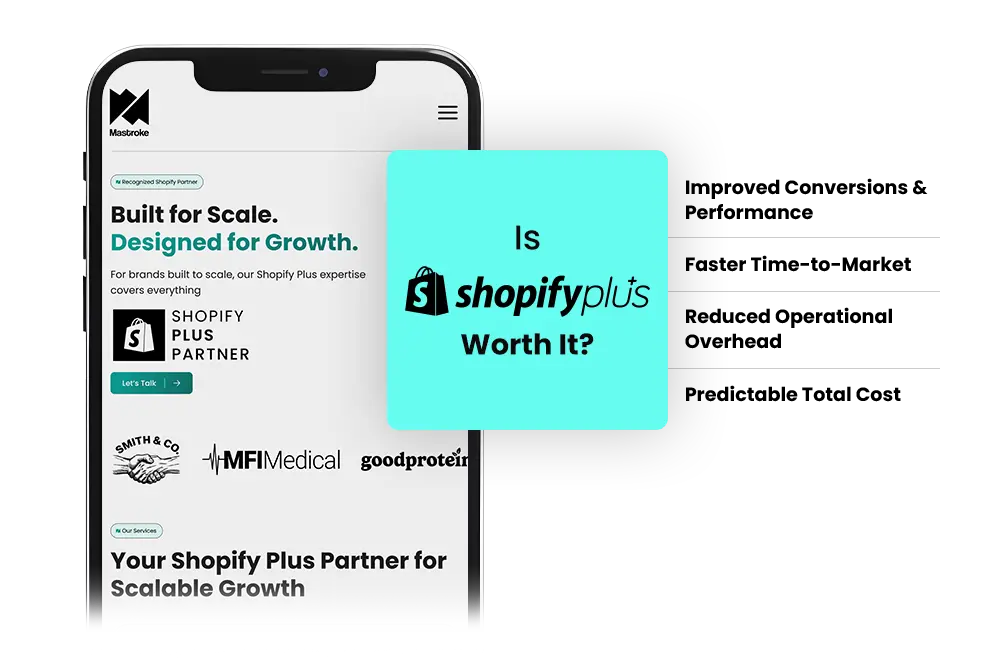
5. Is Shopify Plus worth the investment for enterprise brands?
For brands at the right scale, typically above $1 million in annual revenue, the answer is usually yes — but the math depends on your specific situation. Lower transaction fees, combined with checkout performance improvements and automation savings, often offset the platform cost. Below $80,000/month in revenue, the Advanced Shopify plan at $399/month is likely a better fit.
6. Do you need a Shopify Plus agency to implement it?
You can implement Shopify Plus internally if your team has deep platform experience. For most enterprise brands, though, an agency makes sense — particularly for complex integrations, platform migration, checkout customization, and ongoing optimization. The implementation decisions made at the start affect how the platform performs for years, so getting the architecture right from the beginning matters more than it might seem.
7. What is the difference between Shopify Plus expansion stores and separate Shopify stores?
Expansion stores are regional storefronts of the same brand — intended for selling in different currencies, languages, or to wholesale customers — managed from a single Shopify Plus organization admin. They are not designed for separate brands; Shopify requires a separate Plus contract for each distinct brand. If you’re considering expansion stores for international selling, it’s worth reviewing Shopify’s terms to confirm they fit your use case before signing a contract.