
This blog post explains the real cost structure of Shopify Plus pricing in 2026, emphasizing that the actual investment extends far beyond the base monthly fee. It breaks down how additional costs from apps, transaction fees, development, and integrations can significantly increase the total investment as businesses scale.
Shopify Plus pricing rarely stays limited to the monthly subscription fee. For many growing eCommerce brands, the real expenses begin after the platform upgrade itself.
At first glance, Shopify Plus appears straightforward — a premium Shopify plan designed for businesses operating at scale. But once brands start expanding, costs often grow far beyond the base subscription. Apps, automation tools, integrations, development work, payment processing, and ongoing optimization all become part of the larger investment.
This is where many businesses underestimate the real cost of Shopify Plus.
According to Shopify’s official pricing structure, Shopify Plus is built for enterprise merchants that require advanced customization, automation, multi-store management, and operational scalability. But the total cost depends heavily on how complex the business becomes over time.
For some brands, Shopify Plus improves efficiency and supports scalable growth. For others, upgrading too early can create operational costs that outweigh the immediate benefits.
Understanding the full pricing structure before upgrading helps businesses make smarter long-term decisions — not just cheaper short-term ones.
What Does Shopify Plus Cost in 2026?
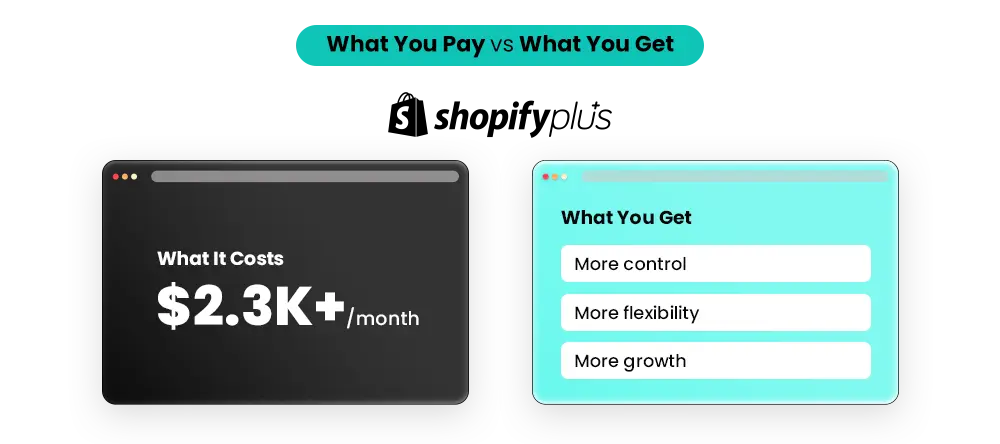
The Shopify Plus plan typically starts around $2,300 per month, though exact costs vary depending on contract structure, business requirements, and region., depending on standard setup and integrations, though pricing can vary depending on region, business size, contract terms, and operational requirements.
On an annual basis, that places the starting platform investment above $27,000 before additional operational expenses are considered.
However, the subscription fee itself is only part of the picture.
As businesses grow, Shopify Plus costs can also include:
- Payment processing fees
- Third-party apps
- ERP or CRM integrations
- Development and maintenance
- Automation tools
- International storefront management
- Agency or technical support
Some enterprise contracts may also include variable pricing structures tied to business scale or operational complexity.
Two Shopify Plus stores generating similar revenue can still operate with completely different monthly costs depending on their tech stack and operational setup.
For official platform details and enterprise pricing information, Shopify’s official Shopify Plus pricing page remains the most reliable reference point.
Shopify Plans Comparison
Before upgrading, it helps to compare Shopify Plus with Shopify’s standard plans.
| Plan | Starting Monthly Cost | Third-Party Transaction Fee | Best For |
| Basic Shopify | $29 | 2.0% | Small businesses |
| Shopify | $79 | 1.0% | Growing brands |
| Advanced Shopify | $299 | 0.6% | Scaling businesses |
| Shopify Plus | $2,300+ | 0.2% | Enterprise stores |
Rates and pricing structures may vary based on region, payment setup, and Shopify contract terms.
The jump to Shopify Plus is significant, but so is the level of operational flexibility businesses receive in return.
What Do You Get With Shopify Plus?
The higher Shopify Plus cost is tied directly to enterprise-level capabilities. Unlike standard Shopify plans, Shopify Plus is designed for businesses managing larger operations, higher traffic volumes, multiple storefronts, and more advanced workflows.
Some of the major features include:
- Checkout customization
- Advanced automation tools
- Multi-store management
- B2B functionality
- Unlimited staff accounts
- API flexibility
- Priority support
- International expansion support
Shopify Plus also includes enterprise-focused tools like Shopify Flow for workflow automation, Launchpad for campaign scheduling, advanced Shopify Functions for checkout customization, built-in B2B capabilities for wholesale operations, and support for headless commerce architectures.
For many enterprise businesses, Shopify Plus also reduces the need to manage hosting infrastructure, security updates, and platform maintenance separately.
That operational simplicity becomes more valuable as a business scales across multiple regions, teams, and customer segments.
Payment Processing and Transaction Fees
One of the most overlooked parts of Shopify Plus pricing is payment processing.
Businesses using Shopify Payments can avoid additional Shopify transaction fees. However, stores using third-party payment gateways may pay extra platform fees alongside standard payment processing charges.
At smaller volumes, these percentages may seem minor. At scale, they become much more important.
For example:
- A 0.2% fee on $100,000 in monthly sales equals $200
- A 0.2% fee on $1 million in monthly sales equals $2,000
That is why payment setup decisions can directly affect long-term profitability for enterprise stores.
Exact transaction fees vary depending on:
- region,
- payment provider,
- negotiated rates,
- and business volume.
The Hidden Costs Many Businesses Miss
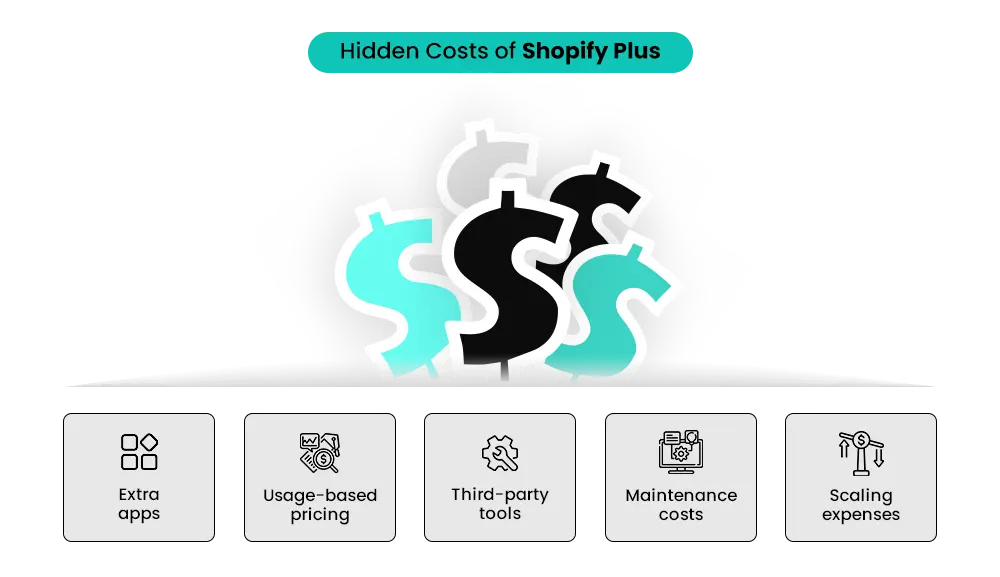
The Shopify Plus subscription fee is usually the most visible expense. The hidden operational costs are what businesses often underestimate.
As stores grow, many brands begin adding:
- automation platforms,
- analytics tools,
- personalization software,
- loyalty systems,
- search apps,
- tax integrations,
- and customer retention tools.
Individually, these tools may appear manageable. Combined, they can become a significant recurring monthly expense.
Several enterprise-focused Shopify analyses have also highlighted how apps, integrations, and operational tooling frequently become major long-term costs as brands scale.
This is also why many growing stores eventually review their entire Shopify setup to identify unnecessary apps, overlapping functionality, and avoidable operational inefficiencies before costs continue increasing.
Regular Shopify store audits often help brands uncover hidden conversion issues and operational inefficiencies before they become expensive long-term problems.
📌 Related Video
>
>
Apps and Tech Stack Expenses
Most Shopify Plus stores rely heavily on third-party tools to support growth.
This usually includes:
- Email marketing software
- SMS platforms
- Inventory systems
- Personalization tools
- Analytics dashboards
- Customer retention platforms
As traffic and operational complexity increase, app-related costs usually increase as well.
A growing Shopify Plus store rarely runs on the platform alone. The surrounding tech stack often becomes one of the largest recurring operational investments over time.
This is why many enterprise businesses prioritize performance optimization and app efficiency instead of continuously adding more tools.
In many cases, improving Shopify performance and conversion flow produces better long-term results than expanding the app stack unnecessarily.
Development and Agency Costs
Development is often one of the largest long-term Shopify Plus investments.
Some businesses require only minor customization. Others need:
- Custom storefront experiences
- ERP integrations
- B2B functionality
- International storefront management
- Advanced checkout customization
As complexity increases, development requirements usually increase alongside it.
Many enterprise brands also work with Shopify agencies or technical teams for:
- Conversion optimization
- UX improvements
- Maintenance
- Performance optimization
- Ongoing feature development
These costs vary significantly depending on project scope and operational scale.
For larger businesses, ongoing optimization is often less about aesthetics and more about improving efficiency, conversions, and long-term operational performance.
Real Shopify Plus Cost Example
To understand Shopify Plus pricing realistically, it helps to look beyond the subscription itself.
A growing enterprise Shopify Plus store may invest in:
| Expense Category | Estimated Monthly Cost |
|---|---|
| Shopify Plus Subscription | $2,300–$2,500+ |
| Apps & Integrations | $1,000–$5,000+ |
| Marketing & Automation Tools | $500–$3,000+ |
| Development & Maintenance | Varies by complexity |
| Agency or Technical Support | Varies by scope |
For enterprise businesses operating internationally or managing larger teams, total monthly operational costs can become significantly higher.
This does not automatically make Shopify Plus expensive or inefficient. It simply means the platform is built for businesses operating at a different level of scale than standard Shopify plans.
Is Shopify Plus Worth the Cost?
For smaller stores, Shopify Plus may feel unnecessarily expensive.
But for businesses managing:
- High order volumes
- International storefronts
- Advanced automation
- Operational complexity
The platform can become far more practical operationally.
The value of Shopify Plus is not only the software itself. It comes from:
- Scalability
- Centralized operations
- Automation
- Checkout flexibility
- Enterprise-level infrastructure
Businesses that benefit most from Shopify Plus usually focus less on minimizing short-term costs and more on building systems capable of supporting long-term growth reliably.
When Should You Upgrade to Shopify Plus?
Shopify Plus is generally best suited for businesses that have moved beyond early-stage growth.
You may consider upgrading if:
- Your business is handling high monthly order volumes
- You operate across multiple countries or storefronts
- Your workflows require advanced automation
- Your current Shopify plan is limiting operational flexibility
- You need more advanced checkout customization
- Your team is spending too much time managing manual processes
At this stage, Shopify Plus becomes less of a simple platform upgrade and more of an operational infrastructure decision.
Build Your Shopify Plus Store From Scratch With Mastroke
Launch faster with Mastroke, an official Shopify Plus Partner. We build enterprise-grade stores with conversion-first design, seamless migration, and features built to scale revenue at every stage.

Pros and Cons of Shopify Plus
Pros
Enterprise Scalability
Shopify Plus is designed to support businesses handling larger operational demands.
Better Automation
Advanced automation tools help reduce repetitive manual work across workflows.
Centralized Operations
Multiple storefronts, teams, and workflows can be managed more efficiently within one ecosystem.
Managed Infrastructure
Businesses do not need to manage hosting, platform security, or server maintenance separately.
Cons
Higher Overall Costs
The subscription fee is only one part of the total investment.
Growing Operational Expenses
Apps, integrations, and technical requirements often increase over time.
Dependence on Third-Party Tools
Many advanced workflows still rely heavily on external apps and integrations.
Requires Long-Term Planning
Without proper optimization, businesses can overspend on unnecessary tools and operational complexity.
How to Reduce Shopify Plus Costs
Businesses can reduce unnecessary Shopify Plus expenses by:
- Auditing apps regularly
- Simplifying workflows
- Optimizing payment setup
- Removing overlapping tools
- Prioritizing only essential integrations
Long-term operational planning usually prevents far more waste than short-term cost cutting.
Conclusion
Shopify Plus pricing is only one part of the equation. If your business is struggling with rising app costs, operational inefficiencies, slow storefront performance, or workflows that no longer scale properly, the issue usually goes beyond the platform subscription itself.
A proper Shopify Plus setup and optimization strategy helps identify what is slowing growth, where unnecessary costs are building up, and how the entire store ecosystem can be structured more efficiently.
A Shopify Plus audit or optimization review helps identify where costs are increasing unnecessarily, which apps are slowing performance, and what operational bottlenecks may limit scalability before they become expensive long-term issues.
Frequently Asked Questions
1. How much does Shopify Plus cost per month?
Shopify Plus typically starts above $2,300 per month, though pricing varies depending on region, contract structure, and business requirements.
2. Does Shopify Plus charge transaction fees?
Additional transaction fees may apply when using third-party payment gateways instead of Shopify Payments.
3. What are the hidden costs of Shopify Plus?
Common additional costs include apps, integrations, development, automation tools, agency support, and operational maintenance.
4. Is Shopify Plus worth it for small businesses?
In many cases, Shopify Plus is better suited for scaling and enterprise businesses with more advanced operational requirements.
5. Can Shopify Plus pricing increase over time?
Yes. Operational costs usually increase as businesses scale, particularly when additional tools, storefronts, automation systems, and integrations are added.
6. Does Shopify Plus include hosting and security?
Yes. Shopify Plus includes managed hosting, security infrastructure, and platform maintenance.
7. When should a business upgrade to Shopify Plus?
Businesses often upgrade when operational complexity, international expansion, automation needs, or high order volumes outgrow standard Shopify plans.
Build Your Shopify Plus Store the Right Way
Bring your vision to life with Mastroke, an official Shopify Plus Partner. We design and develop high-converting, enterprise-ready stores with clean architecture and future-proof features — built to scale as your revenue grows.