This blog post explains why having customer reviews on Shopify product pages isn't enough to increase conversions and sales. It identifies specific problems with review quality and placement that prevent them from effectively addressing buyer hesitations at crucial decision-making moments.
Reviews are live on your product page.
The star rating looks decent. Customers have left feedback. But your Shopify conversion rate tells a different story. Buyers are landing on the page and leaving. The reviews aren’t stopping them. And the frustrating part — you can’t tell why.
The reviews are there. That’s not the issue. It’s what they say, where they’re placed, and whether they’re actually answering the doubt in a buyer’s head at the right moment. A review that says “fast shipping, loved it” confirms an order was placed. It doesn’t convince the next visitor to place theirs.
This guide breaks down exactly where your Shopify product reviews stop working and what to audit and fix today.
Do Reviews Actually Increase Sales? Yes — and Here’s Exactly How
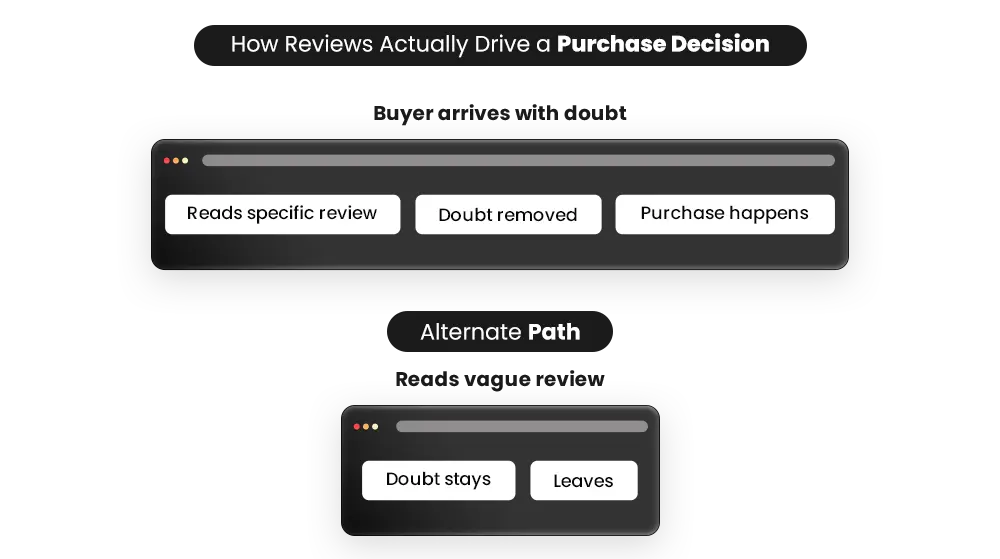
Yes. Customer reviews on Shopify directly impact whether someone buys or leaves.
But not by creating interest. That part is already done. By the time someone reads a review, they’ve already considered the product. The only question left is whether to go ahead. That’s where reviews matter. Reviews don’t create desire — they reduce the risk that stops someone from acting on it. And this is where most Shopify customer reviews fall short. They don’t answer practical questions like sizing, durability, or whether the product actually delivers what it promises.
They talk about the product. But they don’t resolve the decision. And when that final hesitation isn’t cleared, the buyer leaves. The numbers back this up. According to the 2017 Spiegel Research Center, displaying five reviews can lift conversion rates by up to 270%. That effect is often more pronounced for higher-priced products, where buyers typically spend more time evaluating the purchase. That’s the opportunity. But it only works when reviews are set up correctly.
Where Reviews Actually Change a Buying Decision
No one decides to buy in one instant. The decision builds across a few small steps — and reviews play a different role in each one.
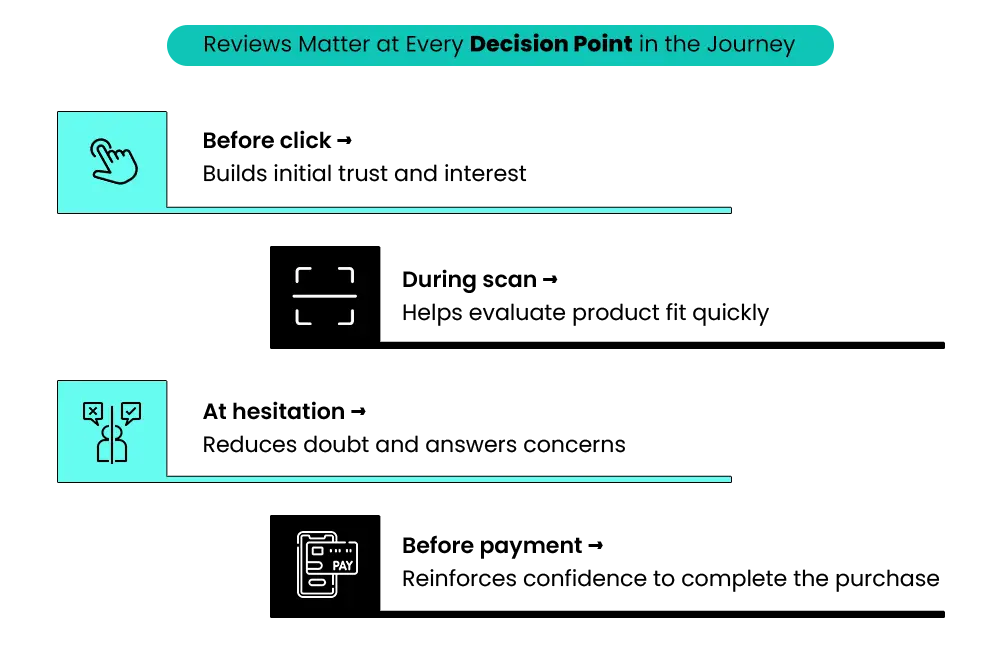
- At the discovery stage, reviews help your product get shortlisted. A visible star rating in search results or collection pages makes a buyer more likely to click before they’ve even read anything.
- At the evaluation stage, the buyer is actively asking: “Will this work for me?” Detailed reviews carry the most weight at this stage. A review that speaks directly to the buyer’s concern does more than reassure — it moves them forward.
- At the final decision stage — near the add-to-cart or checkout — doubt comes back. This is where a short, relevant review next to the buying action can make the difference between hesitation and purchase.
When a review matches the buyer’s exact situation, the decision becomes easier to make.
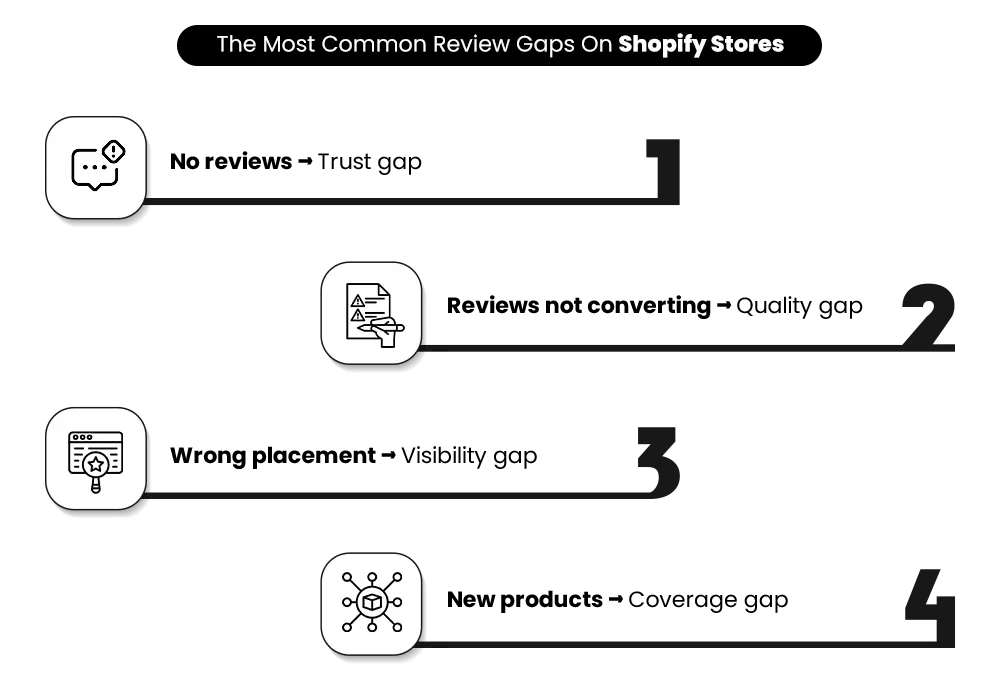
Four Reasons Your Shopify Customer Reviews Aren’t Closing Sales
This is where most review blogs stop short. They tell you customer reviews impact sales, but not why yours might not be working even though they’re there.
1. The Quality Problem — Your Product Reviews Don’t Answer What Buyers Care About
Open your product page. Read the first 5 visible reviews — the ones a buyer sees without scrolling deep. If they mostly say:
- “Good product”
- “Nice quality”
- “Fast delivery”
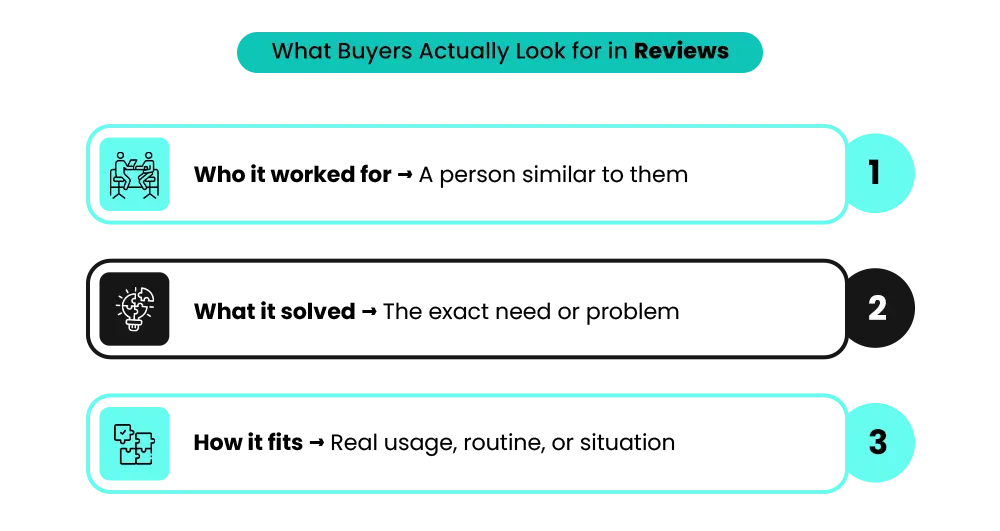
They don’t give a buyer much to work with. Because the buying decision isn’t made on positivity, it’s based on clarity. What tends to make a difference is when a product review mentions something specific:
- A size choice review – “I’m usually M, went with L, fits better.”
- What happened after using it, kind of review – “Used it daily for a week, still holds shape.”
- A comparison or expectation – “Better than the cheaper option I tried earlier.”
What a weak vs strong review looks like:
- Weak review: “Great product, loved it.”
- Strong review: “I was worried this wouldn’t fit well on a small wrist, but the adjustable strap fixed that. Been wearing it daily for two weeks now.”
If none of this shows up in the first few reviews, a buyer gets no clarity. And that’s where your Shopify conversion rate starts to stall.
If you’re not getting enough useful reviews to begin with, the issue usually starts with how you’re asking for them — not your customers. Use this guide to learn the right way to collect customer reviews for your Shopify store.
2. The Placement Problem — The Useful Product Reviews on Shopify Are Too Far Down
Scrolling through your own product page usually makes this clear. The natural pause points are almost always:
- Near the price
- During variant selection
- At the add-to-cart button
That’s where hesitation shows up. If nothing from your Shopify customer reviews is visible at that moment, they’re not influencing the decision. Most stores place all reviews at the bottom. So even if you have strong customer reviews on Shopify, they only show up after the buyer has already decided. Fix this specifically:
- Show star rating + review count directly under product title.
- Pull one review line that answers a concern (size, usage, result) and place it above or next to the add-to-cart button.
If you’re not using reviews in your marketing yet, here’s how to turn real customer language into high-performing ad copy.
3. The Coverage Problem — Traffic Is Reaching Pages Without Enough Ecommerce Social Proof
The pages getting the most traffic aren’t always the ones with strong reviews. In most stores, attention shifts to:
- New launches
- Or products pushed through ads
Buyers are drawn to what’s new. And the newly launched products generally have fewer reviews. At the same time, ads drive visibility before enough feedback builds up. Hence, a buyer lands with interest, but finds no ecommerce social proof to reduce risk. The cost per click stays the same. But fewer visitors feel ready to buy, which pulls down your Shopify conversion rate.
What actually changes this is not waiting for reviews to come in. It’s giving buyers something to rely on early:
- A real use-case explanation (who it’s for, how it’s used)
- A clear comparison (why this over alternatives)
Until Shopify customer reviews build up, this is what carries the decision.
4. The Authenticity Problem — The Page Feels Controlled
A page full of five-star product reviews on Shopify looks strong. But when every review sounds similar — short, positive, no downside — it starts to feel managed.
That’s when buyers question if the reviews are real. They expect some variation — a small issue, a different experience. This is what that usually looks like in real reviews:
- “Color is slightly darker than expected, but the quality is solid.”
- “Delivery took a bit longer, but the fit is exactly right.”
Alongside that, even a simple brand reply like “Thanks for pointing this out, we’ve updated the sizing guide to make it clearer” makes the feedback feel more complete. This is exactly how you respond to customer reviews on Shopify in a way that builds trust
That mix makes Shopify customer reviews feel genuine — and supports your Shopify conversion rate at the decision point.
Note: If your review app is holding negative reviews in a moderation queue, unpublished, this is called selective display — and it creates the exact same problem described above.
Your Product Page Isn’t the Only Place Shopify Customer Reviews Influence the Sale
Most merchants set up a review section on the product page and consider the job done. But a buyer makes several small decisions before they reach that page — and nearly talks themselves out of buying again right before they pay. Shopify customer reviews have a role in every one of those moments.
Google Search — You’re Being Judged Before the Click
When you search for a product on Google, the top results often look like:
- ⭐ 4.5 (238) — Brand A
- ⭐ 4.3 (91) — Brand B
- Brand C — no rating
The eye goes to the ones with ratings first. They feel tested. The others feel unknown. Even if a product is cheaper, it often doesn’t get the first click. A 2026 BrightLocal Consumer Review Survey found that 97% of consumers read online reviews before making a purchase. And star ratings in search results directly influence whether they click through at all.
So a page can rank but still lose traffic before it even loads — affecting Shopify conversion rate early. This is where online review management plays a direct role in your visibility. It usually comes down to whether your setup supports it:
- Shopify customer reviews are collected through an app that can send rating data to Google
- That app places review data (rating + count) in a format Google can read
- And Google has picked up that data from your product page
When this is in place, listings start showing ratings — and enter the click decision instead of being skipped. If your reviews aren’t showing as star ratings in search, the setup is usually the issue — not the lack of reviews.
Collection Pages — Some Products Get Opened, Others Don’t
On a collection page, a few products keep getting clicked. Others don’t. You’ll notice:
- One shows 4.6 (120 reviews)
- The one next to it shows nothing.
The one with Shopify customer reviews feels safer, so it gets opened more. Over time, the same products keep getting clicks. Others never get a chance to convert, which affects your Shopify conversion rate. Showing rating and review count under each product brings more items into the click decision instead of being ignored.
Checkout — Doubt Returns Right Before Payment
You’ll often see a buyer reach checkout, fill in details, then drop off before paying. The product hasn’t changed. The moment has. At checkout, the decision becomes financial. Buyers start rethinking:
- Is this worth it?
- What if it doesn’t meet expectations?
Most Shopify checkouts remove everything that helped them decide — including Shopify customer reviews. So the decision relies on memory, which weakens here. A short, specific customer review line near the order summary — something about fit, quality, or results — brings that context back into the decision.
Ads & Emails — Trust Starts Before They Land
Most ad creatives rely on product visuals and price offers. That creates interest. But interest and trust are different things — and only one of them closes a sale. Consider what a buyer sees before they click:
- Without a review line: “Premium leather wallet — shop now.”
- With a review line: “Finally a wallet that doesn’t stretch in three months” — [Your Brand]
Same product. Same price. The second one arrives with a real person’s word behind it. The buyer clicks with context already formed — not curiosity alone. Take one specific line from a real customer review — about fit, usage, or a result they noticed — and place it in your headline, caption, or just above the CTA. Use their exact words, not a polished version. The rougher phrasing is what makes it feel real.
Your Shopify conversion rate shouldn’t depend entirely on what happens after the click. This way the visit starts with context, not guesswork. This is a simple but effective online reputation management technique that most Shopify stores overlook.
So reviews don’t just close sales. They also build the organic traffic that brings new buyers to your store in the first place.
📌Related Video
How Shopify Customer Reviews Build Organic Traffic Over Time
Reviews don’t just convert visitors — they also bring new ones in. Here’s how:
- Reviews add searchable content to your page. Customers naturally write in the same words other buyers search — “true to size for wide feet,” “good for daily office use.” Your product page starts matching these exact queries on Google without you doing anything extra.
- Your keyword reach grows over time. As more reviews build up, your page starts appearing for a wider range of specific searches. This is often why stores begin seeing traffic from keywords they never directly targeted.
- Unlike ads, this doesn’t reset. Every new review adds more searchable context. The traffic compounds quietly in the background and keeps supporting your Shopify conversion rate over time.
- Recency signals trust — to buyers and Google both. A product with 80 reviews and the last one from nine months ago quietly signals that something stopped. A product with 20 reviews and three from last week reads as more actively trusted. Consistent new reviews carry more weight than a large but stale pool.
Fixed your reviews. Conversions still low?
A Shopify performance audit finds exactly what else is costing you sales — beyond reviews.
A Quick Store Audit — Is Your Shopify Conversion Rate Being Hurt by Product Reviews?
| What to check | What does it mean if it’s missing | What to do |
| Star rating near product title | Buyers evaluate without a credibility anchor | Move the rating widget above the fold |
| Review snippet near add-to-cart | The decision moment has no proof next to it | Pull a specific customer review up near the buy button |
| The last 10 product reviewsmention specifics | Reviews exist, but aren’t answering real questions | Change the review request to ask something specific |
| The newest product has 5+ Shopify customer reviews | Highest-traffic pages have the least social proof | Prioritise the collection of new products first |
| Any review visible at checkout | Hesitation at payment has nothing to counter it | Add a Shopify customer review snippet near the payment section |
| Response to recent negative review | Silence reads as indifference to future buyers — and weakens your online reputation management | Reply to the most recent complaint today |
You’ve just read five reasons your reviews might not be working. Odds are, at least two apply to your store right now. Here’s how to fix the whole conversion picture with Mastroke and not just the reviews. Once you’ve done the audit, most stores fall clearly into one of four situations.
Which Situation Are You In?
After the check, most stores fall into one of these:
- Reviews are live, but buyers still aren’t convinced: The proof is there but it’s not doing the job. Either it’s too vague, too old, or sitting where no buyer is looking when they actually decide.
- Everything looks perfect on the page — and that’s the problem: All five stars, no complaints, no brand replies. It reads as managed, not genuine. Buyers sense it even if they can’t explain it.
- Your best products convert; everything else just sits there: The winning product has history and reviews behind it. The rest of the catalogue doesn’t — and those pages are bleeding conversions quietly every day.
- Traffic is coming in, but it’s landing on empty pages: New launches, ad-driven products, seasonal additions — all going live before a single review exists. Clicks are arriving before trust is built.
- Reviews are being collected, but staying on the product page: Checkout, collection pages, ads, emails — none of it has any review presence. The trust that exists on one page isn’t traveling anywhere else in the store.
- The review section hasn’t been touched in months: No new reviews, no replies, no updates. To a buyer reading the page today, it signals that something quietly stopped.
Identifying which situation applies is the first step. The next question most merchants ask is: How quickly will fixing this actually show results?
Can Reviews Increase Sales? Here’s How Long It Takes
Fixing Shopify customer reviews doesn’t show results at the same speed everywhere.
- Placement changes (fast — 3 to 7 days): Moving the star rating near the title or adding one review line near the buy button usually starts changing clicks and add-to-cart behavior within a week. This is often the first visible shift in your Shopify conversion rate — buyers now see proof exactly where they decide.
- Review quality (medium — 2 to 4 weeks): Changing how you collect product reviews on Shopify — asking about fit, usage, or results — takes 2–4 weeks to show impact. New reviews need to come in before they start helping buyers decide. Using the right app to automate follow-up requests at the right time can speed this up.
- Organic traffic (slow — 4 to 12+ weeks): As detailed Shopify customer reviews build up, your pages start appearing for more searches on Google. This usually grows over 4–12 weeks or more, depending on how consistently new reviews are added.
Customer Reviews Can Sell. But Only When They’re Set Up To.
Customer reviews impact your Shopify conversion rate in a direct way.
Reviews close the gap between interest and action — but only when they’re set up to. But most stores don’t lose sales because reviews are missing. They lose them because Shopify product reviews aren’t visible, specific, or placed where decisions happen.
That’s the gap between traffic and sales. And without an active online review management strategy, that gap rarely closes on its own. If you’re getting visitors but not conversions, review how your Shopify customer reviews are set up across your store. Fixing that is often the simplest way to improve your Shopify conversion rate.
Still Have Questions About Shopify Reviews?
From fake reviews to collection pages — the questions merchants ask most, answered without the fluff.
Q1. Do customer reviews actually increase sales on Shopify?
Yes, but only when they answer real buyer doubts. Reviews don’t create interest; they resolve hesitation. Generic praise like “great product” doesn’t close a sale. A specific review about fit, usage, or results does. Even five detailed reviews can meaningfully lift purchase likelihood on a product page.
Q2. Should I show bad reviews on my Shopify store?
Yes. A page with only five-star reviews feels managed, and buyers notice. A genuine complaint with a thoughtful brand response builds more trust than a perfect score with no brand voice. A 4.6 with honest feedback converts better than a suspicious 5.0 without any.
Q3. Do fake reviews hurt my Shopify store?
Yes — buyers are more perceptive than most merchants expect. When every review sounds identical with no variation, it reads as manufactured. Beyond buyer trust, platforms like Google increasingly flag unnatural review patterns. Real, imperfect reviews from actual customers will always outperform a polished but hollow review section.
Q4. How do I show reviews on my Shopify collection page?
Most review apps support this — it usually needs switching on in settings or a minor theme edit. It matters because buyers on collection pages compare products side by side. A product showing 4.7 (94 reviews) next to one showing nothing gets clicked first, every time.
Q5. Can customer reviews on Shopify help with Google rankings and SEO?
Yes, in two ways. Review text naturally contains the exact phrases buyers search — which helps your pages rank for long-tail queries you never targeted. And with structured data configured correctly, Google displays your star rating directly in search results, improving click-through before a buyer even visits your page.
Q6. Why are customers landing on my product page but not buying, even though I have reviews?
Because present doesn’t mean placed correctly. Check: Are reviews visible above the fold? Do they mention specifics like sizing or results, or just “great product”? Is there any review near the buy button? Vague reviews placed too low don’t influence the actual decision moment.
Q7. Should I add customer reviews to ads and emails too — or just the product page?
Both. On the product page, reviews remove hesitation at the decision point. In ads and emails, they set expectations before the click. A buyer arriving after seeing a real customer quote in an ad already has context, making the product page visit far more likely to convert.
What to Do Next
If your customer reviews on Shopify are there but your Shopify conversion rate isn’t moving, the issue is usually how everything works together — not just the product reviews. Pages can look fine but still lose decisions in small ways that aren’t obvious.
That’s what Mastroke’s Shopify Performance Audit helps uncover — where your store slows buyers down and what needs to change to improve conversions.
Happy customers. Not enough reviews. Let's fix that.
We help Shopify stores set up review systems that collect feedback consistently — without manual follow-ups.