📌 Key Takeaways
This section highlights the most important insights:
- Scaling from $1M to $50M is not about ads—it’s about systems.
High-growth brands invest early in conversion optimization, retention, and infrastructure instead of relying only on paid acquisition. - Most brands hit a growth plateau because their backend isn’t built for scale.
Rising CAC, weak retention, and technical debt slow down growth even when traffic increases. - Brands that hire a Shopify growth agency early scale faster and more efficiently.
They build structured systems (CRO, lifecycle marketing, analytics) that compound revenue over time. - Real growth comes from improving conversion, retention, and profitability—not just traffic.
Even small improvements in conversion rates can unlock massive revenue gains at scale.
Shopify growth agency partnerships often appear early in brands scaling from $1M to $50M, because growth requires systems, not just ads, discounts, or product launches.
According to Shopify and industry benchmarks, thousands of stores launch yearly, yet only a small share grow past $10M, revealing hidden scaling challenges merchants encounter.
At the same time, Shopify’s ecosystem continues to expand rapidly. A recent example is Black Friday 2024, where Shopify merchants generated $11.5 billion in global sales, a 24% increase from the previous year, highlighting both the scale of opportunity and the intensity of competition brands face today.
Many founders assume increasing ad budgets or adding new products will drive revenue, but growth usually slows when conversion systems, retention strategies, and infrastructure remain underdeveloped.
Research from Shopify Plus case studies shows that brands prioritizing lifecycle marketing, CRO testing, and technical performance improvements consistently outperform competitors relying only on acquisition marketing.
This guide examines real growth patterns among brands scaling from $1M to $50M and explains why hiring a Shopify growth agency early often accelerates sustainable ecommerce expansion.
The $1M–$50M Growth Gap in Ecommerce
Many Shopify founders hit a frustrating plateau once their store crosses $1M revenue, realizing growth suddenly slows despite increasing ad budgets and steady traffic.
The gap between $1M and $50M often exposes deeper ecommerce growth challenges that simple marketing tactics cannot solve without a structured ecommerce scaling strategy.
Common roadblocks begin appearing quickly, especially when brands rely heavily on paid acquisition without strengthening the underlying systems needed to support long-term ecommerce expansion. Typical challenges many scaling merchants face include:
- Plateau between $1M–$5M revenue despite rising traffic
- Customer acquisition costs are steadily increasing across ad platforms
Additional issues frequently appear as brands grow:
- Paid ads are becoming less profitable each quarter
- Conversion rates are stagnating even when site traffic improves significantly
At the same time, operational complexity increases as product catalogs expand, marketing channels multiply, and customer expectations grow across fulfillment, support, and shopping experiences.
Without clear systems guiding decisions, founders often rely on guesswork, which makes it difficult to diagnose growth bottlenecks or identify opportunities that could unlock the next stage.
This is where Shopify growth experts and a specialized Shopify growth agency often step in, helping brands build the infrastructure required for consistent scaling.
Brands like Gymshark didn’t scale by simply increasing ad spend. Their growth accelerated when they invested in community-building, performance marketing systems, and a strong ecommerce infrastructure early on. This highlights how moving beyond basic tactics is essential to break through the $1M–$10M plateau.
Instead of simply increasing ad spend, they focus on conversion optimization, retention systems, data-driven marketing, and technical store improvements that support sustainable ecommerce growth.
– Also Read: 7 Shopify Plus Limitations That Premium Brands Must Be Aware Of
What Is a Shopify Growth Agency?
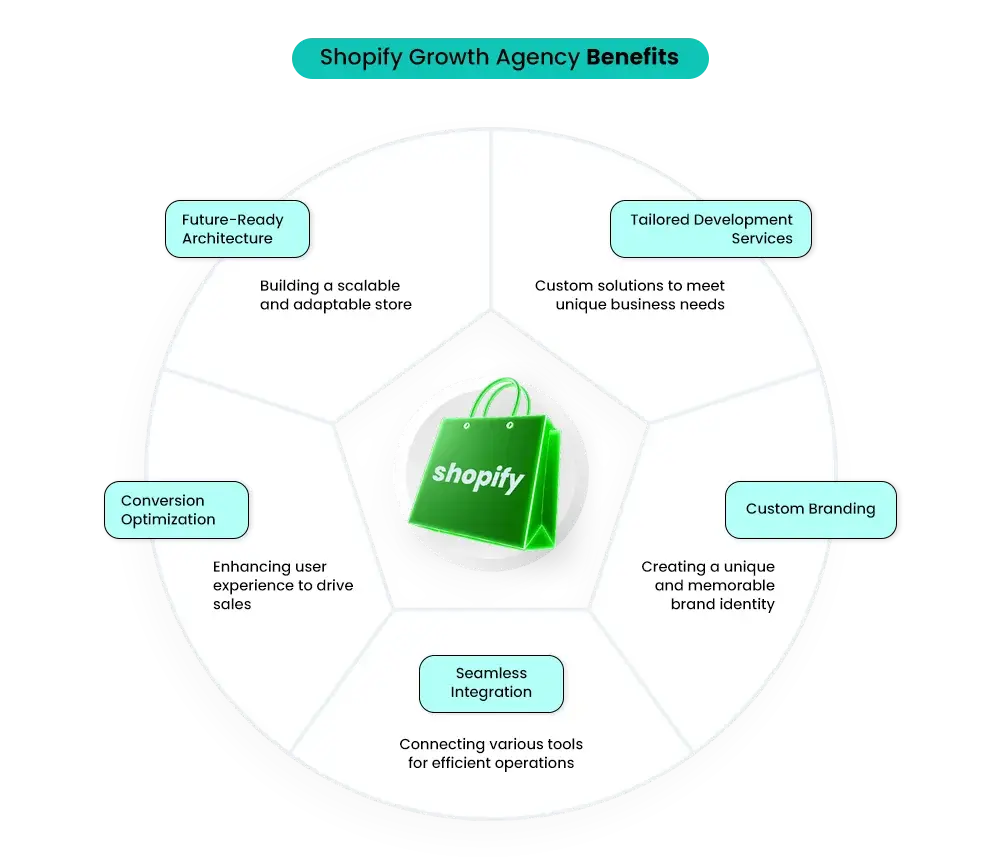
A Shopify growth agency focuses on long-term scaling rather than just ticking off isolated marketing tasks. Unlike a standard Shopify marketing agency, these partners build full revenue systems to move brands from $1M to $50M.
To understand how a Shopify growth agency actually supports scaling brands, watch this quick breakdown explaining the role of growth partners in building full-funnel ecommerce systems.
Core Capabilities of Growth Experts:
- Ecommerce Growth Strategy: Building a roadmap for sustainable, long-term expansion.
- Conversion Rate Optimization (CRO): Turning more visitors into buyers through data-driven design.
- Performance Marketing: Managing ads across search and social to drive profitable sales.
- Retention Marketing: Keeping your existing customers coming back through email and SMS.
- Technical Optimization: Ensuring your store is fast, scalable, and built on clean code.
- Data Insights: Using deep analytics to guide every business decision you make.
Agency Type Comparison
| Agency Type | Primary Focus |
| Development Agency | Store design and technical builds. |
| Marketing Agency | Advertising and creative campaigns. |
| Shopify Growth Agency | Full-funnel revenue growth systems. |
Scaling brands prefer an ecommerce growth partner because they solve the “plateau” problem. Shopify growth experts align your tech, ads, and retention into one high-performing engine. This holistic approach is why many founders seek out the best Shopify growth agency early in their journey.
The Plateau Warning Signs at $1M–$3M
Many Shopify brands start experiencing scaling friction once revenue reaches the $1M–$3M range, where early growth momentum slows, and operational pressure begins increasing rapidly.
At this stage, merchants often notice that growth feels harder each quarter, even though traffic rises and marketing spend continues increasing across advertising channels.
Warning Sign 1: Rising Customer Acquisition Cost
One of the earliest warning signs involves rising customer acquisition costs across advertising platforms as competition increases and ad auctions become more expensive.
Without a clear Shopify scaling strategy or diversified marketing channels, brands rely heavily on paid ads, which quickly increases CAC and reduces overall profitability.
- Advertising competition increases across Meta, Google, and TikTok
- Paid traffic becomes less efficient without strong retention strategies
Brands like MVMT initially scaled through paid acquisition, but long-term growth required optimizing conversion and brand positioning to maintain profitability as ad costs increased.
Warning Sign 2: Technical Debt
As stores grow quickly, many founders stack multiple apps and quick fixes instead of building a clean technical foundation for long-term performance. Common technical issues include:
- Excessive Shopify apps are slowing storefront speed
- Slow or outdated Shopify themes are affecting the mobile experience
Additional problems frequently appear as well:
- Messy Liquid code from repeated customizations
- Poor store performance is affecting conversion rates and search visibility
Warning Sign 3: Founder Bottleneck
During early growth stages, founders often manage too many responsibilities across marketing, product development, and strategic decisions simultaneously.
This creates a major scaling constraint where growth depends heavily on the founder instead of systems, data insights, and specialized expertise guiding decisions.
At this point, many brands begin exploring Shopify growth experts or partnering with a top Shopify growth agency to build scalable systems.
A strong Shopify growth agency helps implement structured growth frameworks, improve marketing performance, optimize store technology, and support founders with a sustainable Shopify scaling strategy.
It isn’t just smaller retailers competing in this ecosystem. Leading global brands such as JB Hi-Fi, Meta, Estée Lauder, Gymshark, SKIMS, and Supreme are all leveraging Shopify, which reflects how mature and competitive the platform has become.
This rapid growth is driven by Shopify’s stable and scalable infrastructure, but it also raises the bar for smaller brands trying to move from early traction to sustained growth.
Data Patterns of Brands That Scale From $1M to $50M
Brands that successfully scale from $1M to $50M rarely grow randomly; they follow consistent operational patterns shaped by disciplined decisions, strong systems, and guidance from Shopify growth experts.
Merchants often believe scaling depends only on advertising budgets, yet real growth usually happens when brands improve infrastructure, analytics, and customer lifecycle strategies together.
Careful analysis of high-growth stores shows clear behaviors that repeat across industries, especially among brands working with a top Shopify growth agency early.
This short video highlights one of the most common patterns we see among Shopify brands that successfully scale beyond the early revenue stages.
📌 Key Video
>
>
These patterns reveal how merchants move from early traction toward scalable operations that support consistent revenue expansion and stronger competitive positioning in crowded ecommerce markets.
Pattern #1: They Hire a Shopify Growth Agency Early
Fast-growing brands rarely wait until growth slows before seeking expert help; instead, they partner with a Shopify growth agency while momentum is still accelerating.
Early partnerships provide structured guidance that helps founders avoid common scaling mistakes and develop clear strategies for sustainable growth across marketing, operations, and technology. Benefits of early collaboration often include:
- Clear strategic roadmap guiding expansion priorities
- Faster experimentation across acquisition and retention channels
Additional advantages often appear as well:
- Scalable Shopify store infrastructure supporting future growth
- Faster decision-making supported by Shopify growth experts
Brands that postpone external expertise frequently spend months correcting technical problems, inefficient marketing structures, and fragmented workflows that slow down scaling opportunities.
Pattern #2: They Focus on POAS Instead of ROAS
Many merchants initially rely on ROAS, yet advanced brands eventually realize that revenue alone cannot measure true business performance.
ROAS (Return on Ad Spend) measures how much revenue you generate for every rupee spent on ads, while POAS (Profit on Ad Spend) goes deeper—it measures how much actual profit remains after accounting for all costs.
In simple terms:
- ROAS tells you how much you earned
- POAS tells you how much you actually kept
Instead, experienced operators shift toward POAS, which evaluates marketing results based on real profitability rather than surface-level advertising returns. Profit-focused measurement accounts for several factors, including:
- Product margin and cost of goods sold
- Shipping costs and operational expenses
Other essential variables include:
- Customer acquisition cost across channels
- Retention impact and repeat purchase behavior
This section highlights a key shift: Scaling brands stop optimizing for revenue (ROAS) and start optimizing for profit (POAS).
A top Shopify growth agency often guides brands through this transition, helping teams align advertising strategies with profitability rather than vanity performance metrics.
Pattern #3: They Prioritize Conversion Rate Optimization
Conversion optimization often generates the fastest revenue growth because it improves the value of existing traffic rather than requiring larger advertising budgets.
Scaling brands track several performance indicators closely, including:
- Overall conversion rate across storefront traffic
- Cart abandonment rate during the shopping process
Additional signals also matter greatly:
- Check out the completion rate across devices
- Product page engagement and interaction metrics
Even a one percent improvement in conversion rate can create millions in additional revenue when traffic volumes grow, especially for stores scaling toward eight figures.
Shopify growth experts frequently conduct CRO experiments that refine product pages, simplify checkout experiences, and strengthen trust signals that help visitors become paying customers faster.
High-growth brands like Fitbit focus heavily on conversion optimization—from product presentation to checkout experience—a Shopify-powered DTC channel for smart devices.
Pattern #4: They Build Data-Driven Marketing Systems
High-growth brands rely heavily on structured analytics rather than instinct when making decisions about marketing channels, customer targeting, and promotional investments.
Data systems typically include:
- Shopify analytics dashboards track store performance
- Google Analytics measures acquisition and behavior insights
More advanced stacks often incorporate:
- Attribution platforms mapping marketing influence
- Customer lifetime value analysis guiding retention decisions
These insights allow brands to identify profitable channels, eliminate ineffective campaigns, and continuously improve customer acquisition strategies without relying on guesswork or intuition.
Pattern #5: They Invest in Retention Early
Retention strategies often determine long-term profitability because returning customers require lower acquisition costs and generate higher lifetime value over time.
Effective retention systems typically include:
- Email marketing automation supporting lifecycle communication
- SMS campaigns promoting personalized engagement
A strong real-world example is Shopify merchant Dukier, which grew its revenue by 525% in just three years, reaching €518,860 by 2025, largely driven by localized email automations across five languages. Notably, 55% of its total revenue came from these retention-driven channels, showing how powerful lifecycle marketing can be when implemented correctly.
Additional retention tools often include:
- Loyalty programs reward repeat purchases
- Post-purchase upsells increase order value
Research consistently shows that returning customers are three to five times more likely to purchase again, making retention one of the strongest growth levers available.
Pattern #6: They Build Scalable Shopify Infrastructure
Technical performance also plays a crucial role in scaling ecommerce operations, especially as traffic volume, product catalogs, and integrations increase significantly.
Brands focused on Shopify performance optimization improve several technical components, including:
- Faster Shopify theme performance across mobile devices
- Optimized checkout speed, reducing friction during purchases
Additional improvements frequently include:
- Streamlined app stack management, reducing conflicts
- Automation workflows are improving operational efficiency
Many scaling brands eventually collaborate with a Shopify Plus agency to strengthen backend systems, enhance checkout flexibility, and build infrastructure capable of supporting global growth.
– Also Read: 7 Common Shopify Store Setup Mistakes First-time Owners Make (And How to Avoid Them)
The Typical Timeline When Brands Hire a Shopify Growth Agency
Most Shopify stores follow a similar growth timeline, where early revenue stages rely heavily on founder-driven decisions before structured systems and external expertise become necessary.
During the first stage, when revenue ranges between $0 and $500K, founders usually manage marketing themselves while learning how advertising, customer acquisition, and product positioning work.
As revenue approaches the $500K to $1M stage, brands begin experimenting with multiple growth tactics, testing new marketing channels, and refining their messaging.
At this point, Shopify stores often run paid ads, influencer campaigns, and email marketing experiments, but processes still remain informal and heavily dependent on founders.
The real tipping point usually appears once brands cross the $1M revenue mark and growth begins, introducing new operational and technical complexity.
Common challenges start appearing quickly, including:
- Operational complexity across inventory, fulfillment, and marketing coordination
- Fragmented marketing strategies across advertising channels
Additional issues often surface as well:
- Technical scaling limitations affecting site performance
- Unclear data insights are slowing strategic decisions
This is the stage when many founders begin seeking guidance from Shopify growth experts who can build structured systems supporting sustainable ecommerce expansion.
Partnering with a Shopify growth agency helps merchants move beyond reactive decision-making and establish scalable growth frameworks.
A top Shopify growth agency brings technical expertise, marketing alignment, and strategic planning that allows brands to scale from early traction toward long-term revenue expansion.
Build Your Shopify Store From Scratch With Mastroke
Launch faster with Mastroke, an official Shopify Partner. We build structured stores with conversion-first design, clean setup, and features built to scale!!
The Cost of Waiting vs The ROI of Early Partnership
Many Shopify founders delay hiring a Shopify growth agency because early traction creates confidence, yet waiting often allows small inefficiencies to quietly compound across marketing, infrastructure, and operations.
As brands grow, those hidden inefficiencies begin affecting profitability, marketing efficiency, and customer experience, which is why Shopify growth experts encourage building scalable systems earlier.
Common consequences of delaying a partnership with a top Shopify growth agency often include:
- Inefficient ad spend across multiple acquisition channels
- Weak retention strategy that limits customer lifetime value growth
Other operational problems usually emerge as scaling continues:
- Technical debt created by quick fixes and scattered apps
- Low conversion rates despite strong traffic volumes
Fragmented marketing channels frequently worsen these problems because teams run disconnected campaigns without unified data, making it harder to understand which efforts actually drive revenue growth.
The financial impact becomes clear when examining simple conversion improvements at different revenue stages for growing ecommerce brands. For example, a 10% conversion lift at one million dollars in revenue can generate more than one hundred thousand dollars in additional annual sales.
At 10 million dollars in revenue, that same conversion improvement can unlock more than one million dollars in additional growth without increasing marketing budgets.
Working early with Shopify growth experts allows brands to build scalable systems sooner, turning incremental improvements into compounding revenue gains as the business grows.
Key Growth Systems Every $10M+ Shopify Brand Builds
As Shopify brands approach eight-figure revenue, growth becomes less about isolated campaigns and more about building structured systems that consistently drive predictable, scalable ecommerce performance.
High-growth brands typically build several operational systems that work together, helping marketing, product experience, and analytics support long-term expansion rather than short-term revenue spikes.
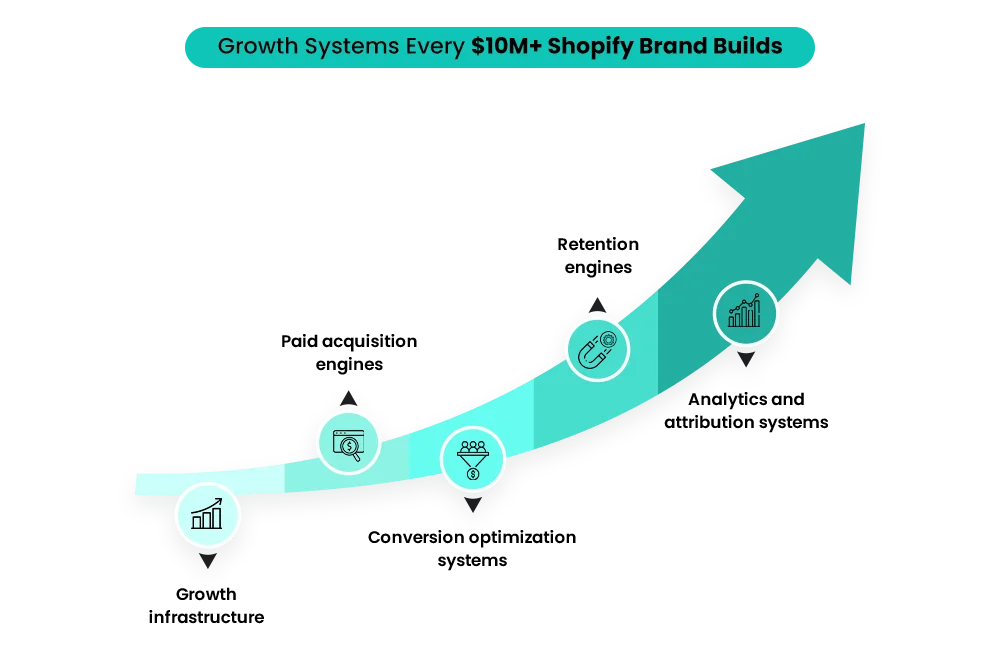
Key systems commonly built by scaling Shopify brands include:
• Growth infrastructure- focused on fast storefront performance, optimized user experience, and reliable Shopify architecture that supports heavy traffic without slowing down product discovery or checkout journeys.
• Paid acquisition engines- combining Google Ads, Meta Ads, and TikTok campaigns designed to attract high-intent customers while maintaining efficient customer acquisition costs across multiple channels.
• Conversion optimization systems– where teams continuously test product pages, pricing presentation, and checkout flows to reduce hesitation and steadily increase purchase completion rates.
• Retention engines– using email automation, SMS campaigns, loyalty programs, and subscription offers that turn first-time buyers into repeat customers and strengthen long-term customer relationships.
• Analytics and attribution systems– that track customer lifetime value, campaign performance, and behavioral insights, helping teams make smarter decisions based on data instead of assumptions.
A top Shopify growth agency often helps design and maintain these systems, while Shopify growth experts ensure each system works together to support consistent revenue growth.
Key Questions Before Hiring a Shopify Growth Agency
Choosing a Shopify growth agency can shape how quickly Shopify stores scale beyond early revenue stages, so founders should evaluate potential partners carefully before committing.
Not every agency understands the operational and marketing complexity involved in scaling Shopify stores from one million to tens of millions in annual revenue.
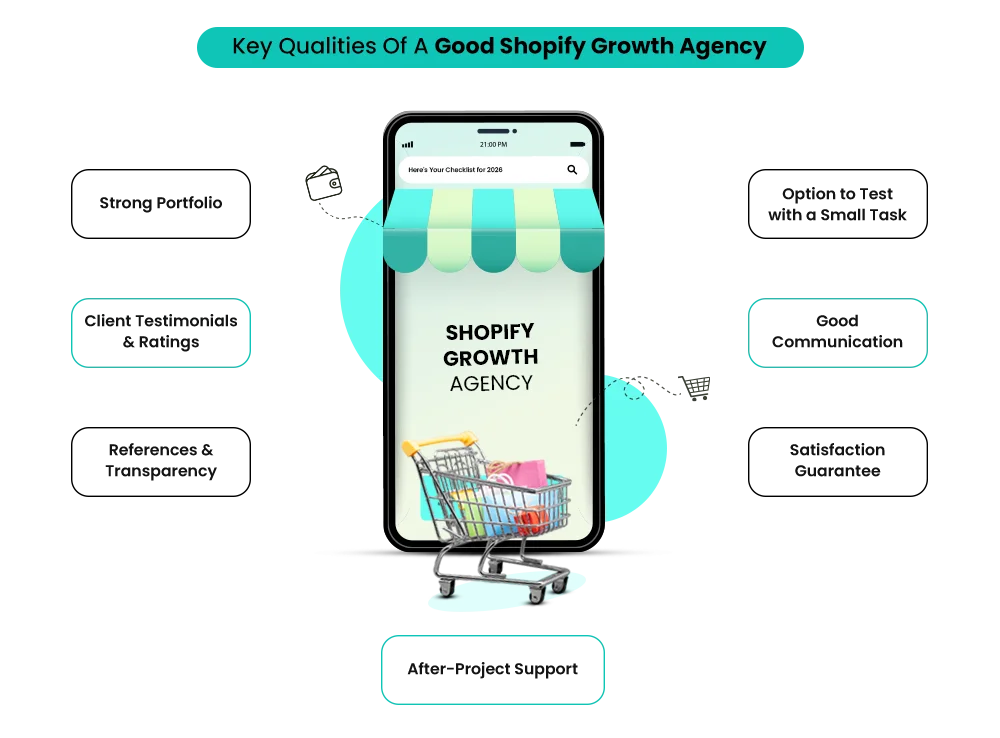
Before selecting a partner, brands should ask several practical questions:
• Do they specialize in ecommerce scaling?
A top Shopify growth agency should understand how growing Shopify stores evolve beyond early traction and require structured systems for sustainable expansion.
• Do they understand Shopify infrastructure?
Shopify growth experts should know how storefront performance, integrations, and app architecture influence conversion rates and overall store stability.
• Can they provide transparent reporting?
Clear reporting helps brands understand which campaigns, experiments, and improvements are actually contributing to revenue growth.
• Do they track profit-focused metrics?
A strong Shopify growth agency focuses on metrics like profit, customer lifetime value, and acquisition efficiency rather than vanity metrics such as traffic or impressions.
Signs Your Shopify Brand Is Ready for a Growth Agency
Many Shopify stores reach a stage where early traction slows, signaling it may be time to work with a Shopify growth agency for structured scaling.
Growth challenges often appear once revenue passes the early startup phase and operational complexity begins increasing across marketing channels, customer retention efforts, and store infrastructure.
Common signals that Shopify stores may benefit from Shopify growth experts include:
• Annual revenue exceeds one million dollars, yet growth begins slowing because existing marketing strategies and operational processes cannot support the next scaling stage.
• Ad spend increases without proportional revenue growth, indicating acquisition channels may be inefficient or poorly optimized across campaigns and audiences.
• Conversion rates remain below two to three percent, suggesting product pages, checkout experience, or user journeys require deeper optimization and experimentation.
• Customer retention remains weak, causing stores to rely heavily on new customer acquisition instead of maximizing repeat purchases and lifetime value.
• Revenue growth has plateaued, even though traffic and product demand appear stable.
At this stage, partnering with a top Shopify growth agency helps build structured systems supporting long-term ecommerce expansion.
– Also Read: DIY vs Shopify Development Agency: How Your Setup Choice Affects Store Performance
Why High-Growth Shopify Brands Work With Mastroke
Many scaling Shopify stores look for a partner that understands both marketing performance and technical store optimization, which is why brands often work with Mastroke.
As a Shopify growth agency, Mastroke focuses on helping ecommerce brands move beyond short-term campaigns and build structured systems that support long-term revenue expansion.
Shopify growth experts at Mastroke support scaling brands through several core areas:
• Shopify store optimization, improving navigation, page structure, and storefront performance so visitors experience a smoother buying journey across growing Shopify stores.
• Conversion rate optimization, where teams analyze product pages, checkout behavior, and customer journeys to reduce friction and increase completed purchases.
• Paid advertising strategies, helping brands manage acquisition across Google, Meta, and other channels while improving efficiency through performance-focused campaign structure.
• Retention marketing systems, including email automation, customer re-engagement strategies, and lifecycle campaigns that increase repeat purchases and long-term customer value.
• Performance analytics, using data insights to guide strategic decisions and measure real growth impact.
Through these systems, Mastroke acts as a long-term partner for brands aiming to scale confidently.
Conclusion
Scaling Shopify stores from one million to fifty million rarely happens accidentally; the fastest brands usually invest in strategy, infrastructure, and expert guidance much earlier.
High-growth Shopify stores typically share common patterns: partnering with a Shopify growth agency early, prioritizing data-driven decisions, and building structured systems supporting sustainable ecommerce expansion.
Working with Shopify growth experts helps brands improve acquisition efficiency, conversion rates, retention performance, and technical store infrastructure, creating a stronger foundation for consistent revenue growth.
Growth is rarely about driving more traffic alone; it’s about turning existing traffic into profitable customers through better systems, smarter strategy, and optimized customer experiences.
If your brand is preparing for its next scaling stage, partnering with a top Shopify growth agency like Mastroke can help transform growing Shopify stores into sustainable revenue engines.
Build your dream Shopify store today
Bring your vision to life with Mastroke, an official Shopify Partner. We design and develop high-converting, scalable Shopify stores with clean structure and future-ready features—built to grow with your business.
Frequently Asked Questions About Shopify Growth Agency-
Here are some important questions that you must learn about a Shopify growth agency:
What does a Shopify growth agency do?
A Shopify growth agency helps ecommerce brands scale revenue through strategy, conversion optimization, performance marketing, retention systems, and technical store optimization.
When should a Shopify brand hire a growth agency?
Most brands benefit from hiring a Shopify growth agency once annual revenue approaches $1M or when growth begins to plateau.
How does a Shopify growth agency increase revenue?
Growth agencies improve revenue by optimizing conversion rates, marketing channels, retention strategies, and technical Shopify performance.
What is the difference between a Shopify marketing agency and a Shopify growth agency?
A marketing agency focuses mainly on campaigns, while a Shopify growth agency builds full revenue growth systems, including CRO, retention, analytics, and infrastructure.