
The rules of ecommerce have quietly changed—and the Shopify Plus trend is proof. What worked for online stores five years ago simply doesn’t work for brands trying to scale globally today.
Modern merchants are no longer just launching online stores — they are building powerful digital commerce ecosystems designed to handle international customers, massive traffic spikes, and highly personalized shopping experiences. As ecommerce competition becomes more intense, businesses need platforms that can support growth without increasing operational complexity.
This is where Shopify Plus has emerged as a leading enterprise solution. Designed for high-growth businesses, it offers the infrastructure, automation, and flexibility required to operate at scale.
The latest Shopify Plus Trends reveal how enterprise merchants are transforming their ecommerce strategies through advanced automation, global storefront capabilities, and deeper system integrations.
For ambitious brands looking to expand internationally, streamline operations, and deliver exceptional customer experiences, understanding these trends is becoming a critical step toward sustainable ecommerce growth.
What Is Shopify Plus? Understanding the Enterprise Ecommerce Platform
Before exploring the latest Shopify Plus Trends, it’s important to understand what Shopify Plus actually is and why it has become one of the most popular platforms for scaling ecommerce businesses.
Shopify Plus is Shopify’s enterprise-level ecommerce platform designed for high-growth brands, global retailers, and businesses that handle large transaction volumes. While the standard Shopify plans work well for small and medium businesses, Shopify Plus is built specifically for companies that require stronger infrastructure, advanced automation, and deeper customization capabilities.
In simple terms, Shopify Plus allows merchants to scale their online stores without worrying about technical limitations. The platform provides a powerful ecommerce foundation that supports global operations, high traffic spikes, and complex business workflows.
You can also read our detailed guide on “Shopify Plus for Enterprise Growth: Features & Benefits” to explore how it helps brands scale efficiently.
Who Shopify Plus Is Designed For?
Shopify Plus is typically used by businesses that have already achieved strong growth and are preparing to scale further. Most merchants upgrade when their annual revenue reaches around $2 million or more, although rapidly growing startups may adopt it earlier. A current Shopify Plus trend shows more mid-market and fast-scaling DTC brands moving to the platform earlier to leverage advanced automation, AI-powered tools, and multi-channel selling capabilities.
The platform is particularly suitable for:
- High-volume ecommerce businesses handling thousands of orders per day
- Global brands selling across multiple countries and currencies
- Direct-to-consumer (DTC) companies experiencing rapid growth
- Businesses running both B2B and B2C ecommerce models
- Brands that require advanced automation and system integrations
These businesses often need more flexibility than traditional ecommerce platforms can provide.
Why Many Enterprise Brands Choose Shopify Plus?
Large ecommerce companies choose Shopify Plus because it combines enterprise-level technology with operational simplicity. Unlike many legacy ecommerce platforms that require heavy development and maintenance, Shopify Plus allows merchants to scale quickly while keeping operations manageable.
A notable Shopify Plus trend is that more fast-growing mid-market brands are adopting the platform earlier, leveraging its automation, AI-powered tools, and multi-channel capabilities to accelerate growth without increasing operational complexity.
For more insights, read our blog on “Why Brands Upgrade to Shopify Plus: Benefits, Costs & When to Switch.”
Some of the major reasons enterprise merchants adopt Shopify Plus include:
- Enterprise-grade infrastructure capable of handling massive traffic spikes
- Advanced ecommerce automation tools that reduce manual tasks
- Support for global ecommerce operations including multiple currencies and regions
- Greater flexibility for custom checkout experiences
- Seamless integration with ERP, CRM, and marketing platforms
Because of these capabilities, Shopify Plus has become a powerful enterprise ecommerce platform that helps businesses grow without constantly rebuilding their technology stack.
Build Your Shopify Store From Scratch With Mastroke
Launch faster with Mastroke, an official Shopify Partner. We build structured stores with conversion-first design, clean setup, and features built to scale!!
Examples of Brands Using Shopify Plus
Many well-known global brands rely on Shopify Plus to power their ecommerce operations. The platform supports businesses across industries such as fashion, electronics, beauty, and consumer goods, following the trend of adopting scalable and automated ecommerce solutions.
Some popular brands using Shopify Plus include:
These companies use Shopify Plus to manage high traffic volumes, launch global campaigns, and deliver seamless customer experiences.
This foundation helps explain why Shopify Plus Trends are becoming increasingly important for modern merchants. As ecommerce grows more complex, platforms like Shopify Plus are enabling brands to automate operations, scale internationally, and build highly optimized digital commerce experiences.
Shopify vs Shopify Plus: What’s the Real Difference?
Both platforms share the same core ecosystem, Shopify Plus is built for enterprise-scale operations, whereas standard Shopify is designed for small to medium-sized businesses.
The difference is not just about pricing—it is about scalability, automation, customization, and operational control. As ecommerce brands grow, they often require deeper integrations, higher performance infrastructure, and advanced workflow automation. This is where the Shopify Plus trend comes into play, as more fast-growing brands adopt the platform early to leverage its enterprise features.
For merchants experiencing rapid growth, understanding these differences helps determine when upgrading becomes a strategic decision rather than just a platform change, making awareness of the Shopify Plus trend increasingly important.
Shopify vs Shopify Plus Comparison
| Feature | Standard Shopify | Shopify Plus |
| Pricing | $39 – $399 per month | Starts around $2,000 per month |
| Transaction Fees | Higher depending on plan | Lower enterprise-level rates |
| API Access | Limited API calls | Unlimited API access |
| Automation Tools | Basic automation | Advanced automation withShopify Flow |
| Checkout Customization | Limited checkout edits | Full Shopify Plus checkout customization |
| Support | Standard support | Dedicated launch manager and 24/7 priority support |
| B2B Features | Limited wholesale support | Built-inB2B ecommerce platformcapabilities |
| Scalability | Suitable for moderate traffic | Enterprise-gradeecommerce scalability |
| Integrations | Standard integrations | Advancedecommerce integrations with ERP, CRM, and analytics tools |
| Multi-Store Management | Not supported nativel | Multiple stores under one account |
Key Takeaways
From a merchant perspective, the biggest difference between Shopify and Shopify Plus lies in operational flexibility and growth capacity.
Standard Shopify works well for businesses that are just starting out or managing moderate sales volumes. However, once companies begin scaling internationally or handling thousands of transactions daily, they often need a more powerful ecommerce infrastructure.
Shopify Plus solves this challenge by offering:
- Enterprise-grade automation tools
- Advanced integrations with major business systems
- Deeper control over checkout experiences
- Infrastructure designed for high traffic events
- Support for complex global commerce operations
Because of these capabilities, many growing brands upgrade to Shopify Plus when their ecommerce operations become more complex. It allows them to continue expanding without switching to highly technical platforms that require extensive development resources.
Understanding this distinction is essential before exploring the next topic—the cost and return on investment of Shopify Plus. While the platform has a higher monthly price, many enterprise merchants find that its automation tools, lower transaction fees, and scalability create significant long-term value.
Shopify Plus Pricing in 2026: Is It Worth the Cost?
Understanding Shopify Plus pricing is important for merchants planning to scale their ecommerce operations. Unlike standard Shopify plans, which range from $39 to $399 per month, Shopify Plus typically starts at around $2,000 per month.
One of the key aspects of the current Shopify Plus trend is its revenue-based pricing model. This means the final cost can scale with your business performance, as pricing is often influenced by your total sales volume and specific operational requirements. For high-growth brands, this flexible structure ensures that the platform evolves alongside their revenue, making it a strategic investment rather than just a fixed expense.
The pricing structure mainly includes three components: the base platform fee, transaction fees, and payment processing charges. The base fee provides access to enterprise-level tools such as automation features, advanced integrations, and global selling capabilities.
In line with the Shopify Plus trend, more growing brands are adopting the platform early to take advantage of these features. In addition, Shopify Plus offers lower transaction fees, which can significantly benefit businesses handling large order volumes, reflecting another aspect of the Shopify Plus trend in scaling operations efficiently.
| Annual Sales | Transaction Savings | Automation Savings | ROI Impact |
| $2M | $5k–$10k | Reduced manual work | Positive ROI |
| $5M | $20k+ | Operational efficiency | Strong ROI |
| $10M+ | $50k+ | Major automation gains | High ROI |
For high-growth brands, the platform often pays for itself through automation, operational efficiency, and improved conversion rates. Instead of managing complex infrastructure or development costs, merchants can focus on growth while Shopify Plus handles the backend technology needed for enterprise-scale ecommerce.
Shopify Plus Features That Enable Enterprise Growth
For growing merchants, Shopify Plus is far more than just an online store builder. It functions as a powerful enterprise ecommerce platform designed to support large-scale operations, global selling, and advanced automation. Many of the latest Shopify Plus Trends revolve around how businesses use these capabilities to scale faster while reducing operational complexity.
Advanced Automation Tools
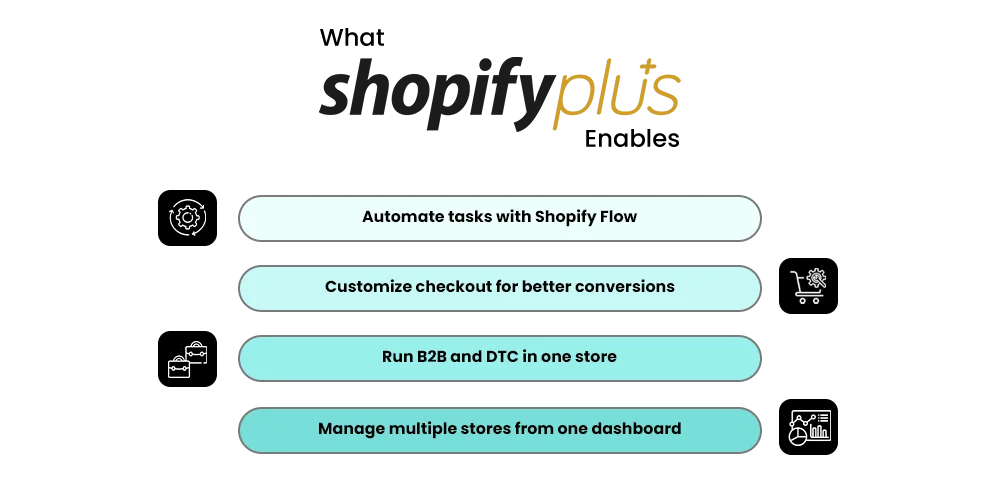
Automation is one of the biggest advantages of Shopify Plus. Built-in tools such as Shopify Flow allow merchants to automate repetitive tasks without coding. Businesses can automatically tag customers, detect potential fraud, manage orders, and receive inventory alerts when stock levels fall.
Another powerful tool is Launchpad, which allows merchants to schedule flash sales, product launches, and promotional campaigns. Instead of manually activating campaigns, everything can run automatically at a scheduled time. Shopify Plus also includes Script Editor, which enables advanced Shopify Plus checkout customization, such as tiered discounts, free shipping rules, and loyalty-based pricing.
Unlimited API Access and Integrations
A key advantage of Shopify Plus is its unlimited API access, which allows businesses to connect their store with external systems. These ecommerce integrations enable seamless connections with ERP platforms, CRM tools, and custom applications. Large companies often integrate Shopify Plus with systems like SAP, Salesforce, and NetSuite to synchronize customer data, orders, and inventory.
Multi-Store Management
Another important feature is multi-store management. Merchants can run multiple storefronts under a single account—for example, separate stores for international markets, different brands, or both B2B and B2C operations. With centralized management, businesses gain better control over inventory, orders, and customer data while supporting long-term ecommerce scalability.
Shopify Plus Scalability: Built for Massive Traffic
For fast-growing brands, scalability is one of the most important factors when choosing an enterprise ecommerce platform. As traffic grows, the ecommerce infrastructure must be able to handle large volumes of visitors and transactions without slowing down. This is where Shopify Plus stands out.
Shopify Plus is built on a powerful cloud-based ecommerce infrastructure that allows online stores to scale automatically when demand increases. The platform delivers 99.99% uptime, ensuring that stores remain operational even during high-demand periods.
One of the biggest strengths of Shopify Plus is its ability to process 10,000+ transactions per minute, making it suitable for large global brands running high-volume campaigns. Whether it is a major Black Friday sale or a viral product launch, the platform is designed to manage sudden traffic spikes smoothly.
Key scalability advantages include:
- Global CDN (Content Delivery Network) that ensures faster website loading worldwide
- Auto-scaling servers that automatically adjust resources during traffic surges
- Enterprise-level security and stability for large-scale ecommerce operations
- Ability to support massive product catalogs and global customer traffic
Because of this infrastructure, Shopify Plus has become a trusted platform for brands expecting millions of visitors during major sales events.
Shopify Plus for Global Brands
For companies expanding internationally, Shopify Plus provides powerful tools for managing global ecommerce operations. Many international brands choose the platform because it simplifies cross-border selling while maintaining consistent performance.
One major advantage is support for multiple global payment methods, allowing businesses to serve customers in different regions. Shopify Plus integrates with widely used payment systems such as PayPal, Apple Pay, Klarna, and Alipay. These options improve customer trust and increase conversion rates in international markets.
The platform also simplifies tax management. Businesses selling across countries must comply with different tax systems such as VAT in Europe or GST in various regions. Shopify Plus helps automate tax calculations and supports regional compliance requirements.
Another important feature is multi-warehouse inventory management. Companies can store products in multiple fulfillment centers and ship orders from the nearest location, enabling faster delivery and more efficient logistics.
Shopify Plus Mobile Commerce Advantages
Mobile shopping has become the dominant form of ecommerce. Studies consistently show that most online shopping traffic now comes from mobile devices, making mobile optimization essential for modern businesses. The Shopify Plus trend emphasizes mobile-first experiences, as more brands prioritize responsive design and seamless checkout for on-the-go shoppers.
Shopify Plus is built with a strong focus on mobile commerce performance. The platform supports responsive themes that automatically adjust to different screen sizes, ensuring a smooth browsing experience on smartphones and tablets. The checkout experience is also optimized for speed. Features such as Shop Pay, Apple Pay, and Google Pay allow customers to complete purchases quickly without repeatedly entering their payment details. Following the Shopify Plus trend, brands using these mobile-optimized features see lower cart abandonment rates and higher conversion rates.
A faster and simpler mobile checkout process helps decrease cart abandonment rates, improve customer satisfaction, and ultimately increase conversions for ecommerce merchants operating on Shopify Plus.
Integrations: Connecting Shopify Plus with Business Systems
Modern ecommerce brands rely on multiple tools to run operations efficiently. Shopify Plus integrations allow businesses to connect their store with enterprise systems like ERP, CRM, marketing platforms, and analytics tools. This creates a unified ecosystem where data flows smoothly between departments.
ERP System Integrations
ERP systems manage inventory, logistics, finance, and supply chains. Shopify Plus integrates with leading enterprise ERP platforms, helping businesses automate backend operations.
Common ERP integrations include:
- SAP – enterprise resource planning for finance, supply chain, and operations
- NetSuite – cloud-based ERP used for inventory management, accounting, and order processing
Benefits of ERP integration:
- Real-time inventory synchronization
- Automated order processing
- Centralized operational management
Top Shopify Plus Trends in 2026
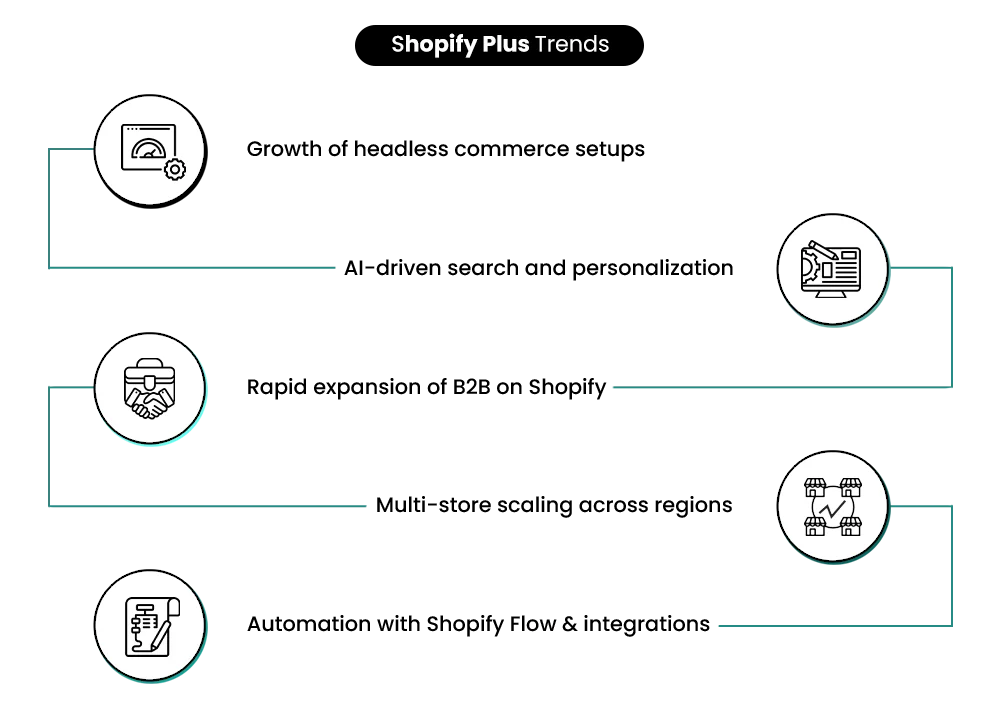
As ecommerce continues to evolve rapidly, businesses are adopting new technologies and strategies to stay competitive. The Shopify Plus trend reflects this shift, with enterprise brands focusing on scalability, automation, and highly personalized customer experiences to drive growth in 2026.
- AI-powered commerce enables smarter product recommendations, automated customer support, and predictive analytics for better decision-making.
- Headless commerce architecture allows brands to build faster websites with fully customized frontends while Shopify Plus handles the backend operations.
- Omnichannel retail expansion where businesses sell seamlessly across ecommerce websites, online marketplaces, social media platforms, and physical retail stores.
- Personalization at scale using AI and customer data to deliver dynamic pricing, behavior-based offers, and highly personalized shopping experiences.
- Subscription commerce growth with brands offering subscription boxes and recurring product deliveries to generate predictable recurring revenue.
- Mobile-first ecommerce optimization focusing on faster mobile checkout experiences and one-click payment options like Shop Pay, Apple Pay, and Google Pay.
- Advanced ecommerce automation using tools like Shopify Flow and Launchpad to automate inventory management, promotions, and order workflows.
- Global commerce expansion through multi-currency checkout, localized storefronts, and region-specific payment gateways for international customers.
Who Should Use Shopify Plus?
Shopify Plus is designed for businesses that require advanced ecommerce capabilities and scalable infrastructure. While smaller stores may succeed with standard Shopify plans, larger organizations benefit from the enterprise-level features offered by Shopify Plus.
The platform is particularly suitable for:
- High-growth brands that are rapidly scaling their ecommerce operations and require automation tools to manage increasing order volumes
- Large enterprises that handle high transaction volumes and need reliable infrastructure for peak traffic events
- Global brands expanding into international markets with multi-currency selling and localized storefronts
- B2B businesses managing wholesale ecommerce operations with custom pricing and bulk order management
- Brands requiring advanced customization for checkout experiences, integrations, and automation workflows
For these businesses, Shopify Plus provides the flexibility, scalability, and performance required to support long-term growth.
Shopify Plus Growth Opportunities for Businesses
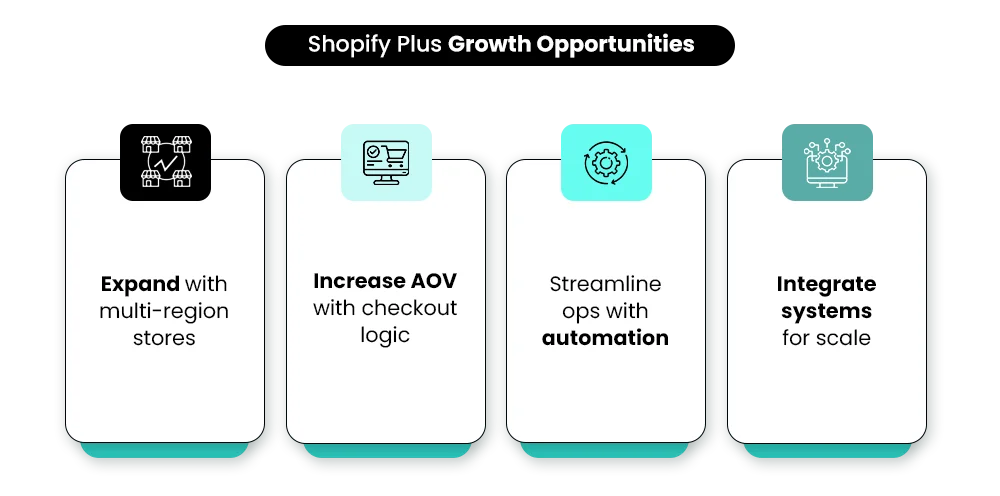
Adopting Shopify Plus opens several growth opportunities for ecommerce brands looking to expand their digital presence. The platform provides the tools and infrastructure needed to scale operations while improving efficiency and customer experience.
One of the biggest opportunities is global expansion. Shopify Plus allows merchants to sell internationally through multi-currency checkout, localized storefronts, and region-specific payment options. This makes it easier for brands to enter new markets and reach global customers.
Another advantage is automation efficiency. Tools such as Shopify Flow and Launchpad allow businesses to automate repetitive tasks like order processing, inventory management, and promotional campaigns. This reduces manual workload and allows teams to focus on strategic growth initiatives.
Shopify Plus also enables businesses to deliver a better customer experience through faster checkout processes, personalized product recommendations, and mobile-optimized storefronts. These improvements often lead to stronger customer engagement and higher satisfaction.
Additionally, advanced checkout customization and marketing integrations help businesses achieve higher conversion rates. By offering personalized promotions, flexible payment options, and faster checkout experiences, brands can increase the likelihood of completing sales.
Finally, Shopify Plus supports omnichannel selling, allowing businesses to reach customers through websites, social media platforms, marketplaces, and retail locations. This unified strategy helps brands expand their reach and create a consistent shopping experience across every channel.
Future of Shopify Plus (2026–2030 Outlook)
The future of Shopify Plus is closely connected to broader technological trends in ecommerce. As digital commerce continues to expand globally, the platform is expected to evolve with new innovations and capabilities.
One of the most important developments will be the growth of AI-powered commerce. Artificial intelligence will increasingly support product recommendations, automated marketing campaigns, and predictive sales analytics.
Another key trend is the adoption of headless commerce architecture, which allows brands to build fully customized storefront experiences while using Shopify Plus as the backend commerce engine. This approach offers greater flexibility and faster website performance.
The rise of voice commerce may also influence ecommerce platforms. With the increasing popularity of voice assistants and smart devices, consumers may begin placing orders through voice commands in the future.
In addition, global ecommerce expansion will continue to drive the demand for scalable platforms. Shopify’s ecosystem of integrations, apps, and global payment solutions is expected to grow further, making it easier for brands to reach customers worldwide.
These developments indicate that Shopify Plus will likely remain a major player in the enterprise ecommerce landscape.
Final Thoughts: Is Shopify Plus the Future of Enterprise Ecommerce?
As ecommerce continues to grow rapidly, businesses need platforms that support scalability, automation, and global expansion—this is where Shopify Plus stands out. With enterprise-grade infrastructure, advanced automation tools, and powerful integrations, the platform enables brands to handle high traffic, deliver personalized shopping experiences, and expand internationally. The Shopify Plus trend shows more growing brands adopting these features early to streamline operations and boost revenue.
For growing businesses, Shopify Plus is more than an ecommerce platform—it becomes a complete digital commerce engine. Features like custom checkout, automation workflows, and multi-store management help brands focus on customer engagement and growth. Following the Shopify Plus trend, partnering with experts like MASTROKE ensures full optimization and scalable, high-performing stores.
Ready to transform your ecommerce store into a powerful growth engine? Connect with MASTROKE today and start building a future-ready Shopify Plus store.
Build Your Shopify Store From Scratch With Mastroke
Launch faster with Mastroke, an official Shopify Partner. We build structured stores with conversion-first design, clean setup, and features built to scale!!
FAQs
What is Shopify Plus used for?
Shopify Plus is an enterprise ecommerce platform designed for high-growth brands and large businesses that require scalable infrastructure, advanced automation, and global selling capabilities.
How much does Shopify Plus cost?
Shopify Plus pricing typically starts at around $2,000 per month, with costs increasing depending on sales volume and additional enterprise requirements.
Is Shopify Plus worth it?
For high-volume businesses, Shopify Plus can deliver strong ROI through automation, improved checkout experiences, and lower operational complexity.
What businesses should use Shopify Plus?
It is best suited for large brands, high-growth ecommerce companies, global businesses, and B2B merchants that require advanced customization and automation.
Can Shopify Plus handle global ecommerce?
Yes. Shopify Plus supports multi-currency checkout, international payment gateways, localized storefronts, and tax automation for global markets.
Does Shopify Plus support B2B ecommerce?
Yes. Shopify Plus includes features for wholesale businesses, including custom pricing, bulk ordering, and specialized B2B storefronts.
Is Shopify Plus better than Magento?
Shopify Plus is generally easier to manage and faster to deploy, while Magento offers deeper customization but often requires more development resources.
How many stores can Shopify Plus manage?
Shopify Plus allows businesses to manage multiple storefronts from a centralized system, making it easier to run international, brand-specific, or B2B stores simultaneously.