📌 Key Takeaways
- What is agentic commerce, and how is it changing how people shop?
It’s when customers ask AI what to buy and get filtered recommendations before ever visiting a store. The decision starts forming inside that interaction, not on your website. That shift is easy to overlook at first, which is why many stores don’t realise where they’re already being left out. - What happens before a customer even reaches your store now?
Their options are already being filtered, compared, and narrowed down by AI. By the time your store appears, part of the decision is already shaped. That layer isn’t visible in analytics, which is why most stores don’t realise what’s influencing the outcome. - What makes AI choose one product over another when options look similar?
It’s less about how good the product looks and more about how clearly it explains itself. When multiple options exist, the one that’s easier to interpret gets picked. The difference feels minor, but it starts revealing gaps most stores don’t realise they have. - Why do some Shopify stores remain ‘invisible’ even when everything looks fine?
The store works, traffic may still come in, and nothing appears broken. But if product information isn’t structured clearly enough for AI, it simply gets skipped. It’s a quiet drop in visibility, which is why it often goes unnoticed until it starts affecting results. - What does it actually take for AI to recommend your product?
Your product needs to match a request clearly without relying on extra context. Small gaps in titles, details, or structure can be enough to remove it from consideration. Knowing this is one thing—getting it right is where most stores need a deeper rethink.
Agentic commerce is changing how customers discover and choose products—often without ever browsing your store. On platforms like ChatGPT, Google AI Mode, Gemini, and Microsoft Copilot, decisions are increasingly happening inside conversations rather than on storefronts. The global agentic commerce market size is expected to reach USD 65.47 billion by 2033.
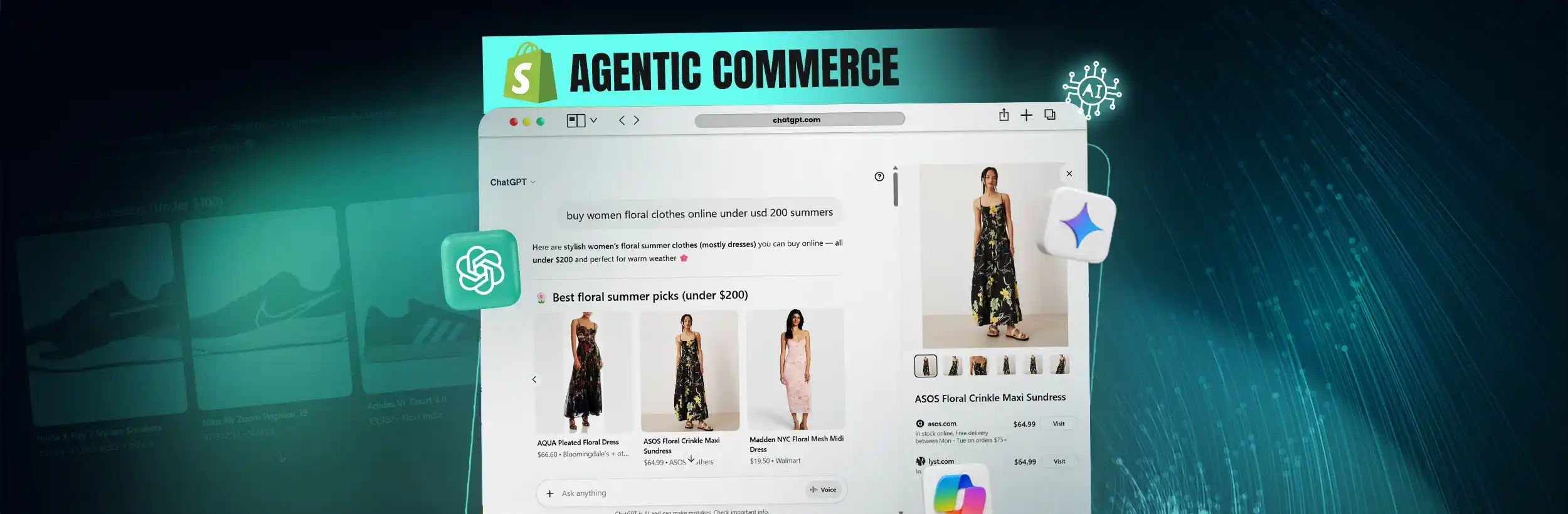
Instead of browsing multiple stores, customers now ask AI assistants what to buy and receive a few curated options instantly. Whether it’s ChatGPT suggesting products, or Google AI summarizing choices the process is compressed into a single interaction—often before your store even gets a chance to appear. This is already happening in early Shopify ecosystems—even if you haven’t noticed it yet.
If your store isn’t part of that AI conversation, do you even exist to the buyers?
This is not future talk. Shopify agentic commerce is already influencing how buying decisions begin—something even Shopify’s latest product updates are now actively building around. Your customers are moving from browsing to asking, and those questions are handled by AI shopping agents. Instead of comparing multiple stores, they receive a few relevant options instantly. The filtering, comparison, and recommendation happen before any visit.
According to research, AI-assisted recommendations can increase conversion rates by 20–30% by simplifying how customers make decisions.
What’s changing isn’t just where people buy—it’s how your store gets considered in the first place. To see where your store stands in this shift, let’s first understand how agentic commerce actually works.
What Is Shopify Agentic Commerce? (And How It Works)
You’ve been running a Shopify store for years. Suddenly, ‘AI agents’ are selling products?
Your store setup hasn’t changed. The shift isn’t in how you sell—it’s in how customers decide. So, what is agentic commerce in a Shopify context?
It’s when an AI assistant looks at your products, picks what fits a customer’s request, and recommends it—before they ever visit your store. For example, someone asks for a minimal desk setup, and the AI suggests a desk lamp or organizer from your catalog without the user browsing your site.
“Agentic” here means the system moves beyond showing options—it leans toward a decision.
Shopify agentic commerce is where your product catalogue is interpreted and recommended by these AI systems. These AI systems evaluate options, compare relevance, and suggest what fits a specific need.
It doesn’t rely on ads, SEO alone, or marketplace listings. Instead, decisions begin inside conversations—where AI interprets needs and narrows choices before a visit happens. That’s the core of agentic commerce. This changes where buying decisions happen. Your store still matters—but it now comes into play after your product has already been filtered and selected.
Drive high-intent traffic from ChatGPT, Google AI, Gemini & Copilot
We help your Shopify products get discovered across ChatGPT, Google AI, Gemini, and Copilot—bringing in high-intent buyers, boosting conversions, and driving more revenue.
This shift is already visible, but still in the process of taking shape. Shopify agentic commerce is already connected with platforms like Copilot, with integrations extending to tools like ChatGPT. Not all stores are part of this yet, but the direction of adoption is clear.
If you want to opt for Shopify agentic commerce then see – Shopify Agentic plan. But before that, it’s worth understanding what actually makes a store ready for this shift.
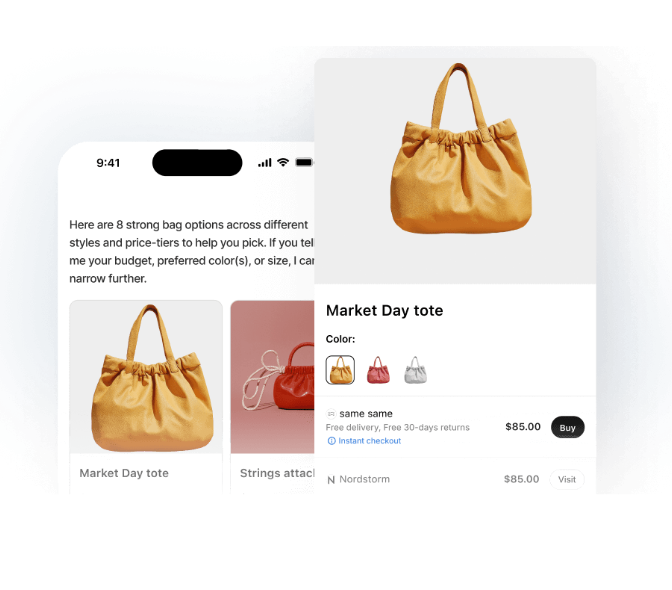
Where AI Shopping Is Happening (ChatGPT, Google AI, Gemini, Copilot)?
So if customers are buying this way, where exactly is this happening?
It’s not limited to one platform. Agentic commerce is already active across AI environments where users interact through conversational interfaces and receive product recommendations directly.
- ChatGPT, where merchants can now make product data available within AI conversations.
- Google AI (Gemini), integrated into search and shopping experiences.
- Microsoft Copilot, connected to browsing and productivity tools.
These platforms function as AI agents in ecommerce systems, interpreting user intent and surfacing products that match the request instead of directing users to browse multiple stores.
Most merchants won’t notice this shift immediately—but over time, fewer decisions start inside your store. Through Shopify agentic commerce, your product data flows into these ecosystems via Shopify AI integrations, even if you’re not actively managing it there.
How to Sell Products on ChatGPT, Google AI, Gemini, and Copilot
You don’t list your products separately on these platforms. They pull data directly from your Shopify store and evaluate how clearly your product communicates its purpose and relevance. What matters most:
- Clear titles and descriptions that define use-case.
- Structured product details that explain what you’re selling.
- Accurate pricing and availability.
Each platform works differently, but the outcome is the same—products that are easier to understand are more likely to be recommended.
How It Works on ChatGPT (Step by Step)
- You turn on the integration with ChatGPT
- Your products are pulled from your Shopify store
- A customer asks something (like “I want a red dress”)
- ChatGPT checks your products and finds the best match
- It shows only a few selected products inside the chat
- The customer can buy the product right there
- You still manage orders, payments, and customer details in Shopify.
How It Works on Microsoft Copilot (Step by Step)
- You set up the connection from Shopify to Copilot.
- The product catalog becomes accessible inside Copilot.
- A customer searches or asks for a product.
- Copilot understands the need and narrows down suitable options.
- It presents useful suggestions based on what the customer wants.
- The customer can go ahead and purchase within the same experience.
- You continue handling pricing, stock, and orders through Shopify.
The Real Shift: From ‘Search → Store → Buy’ to ‘Ask → Decide → Buy’
For years, ecommerce followed a familiar path. A customer searched for a product, opened a few stores, compared options, and then decided what to buy. That flow is changing.
Instead of searching, customers now ask. What used to involve multiple tabs is reduced to a few filtered options, presented instantly. The comparison happens within seconds, and the decision is made before your store is even opened.
Reports suggest 58% of shoppers now use AI and other discovery tools beyond traditional search for product recommendations.
| Step | Traditional Flow | Agentic Commerce Flow |
| Discovery | Google search | AI conversation |
| Evaluation | Multiple tabs | AI summarizes options |
| Decision | User decides | AI recommends |
| Purchase | Store checkout | AI-assisted checkout |
This is the core difference in agentic commerce vs traditional ecommerce. The competition is no longer for clicks—it’s for AI recommendations.
In Shopify agentic commerce, visibility alone doesn’t drive results. What matters is whether your product is selected during that AI-driven evaluation. If your product isn’t selected here, your store will never enter the decision.
Also Read – AI SEO Strategies: What Even Big Brands Must Consider In 2026
What This Means for Shopify Merchants? (In Simple Terms)
The biggest change isn’t in how the store operates—it’s in how customers reach it.
Until now, visibility depended on:
- Search rankings bringing users to your site
- Ads pushing your products in front of buyers
- Direct visits from returning customers
That model still exists—but it’s no longer the starting point. In agentic commerce, discovery doesn’t begin on the storefront. AI systems review product data, match it to a customer’s request, and decide whether it’s worth recommending.
Your products now need to be:
- Clearly understood by AI systems
- Selected based on context and intent
- Recommended before a visit happens
This also changes how products are compared—they’re filtered much earlier in the process.
This is where the impact of agentic commerce becomes visible. Traffic may still come in, but fewer decisions begin in the store itself. What matters now is how well your product fits the customer request at that moment—because that’s what determines whether it gets surfaced at all.
How Are Customers Actually Buying Through AI? (Real Flow Explained)
What changes here is how quickly a customer’s intent is resolved once it’s expressed.
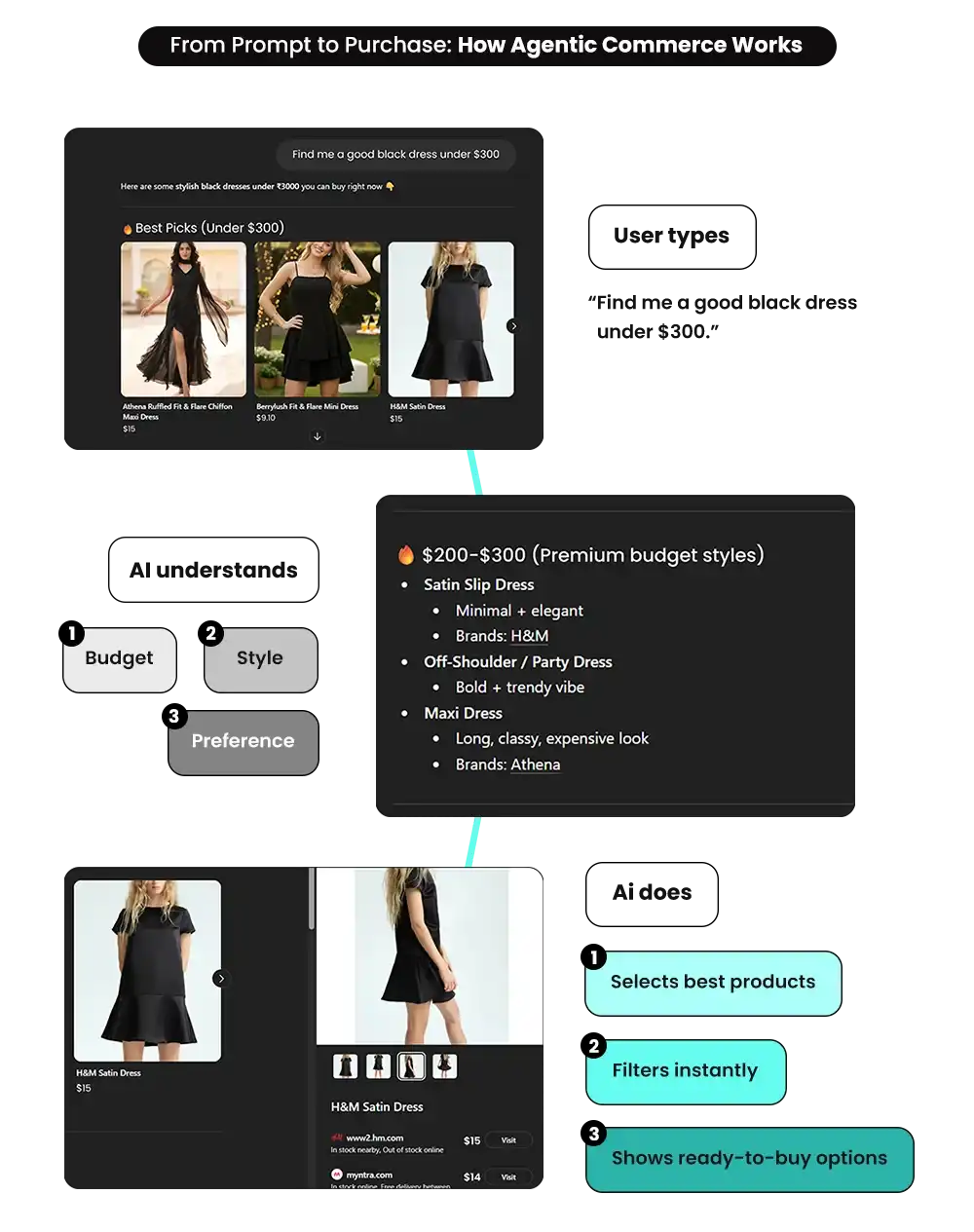
User asks: “ Best water bottle for gym.”
That single query carries enough context for AI systems to understand the need, price range, and intended use in one go. In agentic commerce, the system doesn’t wait for the customer to refine their search. It breaks the query into parts—product type, budget, and purpose—and uses these signals to identify relevant options. This is where AI-driven product discovery begins to replace traditional browsing.
For example, when a shopper asks, “Best budget running shoes under $500.”
The AI first breaks the query into parts—what the product is (running shoes), the constraint (under $500), and the intended use (budget, everyday running). It then looks across available product data and checks which listings clearly match these conditions. Products that explicitly mention running use, fall within the price range, and have clear, complete information are easier for the system to evaluate.
From there, the system ranks options based on how confidently they fit the request, forming the basis of AI product recommendations in ecommerce.
How AI Conversations Turn Into Purchases
The interaction doesn’t end with a single suggestion. Once the AI presents a few options, the interaction continues. The customer may ask for differences, better alternatives, or more specific use-cases, and each response helps refine the recommendations further, shaping the AI customer journey in real time.
Instead of opening multiple product pages or restarting the search, the decision is built within the same interaction. The options become more focused with each step, making it easier to move toward a final choice.
The decision happens before your store. The purchase simply finishes there.
Also Read – Sell Your Shopify Products on AI Platforms Like ChatGPT, Gemini, and AI Assistants
Do You Need to Be on ChatGPT or Google AI to Sell There? (Common Confusion)
No manual listing is required. In agentic commerce, your store is already connected through Shopify AI integrations and product feeds.
But being connected is not the same as being selected. You’re technically present. But not necessarily visible. When a query is made, AI systems:
- Interpret the request (intent, constraints, use-case)
- Scan product data across sources
- Check key details like category, pricing, and purpose
- Rank options based on how well they match
If product data is unclear or inconsistent, it becomes harder to recommend.
This is where most Shopify stores fall short. The setup is complete, but the structure doesn’t support visibility. This is a common issue—one that Shopify experts like Mastroke address by improving how product information is structured for AI interpretation and recommendation.
📌 Key Video
What Needs to Be in Place for AI to Recommend Your Products?
At the point where a request is being matched, products are expected to make sense without additional context.
Products aren’t interpreted in depth here. They’re assessed based on how directly their information aligns with the request. In many ways, this is what defines an AI-readable e-commerce store. That’s where a few elements start to matter:
- Product clarity – Titles and descriptions need to make the product’s purpose immediately clear, so it can be positioned within AI product discovery ecommerce
- Categorization and context – The way a product is grouped influences when it appears, especially within AI search discoverability.
- Pricing and availability – These signals influence whether the product qualifies for real-time recommendations and fits within AI search behaviour in ecommerce.
- Consistency and trust signals – Accurate and aligned information supports building trust in agentic commerce during selection
Structured attributes – Details like size, material, or usage strengthen structured product data, improving how precisely a product can be matched
If any of these pieces are missing, AI doesn’t try to guess—it simply skips. In Shopify agentic commerce, clarity is what determines whether your product gets considered at all.
How AI Actually Chooses Which Products to Recommend
In agentic commerce, selection depends on how clearly a product fits a request—not just whether it matches it.
For any given query, the system evaluates how well each product supports the intent. When multiple stores sell similar products, the one AI understands better gets recommended—not necessarily the one with better design or branding.
The decision is influenced by:
- Clarity of meaning -How clearly the product explains what it is and who it’s for.
- Depth of context – Whether it provides enough detail to support a specific use-case.
- Consistency of information – Aligned data across listings builds confidence.
- Strength of match – How strongly the product can be justified against the request.
Within Shopify agentic commerce, products that are easier to interpret are more likely to be selected.
How Shopify Connects Product Catalogues to AI Platforms
In Shopify agentic commerce, Shopify acts less like a storefront and more like a data layer that feeds into AI-driven environments.
At the center of this is Shopify’s product catalog—a shared collection of products from multiple stores that can be accessed across different systems.
Your product catalogue doesn’t stay within your site. Through Shopify AI integrations and Shopify’s product catalog product data is automatically shared with AI platforms, making it accessible to conversational AI systems. This happens automatically—no manual syncing required.
Products that meet Shopify’s requirements become part of this broader catalog, where they can be discovered and evaluated beyond the store they originate from.
Your product data, including titles, attributes, and pricing, becomes part of a wider network where AI systems can access it in real time and interpret it based on how queries are processed. This catalog is what AI systems read to evaluate and match products. It determines whether a product can be clearly understood and considered at all.
In agentic commerce, Shopify distributes the data—the decision of what gets shown happens within the AI system. To see what allows a product to be included and used in this catalog, you can refer to Shopify’s requirements here – Requirements for being included in Shopify Catalog
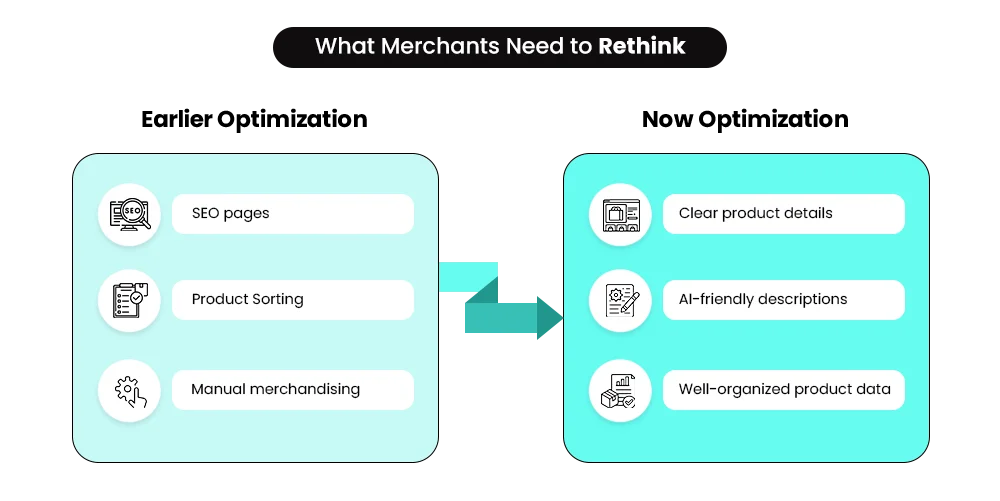
Where Your Shopify Store Might Be Falling Behind in AI Sales?
Many Shopify stores are set up to sell—but not in a way that works for agentic commerce.
The way products are presented is designed for human browsing, not for how AI systems interpret and evaluate them through AI search optimization. What creates the gap is not missing features but misalignment with how decisions are now made:
- Products are written to persuade, not to be clearly understood.
- Information is scattered and hard to extract.
- The product’s purpose isn’t explicitly explained.
- Structure looks organized, but lacks clear AI-readable ecommerce store signals.
Your store doesn’t break. It just stops being chosen. The challenge is that this isn’t immediately visible—everything looks fine, but fewer decisions move in your favour.
Along with product structure, a few basic requirements need to be in place to enable Shopify agentic commerce:
- Clear privacy policy page
- Terms and conditions page
- Refund policy page
These are required for the feature to be enabled on your store.
How Do You Know If Your Shopify Store Is Ready for AI Selling?
Think of this as a quick check. If an AI had to describe your product in one sentence, would it be clear and accurate?
In agentic commerce, products are evaluated on how directly they communicate what they offer—often without the full store context. Run through a few quick checks:
- Can the product be understood without relying on navigation or surrounding content?
- Are the most important details easy to identify without scanning the full page?
- Does the product clearly indicate where it fits and when it should be chosen?
- Is your catalogue structured in a way that supports AI search discoverability in ecommerce?
If the answers aren’t consistent, that’s where gaps start to show. Shopify AI readiness becomes visible here—when products align with how AI agents interpret them.
How to Make Your Shopify Store AI-Ready? (Without Rebuilding Everything)
Improving your store for agentic commerce doesn’t require a redesign—it requires better alignment with how AI systems interpret product data.
The goal is to make your store easier to read, not just easier to browse. This is where Shopify store optimization for AI begins to have an impact. A few focused changes can make a noticeable difference:
- Make product titles more outcome-focused – Titles should reflect what the product helps achieve, not just what it is
- Bring clarity into descriptions, not just persuasion – Go beyond marketing language and include context that supports AI product discovery in ecommerce.
- Standardize key product details across listings – Uniform information improves how products are matched in AI search.
- Organize products around how they’re used – Grouping by purpose makes it easier to connect products to specific queries.
- Reinforce credibility through consistent signals. Reviews and accurate information support building trust in agentic commerce.
You don’t need to fix everything at once—start with your highest-impact products.
If you want to look into how terms and conditions are defined for Shopify stores, you can explore them here – Shopify Legal Terms and Conditions
Also Read – Top 10 AI SEO Tools for Shopify Stores in 2026
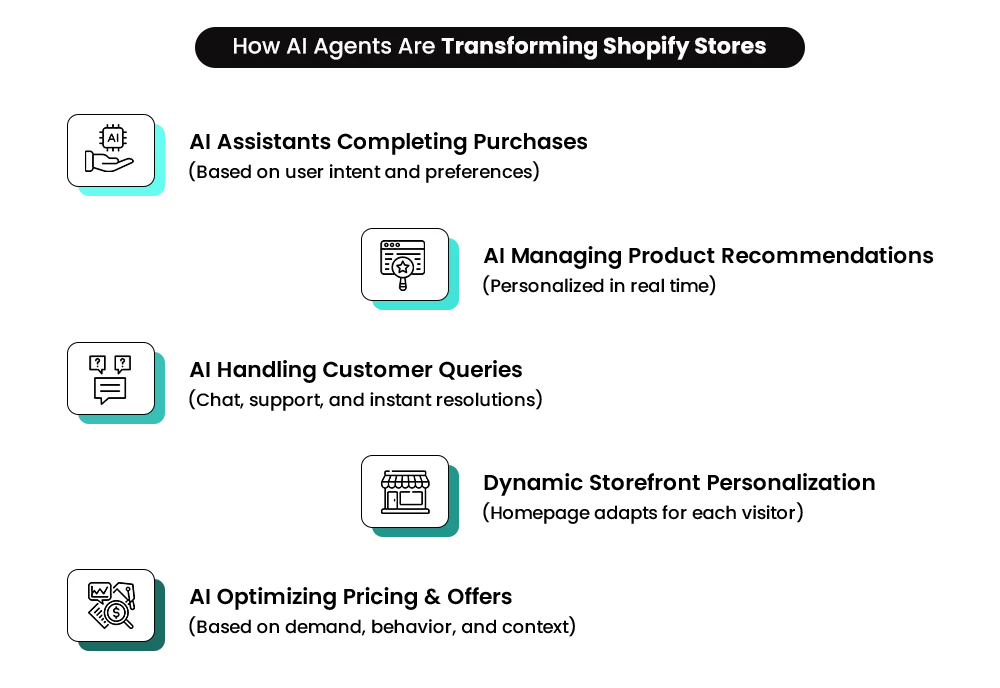
Benefits of Shopify Agentic Commerce (What Changes for Your Store)
One of the biggest outcomes of agentic commerce is how decisions become more direct—and how that reflects in store performance.
Instead of broad traffic, stores start attracting users who are already closer to buying.
- Higher-quality traffic – Visitors from AI product discovery arrive with clearer intent.
- Improved conversion rates – Fewer decision steps lead to more completed purchases.
- More products turning into purchases – When your product is recommended at the right moment, it has a higher chance of converting.
You don’t get more traffic. You get better decisions. And this is how AI-driven product discovery starts to influence how sales are generated.
Challenges and Limitations of AI Commerce (What Merchants Should Know)
While agentic commerce improves how decisions are made, it also changes what merchants can control. Some trade-offs to be aware of:
- Limited control over product selection – You don’t decide when your product is shown—only how well it fits the request.
- Dependence on data quality – Incomplete or unclear product information reduces the chances of being recommended.
- Risk of misinterpretation – If product details aren’t precise, systems may position them incorrectly.
- Less direct brand interaction early on – In a conversational AI system, the first interaction happens with AI, not your store.
The control shifts from placement to qualification. Success in Shopify agentic commerce depends less on promotion and more on how clearly your product can be understood.
Conclusion — The Shift Is Quiet — But the Impact Isn’t
Shopify agentic commerce changes how products are discovered, not what the store sells.
The difference shows up in how products are understood and matched to a customer’s need—before a visit happens. In agentic commerce, visibility doesn’t come from being live. It comes from being understood.
If product information isn’t clearly interpretable, it’s less likely to be considered—regardless of how well the store is designed. This is where many stores hit a limitation. The setup is in place, but the product information isn’t structured clearly enough to be considered. Mastroke works on this layer—refining how product data is structured so it can be interpreted and selected more effectively.
Shopify growth partners like Mastroke don’t just follow AI trends—they apply them while building and refining stores. Because being present is no longer enough. What matters is whether a product can be clearly understood and confidently chosen.
Show your Shopify products in AI search and turn visibility into sales
We make your Shopify products show up in AI search—so you get more high-intent traffic, better conversions, and more sales.
Bring your vision to life with Mastroke, an official Shopify Partner. We design and develop high-converting, scalable Shopify stores with clean structure and future-ready features—built to grow with your business.
FAQs – Everything You Need to Know About Selling On AI
Here are the most common questions store owners ask about how AI discovers and displays products in Shopify stores.
1. Will my products even show up in AI tools like ChatGPT?
Yes, your products can show up—but it’s not automatic or guaranteed. AI tools don’t browse your store the way a human does; they rely on structured, well-written product data to understand what you’re selling. If your titles, descriptions, and attributes clearly explain what the product is, who it’s for, and when it should be recommended, your chances increase significantly. On the other hand, vague naming, missing details, or inconsistent formatting make it difficult for AI to confidently pick your product. In simple terms: visibility isn’t about being listed—it’s about being understandable.
2. Do I need to list my products on ChatGPT or Google AI?
No, you don’t need to manually “list” your products on AI platforms like you would on a marketplace. Your Shopify catalog already acts as the source of truth. However, just being on Shopify doesn’t mean AI will automatically surface your products. These systems pull and interpret data based on how well your store is structured for AI discoverability. That includes clean product feeds, consistent taxonomy, descriptive metadata, and overall Shopify AI readiness. So the real work isn’t distribution—it’s optimization of what you already have.
3. Why are some products shown by AI and others not?
AI doesn’t randomly choose products—it selects what it can confidently match to a user’s intent. When someone searches or asks for something, AI tries to interpret the request and map it to products with the clearest, most relevant data. If one product has detailed descriptions, clear use cases, and proper categorization, while another is vague or incomplete, the AI will favor the first. This is why two similar products in the same store can perform very differently. The difference isn’t quality—it’s clarity and context.
4. Does SEO still matter, or is AI replacing it?
SEO absolutely still matters—but the way it works is evolving. Traditional SEO focused heavily on keywords and ranking on search engines. With AI, the focus shifts toward meaning and context. Instead of just inserting keywords, your product content needs to answer real-world queries clearly. AI systems prioritize content that is structured, descriptive, and easy to interpret. So SEO isn’t going away—it’s becoming more about semantic clarity than keyword density. Think of it as moving from “ranking for search” to “being understood by AI.”
5. Do I need to redesign my store for AI shopping?
No, you don’t need a visual redesign or a complete overhaul of your storefront. AI doesn’t care about how your website looks—it cares about how your data is structured. What matters more is backend clarity: product titles, descriptions, attributes, tags, and consistency across your catalog. Investing in Shopify store optimization for AI—like improving product data quality and standardizing formats—will have a far greater impact than changing layouts or themes. This is less about design and more about data discipline.
6. What is agentic commerce?
Agentic commerce refers to a shift in how buying decisions happen. Instead of customers manually browsing multiple websites, AI systems act as “agents” that understand a user’s intent, evaluate options, and recommend the most relevant products. In many cases, the AI narrows down choices before the customer even lands on a store. This means your product is being judged earlier in the decision-making process—based entirely on how well AI can interpret it. So instead of optimizing just for shoppers, you’re now also optimizing for AI decision-makers.
7. If my store is already running fine, do I even need to care about this?
If your current channels are working, it might not feel urgent—but this shift is about future visibility, not just current performance. Shopping behavior is gradually moving toward AI-assisted discovery, where fewer people start their journey directly on stores or marketplaces. If your products aren’t optimized for AI interpretation, you risk becoming invisible in this new layer of discovery. You don’t need to panic or overhaul everything overnight—but ignoring it means falling behind as the buying journey evolves. This is less about fixing something broken and more about staying relevant as the ecosystem changes.