Many Shopify Plus brands lose revenue due to inefficient systems, where disconnected tools create data silos, operational gaps, and process inefficiencies. As businesses scale, managing inventory, orders, and customer data across multiple channels becomes increasingly complex.
This challenge becomes even more pronounced when brands attempt to manage multiple Shopify store environments without a centralized, unified system.
Without a centralized infrastructure, teams often rely on disconnected tools for inventory, accounting, customer data, and fulfillment. This leads to duplicated efforts, inconsistent reporting, and delays in decision-making. As order volumes increase and operations expand globally, these inefficiencies multiply, making it difficult to sustain growth. Businesses that fail to streamline their backend operations often struggle to maintain profitability despite increasing sales.
A Shopify Plus ERP system solves this by centralizing operations, automating workflows, and providing real-time data across your business. From inventory management to financial reporting, ERP systems bring clarity and control to growing ecommerce brands.
This guide explores the best ERP for Shopify Plus, helping you streamline operations and effectively manage multiple stores while driving measurable ROI.
Why Shopify Plus Brands Struggle Without ERP Systems?
Scaling introduces operational challenges that disconnected tools cannot handle efficiently. As Shopify Plus merchants expand into new markets, add more SKUs, and increase sales channels, the limitations of basic systems become more apparent.
Data silos across platforms create inconsistencies, forcing teams to manually reconcile data between systems. Inventory mismanagement becomes a frequent issue, especially when businesses operate across multiple warehouses or fulfillment partners. It becomes increasingly difficult to manage multiple stores shopify operations when each store operates in isolation without shared data visibility.
Manual workflows slow down processes such as order processing, returns, and reporting. Teams spend more time managing operations than optimizing them. Without real-time insights, businesses rely on outdated information, leading to poor forecasting and missed opportunities.
Customer experience also suffers due to delays, stock inaccuracies, and a lack of transparency. Without proper Shopify Plus ERP integration, these inefficiencies compound over time, directly impacting growth, profitability, and long-term scalability.
What is a Shopify Plus ERP System?
A Shopify Plus ERP is a centralized system that connects inventory, finance, order management, and customer data into one platform. It eliminates the need for multiple disconnected tools and ensures that all business functions operate from a single source of truth. ERP is not just software—it’s the operational backbone that connects every revenue-driving function across your business.
Unlike traditional systems, ERP platforms are designed to handle complex e-commerce operations, making them essential for high-growth Shopify Plus brands. They allow businesses to automate workflows, improve accuracy, and maintain control over operations at scale.
- Centralized data management
- Real-time synchronization
- Workflow automation
- Improved inventory tracking
- Better reporting and analytics
- Ability to manage multiple Shopify stores from a single dashboard
By integrating all business processes, ERP systems enable organizations to operate more efficiently and respond quickly to market changes.
For more insights on scaling performance and handling growth efficiently, keep reading our blog: “How Shopify Plus Handles High Traffic: A Practical Breakdown for Enterprise Ecommerce”
How ERP Systems Drive ROI for Shopify Plus Stores
ERP systems are critical for improving operational efficiency and driving measurable profitability. Instead of just streamlining workflows, they directly impact key revenue metrics by reducing inefficiencies and enabling faster, data-driven decisions.
One of the biggest advantages is cost reduction. By automating repetitive tasks like order processing and inventory updates, businesses can reduce manual effort by up to 30–50% while significantly minimizing errors. Improved accuracy in fulfillment also lowers return rates, protecting margins and customer experience.
ERP systems bring real-time visibility into inventory, demand, and supply chain performance. This helps brands maintain optimal stock levels, reducing stockouts and overstocking—both of which can cost millions annually at scale.
They also improve forecasting accuracy through centralized data and analytics. Instead of reacting to issues, businesses can anticipate demand, optimize purchasing, and align operations with growth. For brands managing multiple Shopify store environments across regions, this level of control becomes a major competitive advantage
- Reduce manual work and operational costs
- Improve order accuracy and fulfillment speed
- Optimize inventory planning
- Enable better forecasting
- Enhance customer experience
- Support scalability
- Simplify operations to manage multiple stores shopify effectively
ERP vs Without ERP (ROI Comparison)
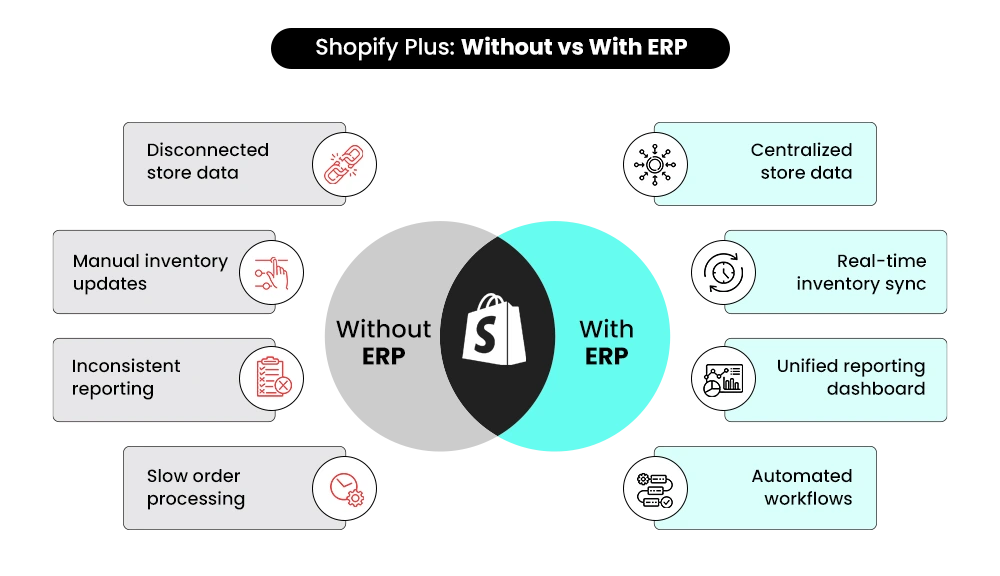
Before implementing an ERP, many businesses rely on fragmented systems that limit growth. These systems often lack integration, leading to inefficiencies and operational bottlenecks.
| Feature | Without ERP | With ERP |
| Inventory Tracking | Manual and error-prone | Real-time and automated |
| Order Management | Slow and fragmented | Fast and synchronized |
| Data Accuracy | Inconsistent | Reliable and unified |
| Scalability | Limited | High |
| Multi-store Management | Complex | Centralized |
As businesses grow, ERP systems become essential to manage multiple Shopify stores environments efficiently and maintain operational control. They provide the foundation needed for long-term scalability and consistent performance.
Best ERP Systems for Shopify Plus Stores
Choosing the right ERP depends on your business needs and integration requirements. The ideal solution should align with your operational complexity, budget, and long-term growth strategy. The right ERP depends less on features and more on your operational complexity:
1. NetSuite
NetSuite is an enterprise-grade ERP designed for large-scale ecommerce operations requiring advanced financial and operational control. It is widely used by global brands for its scalability and robust reporting capabilities.
Key Features:
- Advanced financial management
- Real-time inventory tracking
- Strong scalability for global operations
- Integrated analytics and reporting
- Ideal for businesses that manage multiple stores on Shopify
2. SAP Business One / SAP S/4HANA
SAP provides powerful ERP solutions for enterprises with complex workflows and global operations. It is best suited for organizations that require deep customization and control.
Key Features:
- Advanced supply chain management
- Multi-currency support
- Customizable workflows
- Strong financial control
- Suitable for large enterprises
3. Microsoft Dynamics 365 Business Central
A flexible ERP system ideal for growing businesses looking for scalability and automation. It integrates seamlessly with Microsoft tools, making it a popular choice for businesses already using that ecosystem.
Key Features:
- Integration with Microsoft tools
- Automation of business processes
- Strong analytics and reporting
- Scalable architecture
- Supports ERP integration with Shopify Plus
4. Acumatica
Acumatica is a cloud-based ERP offering flexibility and scalability for modern ecommerce businesses. It provides real-time access to business data from anywhere.
Key Features:
- Cloud-native system
- Multi-location inventory tracking
- Real-time data access
- Flexible customization
- Helps manage multiple Shopify stores effectively
5. Odoo
Odoo is a modular ERP system suitable for businesses looking for a customizable and cost-effective solution. Its open-source nature allows businesses to tailor the system to their needs.
Key Features:
- Open-source flexibility
- Modular structure
- Integrated CRM and accounting
- Affordable pricing
- Requires customization for advanced needs
6. Brightpearl
Brightpearl is built specifically for retail and ecommerce businesses with strong inventory and order management features. It is particularly effective for brands focused on omnichannel selling.
Key Features:
- Native Shopify integration
- Real-time data synchronization
- Omnichannel capabilities
- Automated order processing
- Ideal for retail brands
ERP Comparison
Comparing ERP systems side by side helps businesses make informed decisions
| ERP | Best For | Integration Type | Pricing Level | Complexity |
| NetSuite | Enterprise | Middleware | High | High |
| SAP | Large enterprises | Custom | High | Very High |
| Dynamics 365 | Growing businesses | Connector | Medium | Medium |
| Acumatica | Mid-sized | Native | Medium | Medium |
| Odoo | SMBs | Connector | Low | Medium |
| Brightpearl | Retail | Native | Medium | Low |
Selecting the right system ensures smooth Shopify Plus ERP integration and helps businesses scale while maintaining efficiency.
Build Your Shopify Store From Scratch With Mastroke
Launch faster with Mastroke, an official Shopify Partner. We build structured stores with conversion-first design, clean setup, and features built to scale!!
Key Features to Look for in Shopify Plus ERP
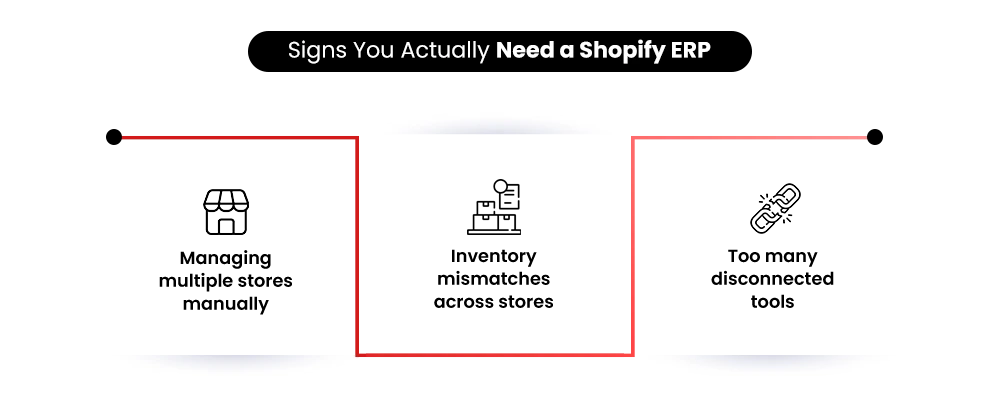
When choosing an ERP, focus on features that improve efficiency and scalability. A strong system should provide real-time visibility across inventory, orders, finances, and customer data—ensuring accuracy, especially when managing multiple Shopify stores.
Automation is key to reducing manual work and errors, while seamless integrations with tools like CRM and OMS ensure a connected ecosystem. Key features to look for:
- Real-time inventory sync
- Multi-store management
- Workflow automation
- Advanced reporting
- CRM & OMS integrations
- Multi-location and multi-channel support
To explore how Shopify Plus supports enterprise-level growth and operations, read: “Shopify Plus for Enterprise Growth: Features & Benefits”
ERP Integration with Shopify Plus
A strong Shopify Plus ERP integration is the backbone of efficient e-commerce operations. It connects your Shopify Plus store with backend systems, ensuring seamless data flow across all business functions.
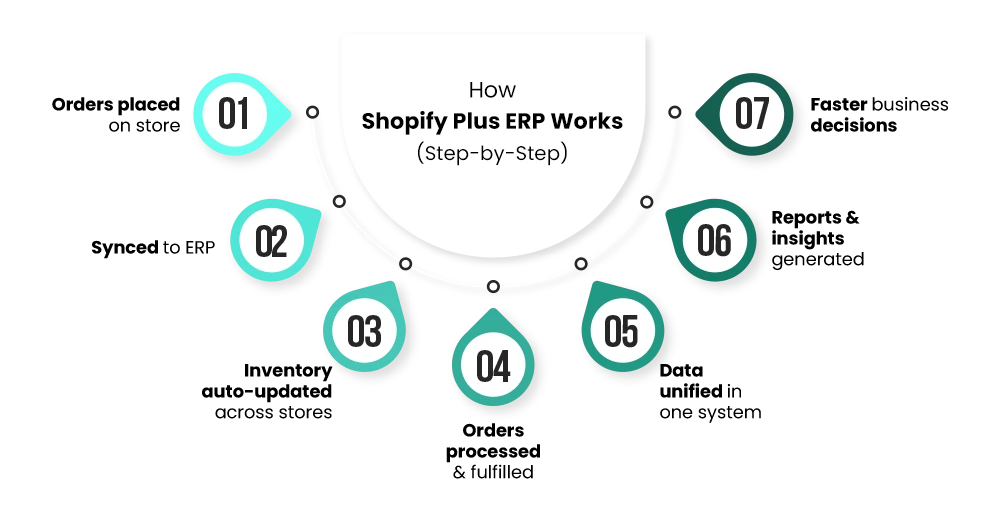
ERP integration eliminates the need for manual data entry by automating the exchange of information between systems. Orders placed on Shopify are automatically updated in the ERP, inventory levels are adjusted in real time, and financial data is synced without delays.
This level of automation is especially important for businesses that need to manage multiple stores Shopify operations. Without proper integration, managing multiple storefronts can lead to data inconsistencies, delayed updates, and operational inefficiencies.
The risk of poor or incomplete integration is significant. Disconnected systems can result in overselling, inaccurate inventory, delayed order processing, and reporting gaps—directly impacting customer experience and revenue. At scale, even small sync issues can compound into major operational failures.
There are different ways ERP systems integrate with Shopify Plus. Some use native integrations, while others rely on middleware solutions or APIs. The choice depends on the complexity of your business and the level of customization required.
- API-based data exchange for seamless connectivity
- Middleware platforms for complex workflows
- Native integrations for faster implementation
- Real-time syncing of orders, inventory, and customer data
- Centralized data management across systems
This integration is essential to integrate ERP, OMS, and CRM with Shopify Plus—enabling businesses to operate efficiently and scale without limitations.
How to Choose the Right ERP for Shopify Plus
Selecting the right ERP system is a strategic decision that impacts every aspect of your business. A structured approach ensures that you choose a solution aligned with your current needs and future goals.
Step 1: Identify your business requirements and operational challenges
Understand where your current systems are failing and what improvements are needed.
Step 2: Define your budget and total cost of ownership
Consider not just subscription costs but also implementation, maintenance, and training expenses.
Step 3: Evaluate integration capabilities
Ensure the ERP supports seamless Shopify Plus ERP integration and works well with your existing tech stack.
Step 4: Check scalability
Choose a system that can grow with your business and support increasing complexity.
Step 5: Assess usability
The system should be easy for your team to use and adopt without extensive training.
Step 6: Understand how to choose a Shopify Plus partner for ERP integration
Working with the right partner ensures smooth implementation and long-term success.
A well-planned selection process helps businesses manage multiple stores shopify efficiently while avoiding costly mistakes.
Common Mistakes to Avoid
Many Shopify Plus businesses face challenges during ERP implementation due to avoidable mistakes. Being aware of these pitfalls can save time, money, and effort.
Mistake 1: Choosing an ERP without clearly defined requirements
This leads to selecting a system that does not align with business needs.
Mistake 2: Ignoring Shopify Plus ERP integration complexity
Poor integration can result in data inconsistencies and operational issues.
Mistake 3: Overpaying for unnecessary features
Many businesses invest in features they never use, increasing costs without added value.
Mistake 4: Not planning to manage multiple stores on Shopify
Failing to consider multi-store operations can limit scalability.
Mistake 5: Choosing the wrong implementation partner
An inexperienced partner can delay implementation and create technical challenges.
Mistake 6: Ignoring training and onboarding
Without proper training, teams struggle to use the system effectively.
Avoiding these mistakes ensures a smoother transition and maximizes the benefits of your ERP investment.
Do You Need a Shopify Plus ERP Integration Partner
For many businesses, ERP success depends as much on implementation as on the software itself. An experienced integration partner ensures the system is configured correctly, workflows are optimized, and all tools work seamlessly together. This becomes especially important when managing multiple Shopify store operations, where complexity increases with scale.
Key benefits:
- Faster deployment
- Reduced risk of errors
- Custom workflows and integrations
- Ongoing support and optimization
A strong partner ensures your ERP integration delivers maximum ROI and supports long-term growth.
When an ERP partner may not be needed:
- Small stores with low order volume
- Simple operations with minimal integrations
- Early-stage businesses not yet scaling operations
In such cases, basic setups can be managed without advanced implementation support.
Conclusion
If you’re ready to scale your Shopify Plus operations without operational bottlenecks, it’s time to partner with experts who understand both technology and business strategy. At Mastroke, we specialize in Shopify Plus ERP integrations that streamline workflows, unify data, and eliminate inefficiencies across your operations.
From selecting the right ERP to implementing and optimizing it for your specific needs, our team ensures a smooth, scalable setup that supports long-term growth. We help you automate processes, improve visibility, and build a system that works as your business grows.
Get in touch with Mastroke today and take the next step toward a more efficient, scalable, and high-performing ecommerce operation.
Build Your Shopify Store From Scratch With Mastroke
Launch faster with Mastroke, an official Shopify Partner. We build structured stores with conversion-first design, clean setup, and features built to scale!!
FAQs
What is a Shopify Plus ERP?
A Shopify Plus ERP integrates business operations into one system.
Which ERP is best?
It depends on your needs. NetSuite and SAP are ideal for enterprises.
What is ERP integration?
It connects systems to enable real-time data sharing and automation.