This blog post compares Shopify Email and Klaviyo as email marketing tools for ecommerce merchants, examining when merchants typically need to upgrade from basic to advanced email marketing capabilities. It analyzes what each platform does well, their limitations, and which growth stage each tool best serves.
A merchant sends the same abandoned cart email to 8,000 customers. No segmentation, no personalization, and no dynamic product feeds show each person what they actually left behind. The open rate looks decent. Conversions aren’t moving.
That’s not a campaign problem. That’s a tool problem.
The Klaviyo vs Shopify Email question comes up at a specific moment for most merchants — when the tool they started with stops doing the job they need it to do. With email marketing delivering an average ROI of $45 for every $1 spent in retail and ecommerce, the cost of using the wrong tool isn’t a minor inefficiency. It’s real revenue left on the table every single send.
Here’s the scale of what’s at stake: Baymard Institute research aggregated across 50+ studies shows that around 70% of all online shopping carts are abandoned before purchase. The email tool you use to recover that revenue directly determines how much of it you actually get back.
This blog maps exactly what each tool does, where each one breaks down, and which stage of growth each one actually fits.
What Shopify Email Actually Is — and What It Isn’t?
Most comparison articles skip straight to feature lists. That creates confusion. So let’s be clear about what Shopify Email actually is before comparing it to anything.
Shopify Email is Shopify’s native email marketing tool — built directly into the admin, zero additional setup, and included with every Shopify plan at no extra cost for up to 10,000 sends per month. It launched in 2019 as a simple way for merchants to send branded emails without leaving their dashboard. That simplicity is still its biggest advantage.
What Does Shopify Email Handle well?
- Branded templates that automatically pull your store’s colors, fonts, and logo — zero manual formatting.
- Core automation flows: abandoned cart, welcome series, post-purchase follow-ups, win-back sequences.
- Pre-built segmentation templates for high-spend customers, frequent openers, and location-based groups — no technical setup required.
- Transactional emails — order confirmations, shipping updates, delivery notices — that do not count toward your monthly send limit.
- A drag-and-drop builder that’s genuinely easy to use for merchants who don’t want to invest time learning a new platform.
What is Shopify Email Not?
It’s not a full-featured email marketing platform. There’s no native SMS. No built-in A/B testing without workarounds. Dynamic product feeds only work in automations — not in regular broadcast campaigns, which means every subscriber in a campaign email sees the same products regardless of their purchase history.
Segmentation depth is limited. There’s no predictive analytics layer. And you can’t import custom HTML templates the way you can in dedicated platforms.
The honest framing: Shopify Email is a starter email tool built for simplicity and zero friction. That’s its strength — and its ceiling.
What Klaviyo Actually Is — and What It Costs You?
Klaviyo isn’t a Shopify feature. It’s a dedicated ecommerce marketing platform built around email and SMS, with a deep Shopify integration that makes it feel native once connected. Understanding how Klaviyo works with Shopify is the key to understanding why merchants switch.
When you connect Klaviyo to Shopify, the platform syncs your entire store data — purchase history, browsing behavior, customer tags, lifetime value, predicted next order date, cart abandonment data — and uses all of it to power everything from segmentation to automation to analytics. Klaviyo doesn’t just send emails. It uses customer behavior to determine who gets what, when, and why.
What Klaviyo handles well?
- Advanced segmentation with no limit on conditions — build segments based on purchase history, browsing behavior, LTV, predicted churn risk, and dozens of other data points.
- 60+ pre-built automation flows covering everything from abandoned cart to replenishment reminders, birthday emails, sunset flows, and multi-step post-purchase sequences.
- Dynamic product feeds in regular campaigns — different recipients see different products based on rules you define, a capability Shopify Email campaigns simply don’t have.
- Built-in A/B testing for subject lines, content, and send times with analytics that tell you what to do next.
- SMS marketing is built into the same platform, coordinated with email from the same segmentation logic and automation flows.
- A built-in CRM with detailed customer profiles built on purchase history, email engagement, and browsing behavior.
- Predictive analytics that forecast individual customer behavior — predicted LTV, next order date, churn risk.
What Does Klaviyo Cost?
Klaviyo is free up to 250 contacts with 500 sends per month. Paid plans scale with list size. One important detail: unlike Shopify Email, transactional emails count toward your Klaviyo send limit — which means the effective threshold where you start paying arrives faster than the contact number alone suggests.
| List Size / Sends | Shopify Email | Klaviyo |
| 3,000 subscribers / 30,000 sends | ~$20/month | ~$70/month |
| 12,000 subscribers / 120,000 sends | ~$110/month | ~$250/month |
| 60,000 subscribers / 600,000 sends | ~$485/month | ~$860/month |
The honest framing: Klaviyo is a professional platform that rewards merchants who know how to use data. It comes with a real price tag, a meaningful learning curve, and a setup investment that smaller stores may not be ready for yet.
Feature-by-Feature: Where Each Tool Actually Differs
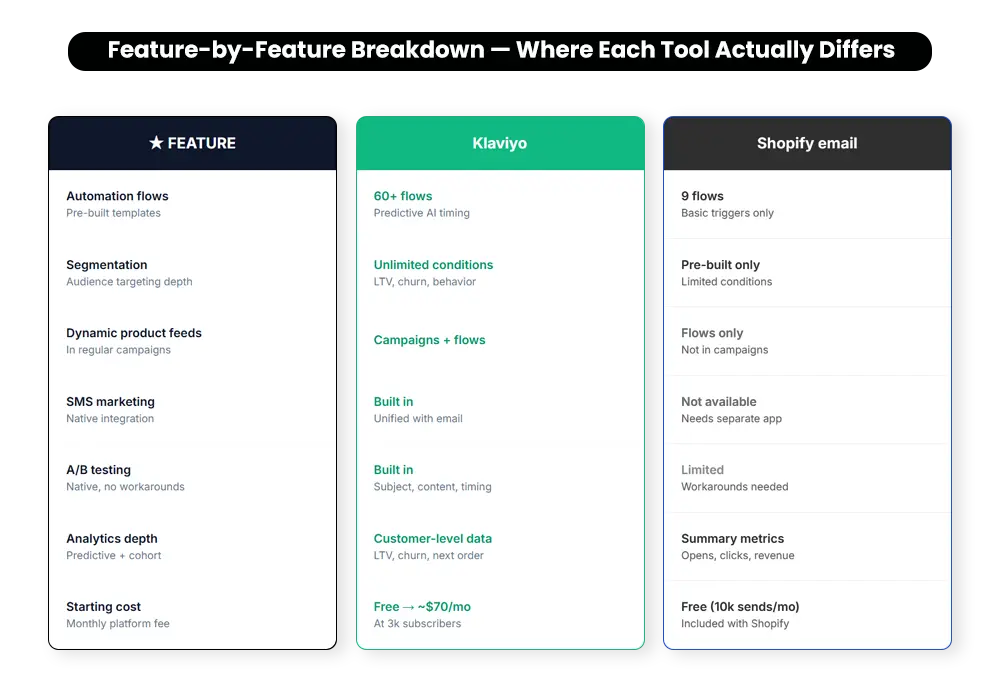
Every point below reflects a real operational difference that affects how you run campaigns day to day — not a feature checklist that looks the same across every comparison blog.
Email Builder and Templates
Shopify Email auto-applies your brand — colors, fonts, logo — to its 46 available templates the moment you open the editor. Zero manual setup. For new merchants who want to start sending quickly and look professional doing it, this is genuinely one of its strongest features.
Klaviyo has more templates and supports dynamic content in regular campaigns — different recipients can see different products based on rules you define. Shopify Email’s dynamic products only work in automations, not in standard broadcasts.
Klaviyo also lets you import fully custom HTML templates and save reusable designs across campaigns, giving brands with more developed creative direction the flexibility they need.
Automation and Flows
Shopify Email offers nine core automation templates covering abandoned cart, welcome series, post-purchase, and a few others. Setting them up requires switching between two separate editors — the automation editor and the email editor — which gets frustrating when you’re managing multiple flows at once.
Klaviyo has 60+ pre-built flows. Beyond the basics, it offers replenishment reminders, sunset flows to remove unengaged subscribers, customer birthday emails, and multi-step behavior-based sequences. Klaviyo’s predictive automation goes further: it forecasts when a specific customer is likely to reorder based on their individual shopping pattern and sends the replenishment email at that precise moment — not the same fixed date for everyone.
This matters more than it sounds. According to Omnisend’s 2024 data, automated emails drove 37% of all email-generated sales while making up only 2% of total sends. Klaviyo’s own benchmark data reinforces this: automated flows generate up to 30x more revenue per recipient than standard broadcast campaigns. The quality of your automation setup — not just whether automations exist — is directly tied to how much revenue your email program generates.
Related read: How to Use Customer Reviews in Your Marketing & Sales Content — email is one part of the retention picture. Customer reviews embedded in post-purchase flows add the trust layer that converts repeat buyers.
Segmentation
Shopify Email offers pre-built segmentation templates — frequent openers who haven’t bought recently, high-spend customers, customers in specific cities, customers who’ve viewed a specific collection. Easy to use, limited in depth. You access segments through the Customers section, then return to Shopify Email to send — a workflow that gets tedious at scale.
Klaviyo lets you build segments with no limit on conditions, using advanced logic across any combination of purchase, behavioral, and predictive data points. The learning curve is real. But the performance difference is significant.
Klaviyo’s own benchmark data consistently shows that stores using advanced segmentation — tailoring messages to specific customer groups based on behavior and purchase history — generate meaningfully more email revenue than stores sending the same campaign to their entire list. The jump from “everyone gets the same email” to “each segment gets a relevant email” is where the revenue difference shows up most clearly.
Klaviyo’s deep Shopify integration means your entire customer data history syncs automatically, giving you a segmentation foundation Shopify Email simply can’t match.
Analytics and Reporting
Shopify Email provides basic metrics — opens, clicks, revenue attributed — tied to your Shopify dashboard. Useful for understanding which campaigns performed. Limited in understanding why.
Klaviyo offers customer-level data, predictive analytics, A/B test results, flow performance breakdowns, and cohort analysis. The difference isn’t just in how much data you see — it’s in what you can do with it. Klaviyo’s reporting surfaces signals you can act on. Shopify Email’s reporting gives you summary numbers.
Shopify’s own published data confirms the performance gap: 90% of email marketing professionals say that using subscriber segmentation to deliver targeted messages improves results — but accessing that level of segmentation requires tools that go deeper than Shopify Email’s built-in capabilities.
SMS Marketing
Shopify Email has no native SMS. To run SMS alongside email, you need a separate app — and the Shopify App Store has over 400 options, most of them with additional monthly costs. Running separate platforms for email and SMS creates data fragmentation that grows more expensive and harder to manage over time.
Klaviyo has SMS built in. Email and SMS campaigns run from the same platform, the same segmentation logic, and the same automation flows. A customer who doesn’t open an email can automatically receive an SMS follow-up — configured from one place, measured from one dashboard.
Sign-Up Forms
Shopify Email supports static sign-up forms through the theme editor. Pop-ups, multi-step forms, and targeted forms require a third-party app.
Klaviyo’s sign-up forms can be targeted by location, device type, cart contents, and browsing behavior — all from within the platform. A merchant can show a different form to a first-time visitor than to a returning customer who hasn’t subscribed yet, without additional tools.
Customer Support
Klaviyo offers email and chat support on paid plans, with strong, consistent response quality for email marketing questions at any level. Free plan support is limited to the first 60 days.
Shopify’s email support quality has declined noticeably based on consistent merchant feedback. Support agents sometimes struggle with basic email marketing questions, requiring the merchant to explain concepts before getting useful help — a friction point for a tool marketed as beginner-friendly.
Outgrowing Basic Shopify Email Marketing?
The Pricing Reality — When Shopify Email Gets Cheaper and When It Doesn’t?
Most comparison blogs either skip pricing or show a table without enough context to act on. Here’s what the numbers actually mean at different stages.
- Shopify Email: 10,000 sends per month are included free with every Shopify plan. Beyond that, $1 per additional 1,000 sends. Volume pricing kicks in after 300,000 sends, dropping to $0.65 per 1,000. Transactional emails don’t count toward this limit.
- Klaviyo: Free up to 250 contacts with 500 sends per month. Paid plans scale with list size. Transactional emails count toward your send limit — so the point where you start paying arrives faster than the contact number alone suggests.
The Shopify Email cost advantage is clearest early on. For stores with under 500 active subscribers, Shopify Email costs essentially nothing. For stores sending fewer than 20,000 emails per month, the cost difference is small enough that capability — not price — should drive the decision.
The inflection point where Klaviyo’s cost starts making genuine business sense: when you have 500 or more active subscribers, and you’re running regular campaigns. At that point, the revenue improvement from better segmentation, dynamic content, and behavior-based automation typically outpaces the additional monthly cost.
For context, a well-run email program should account for 20–40% of a Shopify store’s total revenue. At that contribution level, the cost difference between the two tools — even at the 12,000 subscriber tier — is rarely the deciding factor. The real question isn’t which tool is cheaper. It’s whether Klaviyo’s additional capability justifies the cost difference at your current stage. For most growing stores with an active list and properly configured flows, the answer is yes.
Related read: How to Allocate Business Budget for Website, Marketing & Tech — if you’re deciding where email tools fit in your overall spend, this guide breaks down how to think about marketing budget allocation across your Shopify stack.
Who Should Use Shopify Email?
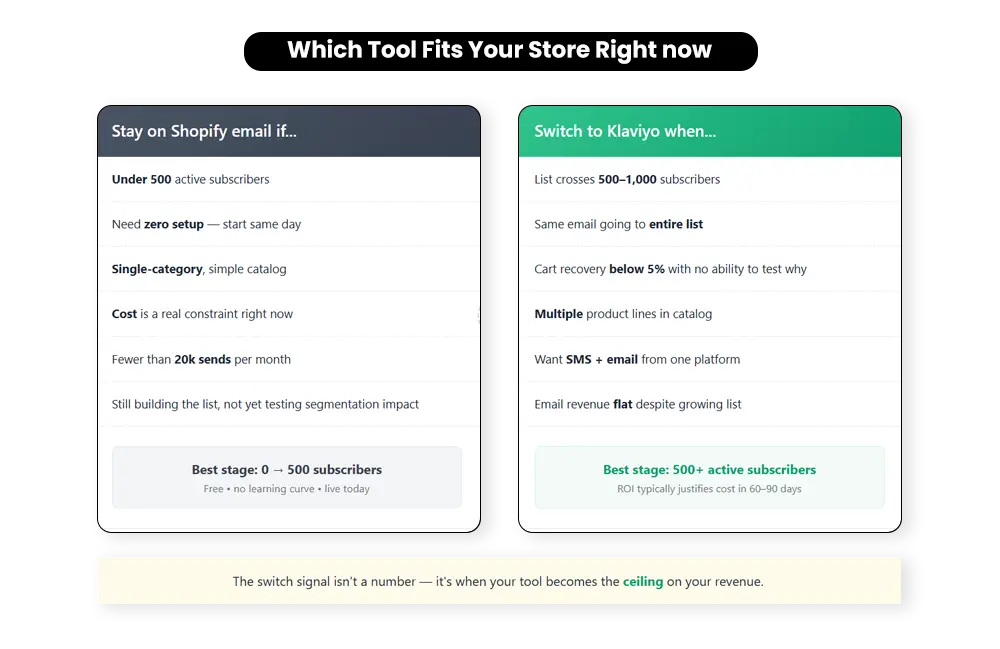
Shopify Email is the right choice for merchants at a specific stage — not a placeholder, the correct and deliberate choice. You should be on Shopify Email if:
- You’re a new store with under 500 active subscribers that needs to start sending without any setup investment
- You need zero friction and want functional email marketing running the same day, with no learning curve
- Your store has a simple, single-category product catalog that doesn’t require deep personalization to drive conversions
- You’re operating with tight margins where additional software costs matter, and the free plan genuinely covers what you need
- You’re focused on building your list first and haven’t yet tested what more sophisticated segmentation would do for your revenue
Mastroke perspective: If you’re at this stage, Shopify Email is the right starting point. Get your basics running cleanly before adding complexity. Most merchants who switch to Klaviyo too early end up paying for features they don’t yet know how to use.
Who Should Switch to Klaviyo?
This is the section that most merchants searching for Klaviyo vs Shopify Email are actually looking for. Here are the specific situations where Klaviyo starts making clear sense. You should move to Klaviyo if:
- Your list has crossed 500–1,000 active subscribers, and you’re running regular campaigns — not just occasional sends.
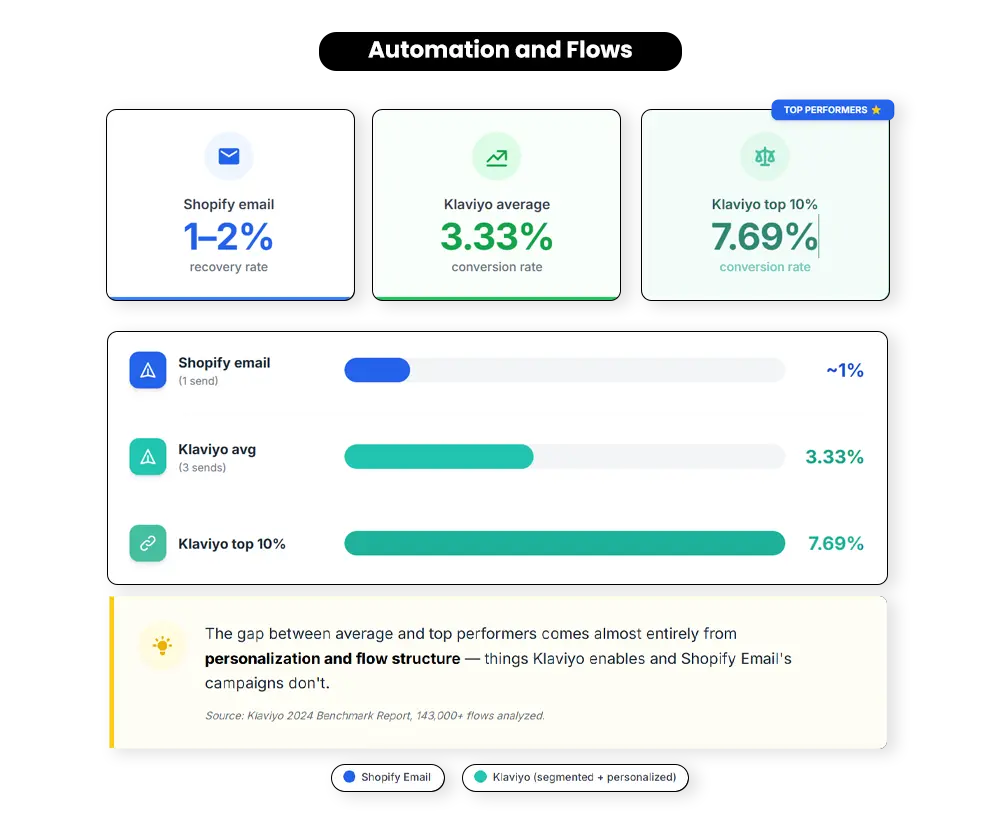
- You’re sending the same abandoned cart email to every subscriber regardless of what they browsed, what they’ve bought before, or how many times they’ve purchased. Klaviyo’s 2024 benchmark report, based on analysis of over 143,000 flows, shows average abandoned cart flows achieve a 50.5% open rate and a 3.33% conversion rate — with top-performing brands hitting 7.69%. That gap between average and top performers comes almost entirely from personalization and flow structure, things Klaviyo enables and Shopify Email campaigns don’t.
- You want to A/B test subject lines, offers, and send times and get statistically meaningful results — without workarounds, without third-party apps, built into the platform you’re already using.
- You’re selling products with natural repurchase cycles — supplements, skincare, pet food, coffee — and want automated replenishment reminders that fire at the right individual moment based on purchase history, not a fixed schedule applied to everyone.
- You want SMS without managing a separate platform and fragmented customer data across two tools.
- Your average order value or LTV is high enough that personalized campaigns at scale create a measurable revenue difference. Campaign Monitor data shows personalized emails deliver six times higher transaction rates than generic ones — at scale, that compounds fast.
- You have — or are willing to invest in — the time and setup to configure Klaviyo properly. A half-configured Klaviyo account underperforms a well-configured Shopify Email account. The platform rewards setup investment.
Klaviyo is particularly powerful for stores with multiple product categories, because the platform serves product recommendations based on purchase history and browsing behavior across an entire catalog — something Shopify Email’s campaign functionality can’t do.
Related read: How to Run a Shopify CRO Audit: The 7-Point Framework We Use with Every Client — if you’re evaluating whether Klaviyo would move the needle for your store, a CRO audit gives you the clearest picture of where your conversion funnel is leaking before you invest in more sophisticated email tools.
The Real Signals That Tell You It’s Time to Switch
These aren’t theoretical criteria. They’re situations. If your store is living any of these right now, you’re likely losing revenue because of the tool — not despite it.
You’ve sent the same campaign to your entire list three or more times with no segmentation.
Every subscriber gets the same email regardless of what they’ve bought, how engaged they are, or how long they’ve been on your list. Klaviyo’s benchmark data consistently shows that stores using targeted segmentation generate more email revenue than those broadcasting meaningfully to everyone — and right now, every unsegmented send is leaving a measurable portion of that on the table.
Your abandoned cart recovery rate is below 5%, and you haven’t been able to run a meaningful test to find out why.
Your current platform doesn’t support it without significant workarounds. That’s the gap between a basic abandoned cart setup and a properly structured one.
You’ve started selling multiple product lines, and customers are regularly receiving emails about products that have nothing to do with their purchase history or browsing behavior. That’s not just an annoyance — it drives unsubscribes and kills the list you’ve spent time building.
You’re paying for an SMS app separately and want your email and SMS coordinated from one place — shared segmentation logic, unified reporting, and one platform to manage.
Your email revenue has plateaued despite a growing list.
This is one of the clearest signals that the tool — not the strategy — is the ceiling. If you’re wondering why some Shopify stores grow email revenue consistently while others stay stuck despite a growing list, this quick breakdown explains the difference clearly:
📌 Key Video
>
>
You have repeat buyers, and you’re treating them the same as first-time visitors. They get the same welcome email, the same broadcast campaigns, the same discount offers. A customer who has bought four times deserves a different experience than someone who just subscribed yesterday.
Can You Use Both? And What Does Migration Actually Look Like?
Yes, you can run both simultaneously. Some merchants keep Shopify Email active for transactional and basic campaigns while testing Klaviyo flows in parallel. For stores that want to validate Klaviyo’s performance before fully committing, this can be a sensible transition approach.
In the long term, running both creates data fragmentation. Customer engagement data splits across two platforms, segmentation logic becomes inconsistent, and you end up maintaining two separate systems with no single source of truth. Pick one as your primary platform and migrate fully.
What migration from Shopify Email to Klaviyo actually looks like?
Klaviyo’s native Shopify integration handles the heavy lifting. When you connect the two, it syncs all your historical order data, customer profiles, tags, and behavioral data automatically. Most of your customer data transfers without any manual work.
What you do need to rebuild: your email templates (Klaviyo has pre-built templates for all main flows), your automation flows (60+ pre-built options to start from), and your segments (which Klaviyo recreates with significantly better logic than most stores had before).
None of this is starting from zero — it’s starting from a better foundation.
One thing worth being clear about: a poorly executed migration can break existing flows and create a gap in email revenue during the transition. Getting the setup right matters. Timeline for a complete, properly done migration is typically one to two weeks — not months, not a major disruption, but a focused setup period that requires real attention.
If migrating feels like a project you’d rather not manage yourself — or you’re worried about breaking your existing flows in the process — Mastroke’s email marketing team handles this as part of our Shopify growth engagements.
Related read: Shopify Plus Integrations: The Stack That Works — and What to Avoid (2026 Guide) — for merchants on Shopify Plus, this covers which integrations, including email platforms, work well at scale and which ones create problems.
The Decision Is Simpler Than the Debate Makes It Sound
Shopify Email is a genuinely solid tool for the right stage. It’s not a placeholder for “real” email marketing — it’s the correct choice when a store is early, the catalog is simple, or the budget makes additional software costs hard to justify.
Klaviyo’s Shopify integration runs deep at this stage, and the combination of platform capability and store data is what makes it the go-to choice for growing stores.
If you need a team that understands both sides of this — the email platform decision and the Shopify store it sits on — we work specifically with merchants to get both right. Book a call with Mastroke, and we’ll give you an honest read on where you are and what would actually make a difference at your current stage.
Ready to Build a Shopify Growth System That Retains Customers?
FAQs — Questions Merchants Ask Most Often About Klaviyo vs Shopify Email
Q: Is Klaviyo better than Shopify Email for abandoned cart recovery?
A: Yes, meaningfully so. According to Klaviyo’s 2024 benchmark report — based on analysis of over 143,000 abandoned cart flows — the average Klaviyo abandoned cart flow achieves a 50.5% open rate and a 3.33% conversion rate. Top-performing brands reach 7.69% conversion rates. Shopify Email sends the same recovery sequence to everyone. For stores where context matters — multiple product lines, varying price points, repeat purchasers mixed with first-time visitors — Klaviyo’s personalized approach consistently recovers a higher percentage of abandoned carts.
Q: Does Klaviyo integrate with Shopify automatically?
A: Yes. Klaviyo’s Shopify integration syncs your full customer data — order history, browsing behavior, customer tags, LTV — automatically once connected. After setup, Klaviyo has access to the same store data as your Shopify admin, updated continuously. Connection takes minutes; the sync runs automatically after that.
Q: What is the free plan limit for Shopify Email vs Klaviyo?
A: Shopify Email includes 10,000 sends per month at no extra cost with every Shopify plan. Klaviyo’s free plan is limited to 250 contacts and 500 sends per month — and transactional emails count toward that limit. For any active store sending regular campaigns, Klaviyo’s free tier runs out quickly. Shopify Email’s free threshold is significantly more generous for early-stage stores.
Q: Can I use Shopify Email for SMS marketing?
A: No. Shopify Email does not include native SMS. You’d need a separate app from the Shopify App Store — there are over 400 options available, most with additional monthly costs. If you want email and SMS coordinated from one platform with shared segmentation, automation flows, and reporting, Klaviyo is the more practical choice.
Q: How long does it take to migrate from Shopify Email to Klaviyo?
A: Typically, one to two weeks for a complete migration done properly. Klaviyo’s Shopify integration handles the data sync automatically. The time investment goes into rebuilding email templates, configuring automation flows, and setting up segments with Klaviyo’s more advanced logic. Getting it right upfront avoids revenue gaps from misconfigured flows during the transition.
Q: Is Klaviyo worth it for a small Shopify store?
A: It depends on list size and revenue stage. For stores with under 500 active subscribers, Shopify Email is almost always the more sensible choice — the cost savings are real, and the missing features don’t yet create meaningful revenue loss. For stores with 500 to 2,000 active subscribers running regular campaigns, the revenue improvement from Klaviyo’s segmentation and automation typically justifies the cost difference within the first 60 to 90 days of a proper setup.