
This blog post explains what a Shopify growth retainer actually includes and how to evaluate whether an agency's offering matches your store's needs. It clarifies the difference between support retainers (maintenance-focused) and growth retainers (performance improvement-focused).
You’ve probably seen agencies pitch a “Shopify growth retainer.” Getting a clear answer on what’s actually inside one is another story.
That’s not an accident. A Shopify growth retainer is a monthly engagement where an agency works on your store continuously — SEO, paid ads, development, CRO — with the goal of growing revenue over time. But agencies package it differently, price it differently, and define “growth” very differently.
Before you sign anything, you need to know what a legitimate retainer covers, what it doesn’t, and whether the one you’re being sold matches what your store needs. That’s exactly what this post breaks down.
What Is a Shopify Growth Retainer, Really?
A Shopify growth retainer is an ongoing working relationship with measurable deliverables on both sides. Not a one-time project. Not a break-fix arrangement. The one distinction that matters most:
Shopify Support Retainer |
Shopify Growth Retainer |
|
|---|---|---|
| Focus | Store maintenance, fixes, and technical support | Store growth and performance improvement |
| Work Style | Primarily reactive, with some preventative maintenance | Primarily proactive and strategy-driven |
| Goal | Keep the store stable, secure, and functioning properly | Increase traffic, conversions, and revenue |
| Typical Activities | Bug fixes, theme updates, app troubleshooting, technical support | SEO, CRO, paid ads, analytics, content, growth strategy |
Agencies don’t always make this distinction clear, but it changes what you should expect. A support retainer keeps the store running. A growth retainer exists to improve business outcomes — and should be held to that standard.
Who is it for? Stores that already sell consistently and want month-over-month growth — not occasional technical help when something breaks.
What a Shopify Growth Retainer Actually Includes
Every agency packages this differently, and the exact scope depends on your store’s size, goals, and budget. A solid retainer, though, should cover five core areas. Here’s what each one means in practice.
1. Shopify Store Development and Maintenance
Your store is never really “done.” New campaigns need landing pages. Apps get added and updated. Shopify ships platform changes that can break custom code, so each release needs testing against your store.
Without ongoing maintenance, small issues stack up quietly. By the time you notice, they’ve already hurt the customer experience — and possibly your rankings.
Monthly development work typically looks like this:
- Building new landing pages and sections for campaigns.
- Catching and fixing app conflicts before customers run into them.
- Testing the store after Shopify platform updates.
- Removing slow or unused apps that add load time without adding value.
- Keeping page speed consistent over time — not just on launch day.
Page speed connects directly to revenue. Shopify’s analysis of stores across its platform found that for every 100 milliseconds slower a store loads, conversion drops by about 3.5%. Speed is not a technical checkbox. It decides how many people stay long enough to buy.
2. SEO and Organic Growth
Paid traffic stops the moment you stop spending. SEO builds traffic you own.
The catch is that rankings shift, pages drop, and new competitors appear every month. A retainer means someone is watching this continuously — adjusting when things move, not waiting until the monthly report to notice.
The work inside this channel typically covers:
- Fixing crawl errors before they affect indexation.
- Updating collection pages and meta descriptions when rankings slip.
- Briefing, writing, and publishing blog content on a consistent schedule.
- Monitoring Core Web Vitals — performance signals Google uses in ranking.
- Catching ranking drops early enough to act on them.
Not sure where your store currently stands? A Shopify store audit gives you a baseline before any retainer work begins, so the strategy builds on real data instead of assumptions.
3. Paid Media Management (Meta and Google Ads)
Ad performance doesn’t stay stable on its own. Audiences get saturated, creative goes stale, and costs creep up — often without anyone noticing until ROAS has already dropped.
A paid media retainer covers the ongoing decisions that keep campaigns profitable:
- Campaign structure, testing, and continuous adjustment across Meta and/or Google Ads.
- Audience building, retargeting setup, and full-funnel mapping.
- Ad copy direction and monthly creative briefs.
- Budget pacing — scaling when it’s working, pulling back when it isn’t.
What you should expect every month: actual numbers — ROAS, CPM, CAC — with context behind them. Not a report full of arrows pointing up with no explanation of why.
One thing worth pressure-testing: what counts as a “good” ROAS varies by product category, average order value, margins, and customer lifetime value. A 3x ROAS might be profitable for one store and unprofitable for another. Ask your agency how they calculate profitability and evaluate performance for your store specifically — not against generic benchmarks.
4. Conversion Rate Optimization (CRO)
More traffic is one lever. Getting more out of the traffic you already have is often the faster path to revenue.
Here’s the uncomfortable part: plenty of stores never measure their conversion rate at all. If you don’t measure it, you can’t see where you’re losing sales — and the leaks stay invisible while the ad spend keeps flowing. A CRO retainer focuses on finding and fixing exactly those leaks:
- Running heatmaps and session recordings to see what users actually do on the page.
- Testing changes on the homepage, product pages, and cart.
- Reviewing the path from product page to checkout to find friction and drop-off points.
- Prioritizing UX fixes by revenue impact — ranked by what moves the needle, not by what’s easiest to test.
Every recommendation should come with reasoning. Every test should have a measurable outcome you can track. If you want to see what a structured diagnosis looks like, this breakdown of how to run a Shopify CRO audit shows the framework in detail.
One expectation worth setting early: CRO isn’t a one-month fix. Patterns take time to surface, and tests take time to run properly. The value compounds — small, data-backed improvements every month that add up meaningfully over a quarter or two.
5. Reporting and Strategy
You should never have to guess where your retainer hours went or what the agency actually did.
This is the part most merchants don’t think to ask about until they’re three months in with no clear picture of what moved, what didn’t, or what’s coming next. A legitimate retainer makes this visible every month:
- A performance report covering what was done, what changed, and what’s planned.
- Channel-level metrics broken down separately — organic, paid, on-site — not bundled into one vague number.
- A monthly strategy call or async review to adjust priorities based on real data.
- A forward-looking plan, so you’re never surprised by what the agency works on next.
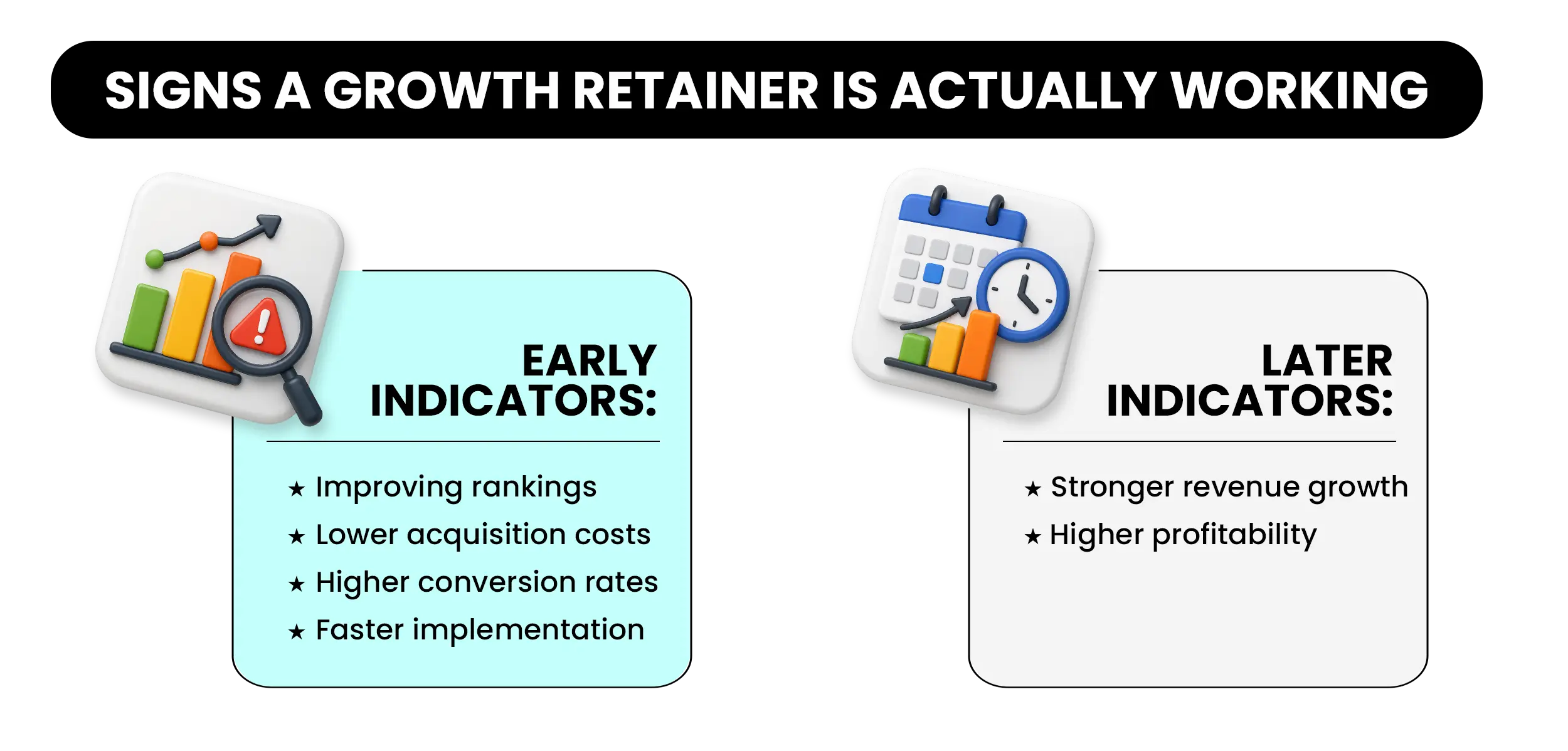
What to watch for: reports full of activity but no outcomes. Graphs that go up with no explanation. Recommendations that look identical month after month, regardless of what the data shows.
If you can’t tell what your retainer produced this month, the problem runs deeper than a bad report.
Losing customers somewhere between landing and checkout?
How Much Does a Shopify Growth Retainer Cost?
No agency will give you a fixed price without understanding your store first — but here’s what the market generally looks like:
Tier |
Monthly Cost |
What’s Typically Covered |
|---|---|---|
|
Entry Level |
$1,500 – $3,000 |
Basic dev work, one channel (either SEO or paid ads), monthly reporting |
|
Mid-Tier |
$3,000 – $10,000 |
Active SEO, paid media on Meta or Google, dev support, strategy calls, monthly reporting |
|
Full-Service |
$6,000 – $15,000+ |
All channels running together — SEO, paid ads, CRO, dev, content, dedicated point of contact, full strategic direction |
A note on these numbers: Retainer pricing varies a lot depending on your location, store size, and whether ad management fees are billed separately from your actual ad spend. The ranges above reflect general market patterns — not a universal standard.
What typically pushes cost higher:
- More channels covered at the same time.
- Higher ad spend requiring active management.
- Complex store builds or custom integrations.
- A dedicated strategist rather than an account manager.
Before signing, ask the agency to break down cost by channel or service area — not just a total number. If they won’t itemize, that’s worth a conversation. For a broader view of what to look for before hiring, this Shopify marketing agency checklist covers the right questions to ask.
What’s Usually NOT Included
Most scope disputes happen because this conversation never took place upfront. A retainer covers ongoing, repeatable work. These are almost always separate engagements:
- Full site redesigns or theme rebuilds — these carry their own scope and budget.
- Major custom app or integration builds — typically quoted as a separate project rather than absorbed into the monthly retainer.
- Platform migrations — moving to Shopify Plus or migrating from another CMS is a project, not a retainer task.
- Ad creative production at scale — photography, video shoots, and motion graphics are usually quoted separately.
- Third-party costs — Shopify plan fees, app subscriptions, and ad spend are always the merchant’s direct costs and should never be bundled into a retainer fee.
- Full technical, SEO, or CRO audits — usually conducted before a retainer begins or scoped as a standalone project.
One question worth asking any agency before you sign: “What would trigger a separate project quote?” A legitimate retainer draws a clear line between what’s in scope and what isn’t. If the answer is vague, get the boundaries documented before money changes hands.
Is a Shopify Growth Retainer Right for You Right Now?
A retainer works best at a specific stage — not too early, not too late.
Signs you’re likely ready:
- Roughly $20K–$30K/month in revenue (or the equivalent in your market) — enough real data to work with.
- Running paid ads but not fully confident anyone is actively managing them.
- Organic traffic has stayed flat despite having products people search for.
- Handling SEO, dev, and ads yourself — and at least one of them keeps slipping.
- A clear sense of what needs improving, but no in-house team to act on it.
Signs it might be too early:
- Revenue is still inconsistent month to month.
- You need one specific thing done — that’s usually better as a project.
- You’re not yet in a position to act on strategy recommendations consistently.
If most of the first list applies, the next step is an audit — it tells you what a retainer should actually focus on. If it’s mostly the second list, scope a one-off project first and revisit the retainer conversation once revenue steadies.
What a Shopify Growth Retainer Should Feel Like
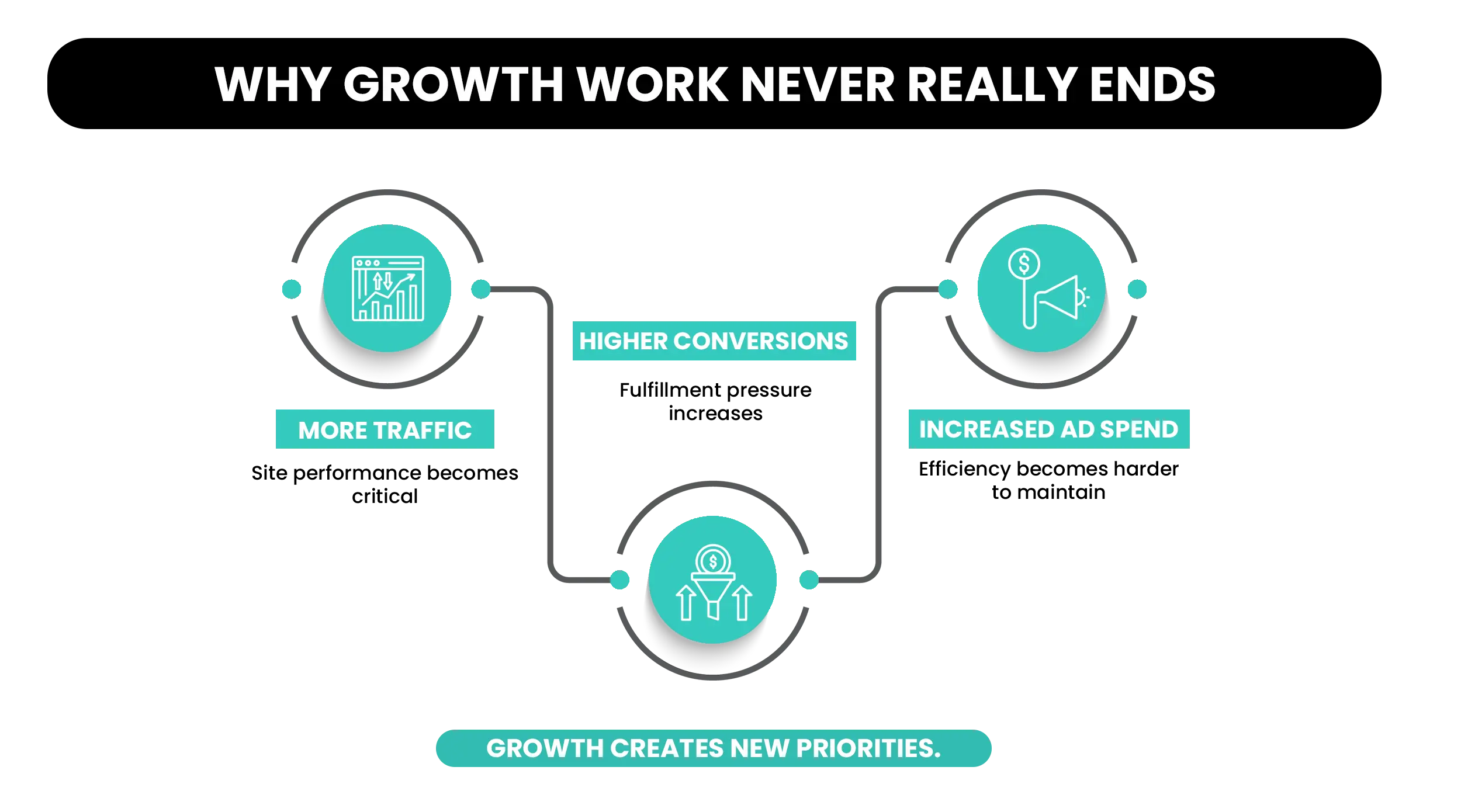
A good Shopify growth retainer should never feel like a mystery. You should know what’s being worked on, why it matters, and what it’s moving — at every stage.
The right agency brings a plan, not just a task list. They tell you when something isn’t working. They adjust when priorities shift. And they’re honest about what a retainer can and can’t do for your store at this stage. That’s the baseline worth holding any agency to.
Not sure where your store is leaking revenue?
Questions Merchants Ask Before Signing a Shopify Growth Retainer
These are the questions that come up most often — answered straight, without the agency spin.
Q: Is a Shopify growth retainer worth it for a small store?
A: It depends on where the store is. If revenue is inconsistent and the basics aren’t in place yet, a retainer is premature. But if the store generates steady sales and growth has plateaued, a growth retainer starts making sense — the return compounds over time, not overnight.
Q: How long before a Shopify growth retainer shows results?
A: Paid media can show movement within the first month. SEO typically takes three to six months to reflect in traffic. CRO results depend on test cycles — usually visible within a quarter. Expect a mix of quick wins early and compounding improvements over time.
Q: What’s the difference between a growth retainer and hiring a freelancer?
A: A freelancer usually covers one skill — a developer, an SEO specialist, or an ad buyer. A growth retainer gives you a team across all of those channels, coordinated under one strategy. For stores that need multiple channels working together, the retainer model removes the burden of managing several separate contractors.
Q: Do I still pay for ad spend on top of the retainer fee?
A: Yes, almost always. The retainer covers the agency’s management work — strategy, setup, testing, and reporting. Ad spend goes directly to Meta or Google from your account. Confirm this split in writing before signing, and be wary of any agency that blends the two into one number.
Q: Can I pause or cancel a retainer mid-engagement?
A: Most agencies allow cancellation with 30 days’ notice. Pause policies vary — some allow it, some don’t. Always confirm both in writing before signing. A legitimate agency won’t hide exit terms in the fine print.
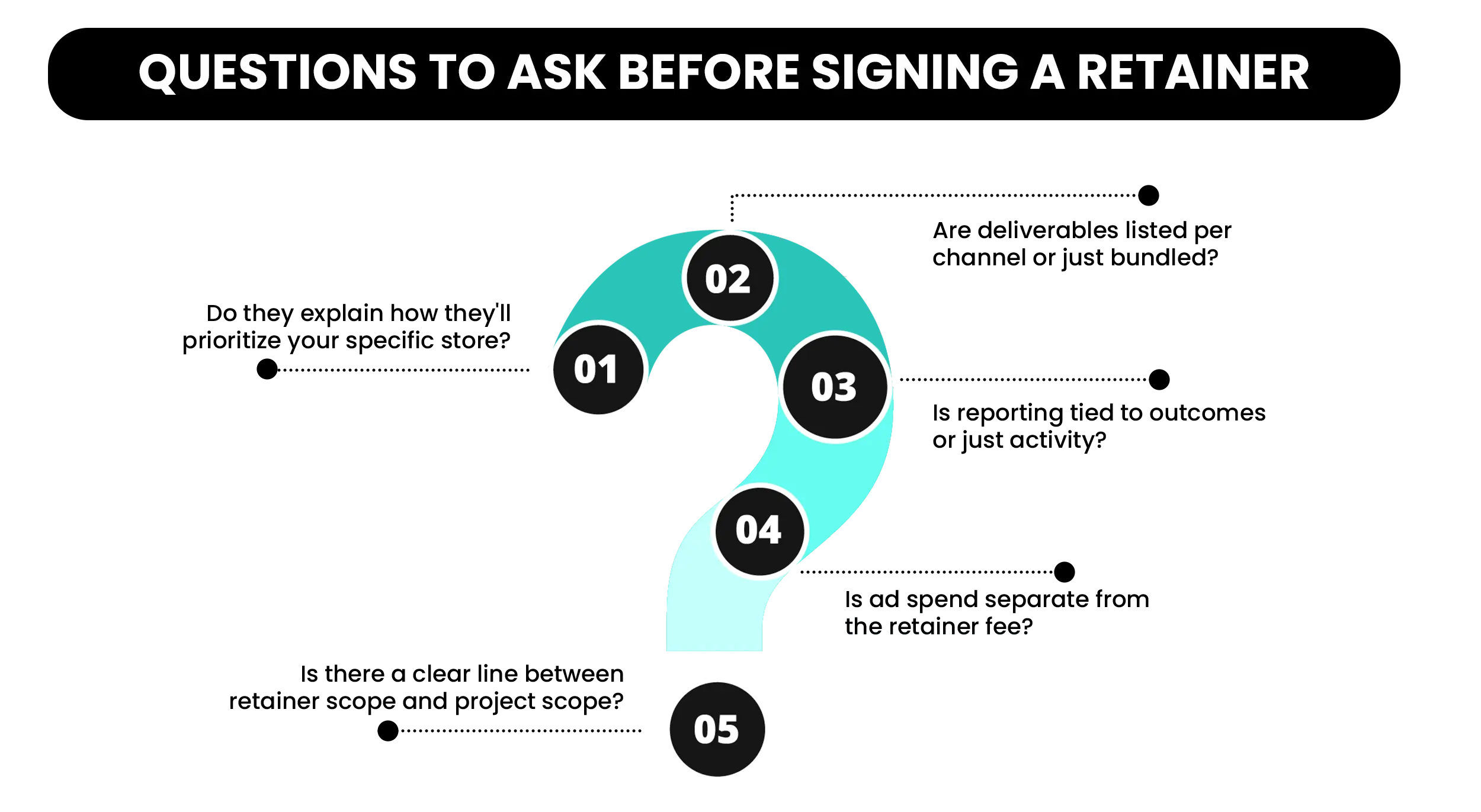
Q: What should I ask an agency before signing a Shopify retainer?
A: Ask what channels are covered, how deliverables are tracked, what’s explicitly out of scope, and who your day-to-day contact is. Also ask what triggers a separate project quote. Vague answers to any of these are worth paying attention to before committing.
Before You Sign Anything, Know What You’re Working With
Before committing to a monthly engagement, it helps to know exactly where your store stands — what’s working, what’s leaking revenue, and where the biggest growth gaps are.
A Shopify performance audit gives you that clarity before any retainer conversation begins — so you’re evaluating options from a position of real data, not guesswork.