This post explains Generative Engine Optimization (GEO) for Shopify stores, which is the practice of optimizing content so AI platforms like ChatGPT recommend your products instead of competitors. The author argues that traditional SEO rankings don't guarantee visibility in AI-generated shopping recommendations, creating a new competitive challenge for e-commerce businesses.
Your competitor just got recommended by ChatGPT. You didn’t.
That’s not a ranking problem — it’s a visibility problem. GEO for Shopify stores is what fixes it. AI platforms like ChatGPT, Gemini, and Perplexity don’t show a list of links anymore — they give shoppers direct product recommendations. And the stores showing up in those answers are picking up customers before a shopper clicks a single link.
By the end of this guide, you’ll know exactly what Generative Engine Optimization is, why it’s already costing you sales, and what to change first.
How AI Search Is Changing Ecommerce Discovery
The numbers are hard to ignore. During Shopify’s Q1 2026 earnings call, president Harley Finkelstein confirmed that AI-driven traffic to Shopify stores grew 8x, while orders from AI-powered searches increased nearly 13x — with new buyer orders arriving at nearly twice the rate of other channels. These are still early numbers on a small base. But the direction is clear, and it’s accelerating every quarter.
Shoppers aren’t just typing keywords into Google anymore. They’re asking full questions:
- “What’s the best standing desk for small apartments under $500?”
- “Which skincare brand is good for sensitive skin?”
- “Best minimalist furniture stores online”
Instead of a list of links, they’re getting direct AI product recommendations — comparisons, buying advice, specific store names — all before visiting a single website. These aren’t browsing queries. They’re decision queries. Shoppers asking AI these questions are close to buying, not just looking around.
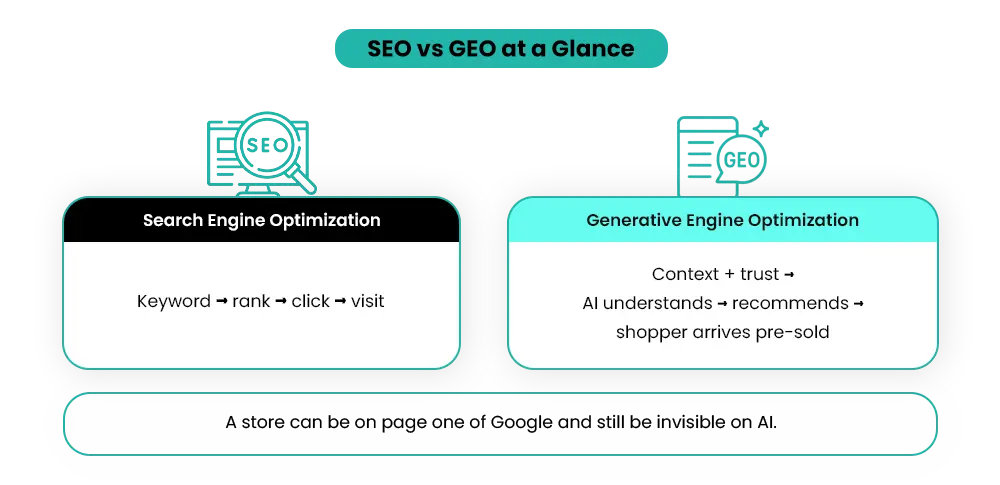
This creates two problems most merchants haven’t dealt with yet. First, customers form opinions about brands before landing on your store. If you’re absent from those AI answers, you’re cut out of the buying decision at step one. Second, ranking on Google doesn’t guarantee AI search visibility. A store can rank on the Google search result page one and still be completely invisible to ChatGPT. That gap is exactly what Shopify GEO is built to close.
To understand how Shopify itself is responding to this shift, read our guide on Agentic Commerce on Shopify and how AI selling works.
Why GEO Matters for Your Shopify Store Right Now
Think about what actually happens when a shopper asks ChatGPT for the best skincare brand for sensitive skin. They get 3–5 specific brand names, a quick summary of what makes each worth considering, and sometimes a direct link to buy. If your store isn’t in that answer, the sale goes elsewhere — and you never knew the shopper existed.
That’s the real cost of ignoring GEO for Shopify stores: invisible losses. No impression, no click, no conversion. Unlike a Google ranking drop you’d catch in Search Console, there’s no alert telling you ChatGPT started recommending your competitor over you.
The upside is just as real. When your store shows up in AI answers, you’re reaching shoppers at the exact moment they’re deciding — not browsing, deciding. Traffic quality is higher, intent is sharper, and you’re in front of buyers your ad budget never reached. Being recommended by AI also carries a trust signal that paid ads can’t replicate. Shoppers assume that if an AI is pointing them somewhere, the store must be worth it.
The window is still open — but not for long. Most Shopify merchants haven’t touched GEO yet. The ones building this foundation now will hold an AI visibility advantage that only gets harder to close as competition picks up. And unlike paid ads, GEO doesn’t stop when the budget runs out. Every improvement compounds.
What Is GEO (Generative Engine Optimization)?
Generative Engine Optimization (GEO) is the process of making your store’s content, product data, and brand signals clear enough that AI-driven search systems can understand, reference, and recommend you.
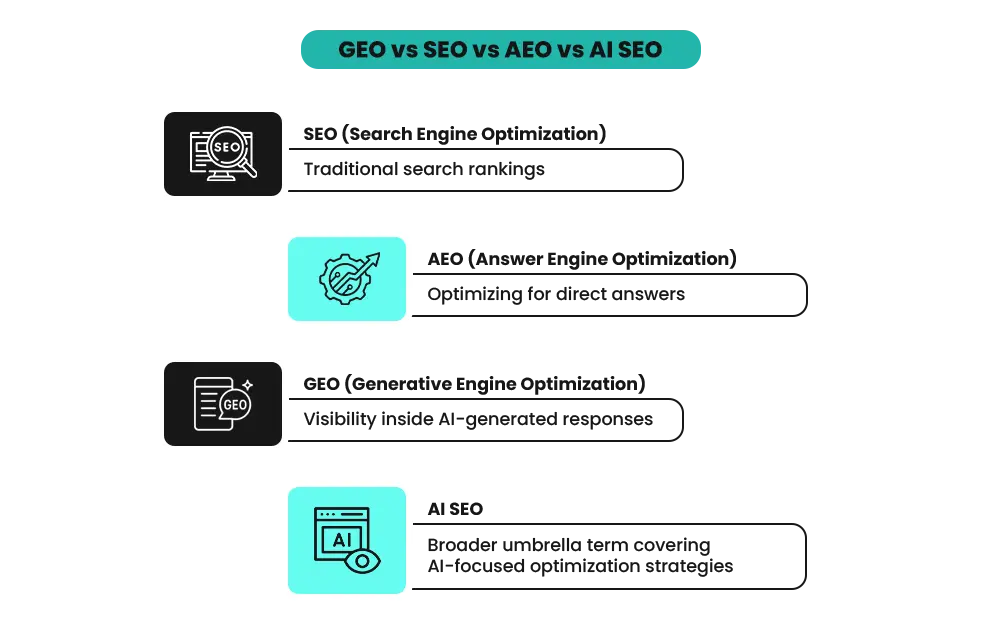
Unlike traditional SEO, GEO is less about ranking pages and more about helping AI systems confidently surface your store in generated answers, shopping recommendations, and product comparisons. Think of it this way. SEO helps Google find your store. GEO helps AI recommend it.
When someone asks ChatGPT, “Which protein shaker is easiest to clean?” — AI doesn’t randomly pick a brand. It recommends stores that it understands and trusts. If your store doesn’t give AI enough to work with — clear product descriptions, useful content, strong credibility signals — it picks your competitor instead.
Generative Engine Optimization for Shopify is what changes that outcome.
The good news: GEO doesn’t replace SEO. It builds on top of it. Most GEO improvements — better content, structured data, stronger trust signals — also strengthen your existing SEO at the same time.
What GEO Actually Focuses On
- AI Discoverability — making sure AI tools can find and access your content. Without this, AI platforms skip your store regardless of how good your products are.
- Contextual Understanding — making it easy for AI to grasp what your products actually mean. Vague descriptions mean your products never get matched to what shoppers are searching for.
- Entity Recognition — helping AI identify your brand and business as a real, recognizable entity across the web. Without this, AI treats your store as an unknown and routes shoppers elsewhere.
- Structured Information — using schema markup, organized product data, and clear formatting so AI can read your pricing, reviews, and specs. Without it, that data may as well not exist.
- Trust and Authority Signals — strengthening reviews, brand mentions, expert content, and consistency so AI views your store as credible enough to recommend.
How AI Search Engines Actually Read Shopify Stores
AI platforms don’t browse your store the way a customer does. They analyze specific signals to decide whether your store is relevant and trustworthy enough to recommend. Here’s what they’re actually looking at:
- Store Content — if your product page says “high quality gym bag” without explaining who it’s for or what makes it different, AI has nothing specific to recommend you for.
- Product Data Quality — missing specs, vague variants, or inconsistent pricing tells AI your store isn’t reliable enough to reference.
- Structured Data — without schema markup, AI can’t read your pricing, reviews, or product details — even if all that information is sitting right there on the page.
- Brand and Entity Signals — if your brand appears differently across your store, social profiles, and marketplace listings, AI loses confidence in recommending you.
- User Intent Relevance — AI prioritizes stores that directly answer what shoppers are asking, not stores that just repeat keywords.
One thing that surprises most merchants: Shopify does generate some basic structured data automatically through your theme — including details like product name, price, and availability. Shopify’s SEO documentation explains how Shopify handles foundational SEO elements. But that automatic coverage is limited.
FAQ schema, review schema, and many advanced schema types usually need additional setup through apps or custom code, while the Organization and Breadcrumb schema depend heavily on your Shopify theme. Those are exactly the schema types AI needs to understand your store more fully. A schema app doesn’t replace what Shopify generates; it fills the gaps Shopify leaves open.
⚠️ Warning: If a competitor has more complete schema markup than you, AI systems may understand and reference their store more confidently. Product, Review, FAQ, and Organization schema are some of the most important schema types for GEO for Shopify stores.
Note – Inconsistent brand signals hurt your AI search visibility. Your brand name, descriptions, and business information need to match everywhere — store, social profiles, online listings. Inconsistency makes AI less confident in recommending your store.
📌Key Video
How to Optimize Your Shopify Store for GEO
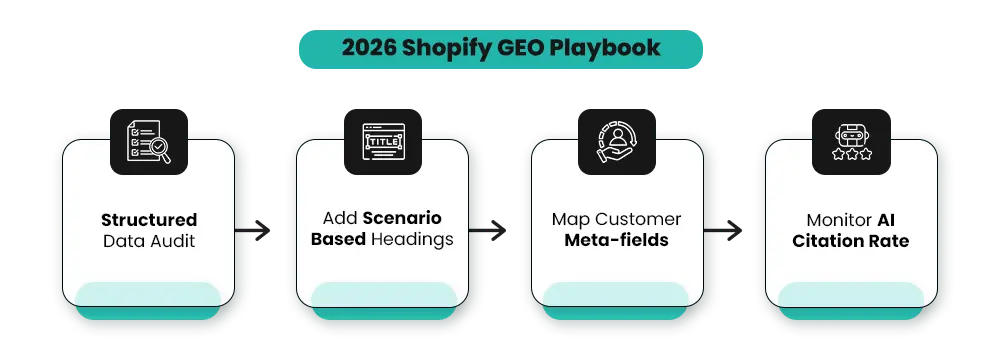
Getting your store ready for GEO isn’t about rewriting everything at once. It’s about making your store clearer, more trustworthy, and easier for AI to understand. These five steps build on each other. Work through them in order.
1. Build Product Pages AI Can Actually Understand
Start with one question: if a shopper asked ChatGPT “What’s the best gym bag for someone who goes straight from work to the gym?” — does your product page answer that? If yours just says “High-quality gym bag with multiple pockets,” AI has nothing useful to work with. Neither does the shopper.
Your product title is the first thing AI reads. Start there.
Product titles — be descriptive:
- Before: “Premium Gym Bag”
- After: “Waterproof Gym Bag with Laptop Compartment — Ideal for Work to Gym Commutes”
Once the title is specific, your description needs to back it up. Don’t describe the product — explain it in a way that matches how shoppers actually think about buying it.
Product descriptions — answer what shoppers actually ask:
“Fits a 15″ laptop and a full gym kit without overpacking. Water-resistant exterior keeps everything dry on the commute. A separate ventilated compartment means your gym gear never touches your work things. Used by 1,200+ daily commuters — holds its shape after months of daily use.”
Every description should cover three things: who it is for, what problem it solves, and how it is used.
Variant labels — be specific:
- Before: “Blue / Large”
- After: “Navy Blue / 32L — fits 15″ laptop + gym gear”
FAQs on product pages — answer real pre-purchase questions:
“Q: Can this bag fit a 15″ laptop and gym clothes together? A: Yes — it has a dedicated padded laptop sleeve and a separate ventilated compartment for gym gear.”
The last 10 questions customers asked before buying — those are your FAQs. Use them.
📝 Note: If ten stores use the same supplier description, AI has no reason to pick yours. Unique, context-rich product descriptions aren’t optional for GEO for Shopify stores — they’re the foundation everything else builds on. Start with your top five products this week, then work through the rest.
Once your product pages clearly explain what you sell and who it’s for, the next step is making sure AI can actually read all that information — which is where structured data comes in.
2. Implement Structured Data (Schema Markup)
Your store could have great reviews, accurate pricing, and detailed product specs — but without structured data for ecommerce, AI can’t read any of it properly.
Shopify generates basic product schema automatically — name, price, availability. That’s the floor. To fully support GEO for Shopify, you need to go further. Two apps that handle schema markup for Shopify stores well are JSON-LD for SEO (by Little Stream Software) and Schema Plus for SEO (by Booster Apps). Both add schema types Shopify doesn’t generate on its own, and help improve how search engines and AI systems interpret your store.
Priority schema types to add:
- Product schema — name, price, availability, and attributes
- Review schema — star ratings and review count
- FAQ schema — makes your FAQs directly readable by AI
- Organization schema — establishes your business identity
- Breadcrumb schema — helps AI understand your store structure
Here’s why it matters in practice. Two stores sell the same ergonomic chair at the same price. Store A has product schema, review schema, and FAQ schema in place. Store B has none. When someone asks ChatGPT for the best ergonomic chair under $400 — Store A’s pricing, 4.8-star rating, and FAQ answers are all readable. Store B is invisible to AI, even though all that information exists on their page.
After setting up your schema, use Google’s Rich Results Test to confirm it’s reading correctly. Don’t install an app and assume it’s working — check it. Then check again after every major product or content update.
For a deeper look at how structured data for ecommerce fits into a broader AI search strategy, read our guide on ranking your Shopify products in ChatGPT and other AI platforms.
📝 Action step: Install a schema app first, run the Rich Results Test, and fix any errors before moving on.
3. Create Content That Answers Real Buyer Questions
Try this: go to ChatGPT and type a question your ideal customer would ask before buying. Does your store answer it better than your competitors? If not — that’s your content gap, and it’s fixable.
The problem with most Shopify blogs isn’t quality — it’s angle. “Best Gym Accessories” is a topic. “How to Choose the Right Gym Bag Size for Daily Use” is a buyer question. AI rewards the second type because it’s built around intent, not keywords.
Content formats that work best for GEO:
- Buying guides tied naturally to your products. A skincare brand writing “How to Build a Skincare Routine for Sensitive Skin” and linking to products in context — that’s content AI can use.
- Comparison posts (“Ceramic Cookware vs Stainless Steel — Which Lasts Longer?”) answer a decision question directly.
- Use-case content (“How to Set Up a Productive Home Office in a Small Apartment”) shows your products solving a real problem.
- FAQs on product pages, collection pages, and blogs all add up over time.
A handful of genuinely useful guides will always outperform generic AI-generated posts. GEO for Shopify works because AI learns to associate your store with specific topics over time — and that association builds from real, useful content, not volume.
📝 Action step: Identify your three biggest content gaps by searching buyer questions on ChatGPT, then write one guide that answers a question your competitors aren’t covering well.
4. Build Trust Signals AI Can Verify
Two stores selling identical products — AI recommends the one that looks more credible. Every time. This is the E-E-A-T principle (Experience, Expertise, Authoritativeness, and Trustworthiness) applied to AI recommendations, not just Google rankings.
Customer reviews are one of the clearest trust signals AI systems can actually evaluate. Get better reviews. Most post-purchase emails ask, “How would you rate this product?” That gets star ratings. It doesn’t get useful reviews. Try this instead:
“Hi [Name], could you share: How are you using it? What problem did it solve? Who would you recommend it to?”
The difference in review quality is significant. Instead of “Great product!” you get: “Thick enough for joint support, didn’t slip once during hot yoga — used it daily for 3 months and still looks new.” That tells AI exactly what your product does and who it’s for.
Write an About page that actually says something. AI reads your About page to understand who you are and whether you’re worth recommending.
“We’re certified nutritionists who built [Brand] after struggling to find supplements free from artificial fillers. Every product is third-party tested — designed for people who take their health seriously, from beginners to competitive athletes.”
Credentials and specifics signal expertise. A generic “We’re passionate about quality” tells AI nothing useful.
Make policies concrete:
- Before: “Returns accepted. Contact us for details.”
- After: “Return any unused item within 30 days for a full refund — no questions asked. Processed within 3–5 business days.”
Keep your contact details visible — on your homepage, footer, and contact page. A store with no visible support channel looks untrustworthy to both shoppers and AI.
📝 Action step: Update your post-purchase email with the review prompt above and rewrite your About page this week if it currently reads like a generic brand statement.
5. Build a Consistent Brand Presence Across the Web
Trust signals cover your on-site credibility. Brand entity optimization is about your off-site presence — how consistently and clearly your brand appears across the entire web. AI notices inconsistencies fast.
Here’s what a fragmented presence looks like:
- Shopify: “FitGear Pro — Fitness Equipment for Serious Athletes”
- Instagram: “fitgearpro_ | Gym stuff & more”
- Google Business: “Fit Gear — Sports Equipment Store”
- Amazon: “FGP Fitness”
AI sees four different identities and loses confidence. Here’s what consistency looks like:
- Shopify: “FitGear Pro — Fitness Equipment for Serious Athletes”
- Instagram: “FitGear Pro | Fitness Equipment for Serious Athletes”
- Google Business: “FitGear Pro — Fitness Equipment for Serious Athletes”
- Amazon: “FitGear Pro”
Same name, same description, same story everywhere. A clear identity helps AI recognize your brand. External mentions help AI trust it.
Build external mentions. A fitness brand mentioned by three fitness creators and a wellness publication is far more recognizable to AI than one that only exists on its own website. Start small — find creators in your niche with 5,000–50,000 engaged followers and reach out with a simple offer: your product in exchange for an honest review. Three to five mentions from relevant sources are enough to start building your brand’s footprint in AI systems.
Complete every social profile. Every platform should have your exact brand name, a consistent description of what you sell, and a link back to your store.
🔍 Quick audit: Search your brand name on Google right now. Check the first 10 results — are they consistent? Fix anything that doesn’t match. That’s your starting point, and it costs nothing.
Common GEO Mistakes Shopify Merchants Make
Most mistakes come down to applying old SEO logic to a system that works differently.
- Duplicate product descriptions. If ten stores list the same product with the same supplier copy, AI has no reason to pick yours. Every product page needs unique, context-rich content written around real buyer questions.
- Missing structured data. Without schema markup for Shopify, AI can’t read your pricing, reviews, or product details — even if everything is right there on the page. This single gap can make a well-optimized store invisible to AI.
- Mass-produced AI-generated content. Blogs with no real buying guidance hurt more than they help. Fifty generic posts won’t do what five specific, useful guides do. Quality is how GEO for Shopify actually works.
- Focusing only on Google rankings. A store can rank well on Google and have zero AI search visibility. Both need to run alongside each other — they serve different systems and reward different things.
- Treating GEO as a one-time project. AI systems evolve. Conversational search behavior shifts. Merchants who keep improving their content, product data, and trust signals will stay ahead — those who fix it once and move on won’t.
Not sure where your store stands in AI search?
How to Measure GEO Performance
Shopify GEO doesn’t have a single ranking position to track the way Google SEO does. But these signals — taken together — tell you whether your AI visibility is actually growing.
- Test AI platforms directly. Go to ChatGPT, Gemini, and Perplexity right now. Search for products you sell — “best ergonomic chair for home office” or “best skincare brand for sensitive skin.” Is your store showing up? If not, that’s your baseline. Test monthly and track what changes.
- Watch branded search volume. When AI recommends your store, shoppers often search your brand name directly before buying. Open Google Search Console and filter by branded queries. Steady growth here is one of the clearest GEO signals available.
- Track conversational search traffic. In Google Search Console, check which queries are bringing people to your site. Growing long-tail queries like “which gym bag fits a laptop and gym clothes” mean your content is being matched to real buyer questions — exactly what GEO for Shopify stores is designed to do.
- Monitor assisted conversions. In Google Analytics 4, attribution and conversion path reports can help you spot users who first discovered your store through one channel and later returned directly to purchase.
- Track Shopify AI traffic directly. Open Shopify Analytics, filter any report by “Referrer name,” and enter “ChatGPT.” Repeat for Perplexity and Gemini. Steady growth in referrals from these sources is the most direct signal you have that your AI search visibility is improving.
One important note: AI referral attribution isn’t always clean — traffic from platforms like ChatGPT can sometimes appear as direct traffic. Use GSC and GA4 together rather than relying on either alone.
📝 Action step: Set up your baselines. Run your brand name and three top product categories through ChatGPT, note the results, and check branded search volume in Google Search Console. You need a starting point before you can measure progress.
The Future of AI Search and What It Means for Your Store
The direction is set — and Shopify is already building for it. By the end of 2025, Shopify launched Agentic Storefronts, making every eligible merchant’s products discoverable inside ChatGPT, Microsoft Copilot, Google AI Mode, Gemini, and Perplexity — no app install required. Your products are already in the system. The question is whether AI can understand them well enough to surface them when a shopper asks the right question.
Agentic Storefronts give you distribution. GEO determines whether you actually show up in the answers.
A few things to expect as conversational commerce develops:
- AI shopping agent tools will move from answering questions to completing purchases on behalf of buyers — the transaction layer is already being built.
- Product data quality will carry more weight — richer, more structured data gets matched to buyer questions more accurately than thin, generic content.
- Brand authority will matter more — stores with stronger E-E-A-T signals and real external recognition will get recommended over stores that lack them, consistently.
To understand how Shopify’s Agentic Storefronts work and what control you have over your store’s participation, read our breakdown: Shopify Agentic Storefronts — Should You Opt Out? The merchants building these foundations now won’t need to scramble when everyone else catches up. That lead is worth something — but only if you start building it.
GEO Checklist for Shopify Stores
Instead of treating GEO like a one-time SEO task, audit your store across these six operational layers.
- Product titles include clear use cases and features.
- Descriptions explain who the product is for, what problem it solves, and how it is used.
- Specifications, FAQs, and variant labels add context AI systems can understand.
- Product, FAQ, Review, Organization, and Breadcrumb schema are implemented via a dedicated app.
- Schema verified with Google’s Rich Results Test, and reviewed after major updates.
- Content strategy built around buyer questions — not broad topics.
- Each blog answers a specific buyer intent query.
- Comparison content covers differences, use cases, and who each option suits.
- FAQs added to product pages, collection pages, and blogs.
- Post-purchase email asks: “How are you using it? What problem did it solve? Who would you recommend it to?”
- About page covers: who you are, your expertise, who your customers are, and what makes you different.
- E-E-A-T signals present: credentials, third-party testing, named founders, specific claims.
- Policies state exact timelines — return window, refund processing time, warranty period.
- Contact details visible on homepage, footer, and contact page.
- Brand name and description are identical across Shopify, social profiles, Google Business, and marketplaces.
- Every social profile has: brand name, consistent description, and store link.
- Google Business Profile is complete and up to date.
- Reached out to 3–5 niche creators or bloggers for honest product mentions.
- Shopify AI traffic checked via Analytics — filter by ChatGPT, Perplexity, Gemini
- Branded queries tracked in Google Search Console — baseline set
- Long-tail conversational queries monitored in Google Search Console
- Conversion paths reviewed in Google Analytics 4 under Advertising > Attribution
Wrapping It Up
AI-powered search is changing how customers find and buy products — and the stores that adapt early will hold an advantage that compounds over time. Most of your competitors haven’t touched GEO for Shopify stores yet. That gap is your opportunity, and it won’t stay open.
Pick one section from the checklist above — product descriptions, schema, your About page, brand consistency — and fix it first. Small, consistent improvements add up faster than most merchants expect. The merchants who win won’t be the ones who tried to do everything in a sprint. They’ll be the ones who built steadily while everyone else was still thinking about it.
Your competitor is already showing up in ChatGPT. The question is whether you will too.
GEO feels overwhelming? Let's simplify it.
Frequently Asked Questions Around GEO For Shopify Stores
These are the questions merchants ask most before getting started with GEO for Shopify — answered plainly, without the jargon.
Q: What is GEO, and how is it different from SEO?
Generative Engine Optimization (GEO) is the process of making your store’s content and data clear enough that AI platforms like ChatGPT, Gemini, and Perplexity can understand and recommend it. SEO focuses on ranking in Google results. GEO focuses on AI search visibility — showing up in AI-generated answers when shoppers ask buying questions. A store can rank well on Google while being completely invisible on AI platforms. Most GEO improvements also strengthen your existing SEO at the same time.
Q: My store is already on Shopify Agentic Storefronts — do I still need GEO?
Yes — and this is the most important distinction right now. Agentic Storefronts make your products available to AI platforms. GEO determines whether AI actually recommends them. Being in the system and showing up in answers are two entirely different things. Think of it like being indexed by Google — just being crawled doesn’t mean you rank. Your product data quality, schema, content, and trust signals decide whether AI surfaces you or your competitor.
Q: How long does it take to see results from GEO for Shopify stores?
There’s no fixed timeline. Schema markup improvements can be indexed within days. Content built around real buyer intent typically takes 4–8 weeks to gain traction in AI-powered search. Brand entity work — external mentions, profile consistency — builds over 2–3 months. Track your Shopify AI traffic monthly and watch branded search volume in Google Search Console as you go. Progress is measurable — you just need a baseline to measure from.
Q: Does GEO work for small or new Shopify stores?
Yes — and smaller stores have a real advantage here. Strong product descriptions, consistent brand presence, and a specific About page cost nothing but time. GEO doesn’t favour big ad budgets the way paid search does. It favours stores that give AI the clearest, most trustworthy information. A focused niche store with detailed, AI-readable product pages and genuine reviews can consistently outperform a larger competitor running generic content.
Q: Do I need a developer to add schema markup to my Shopify store?
Not necessarily. Apps like JSON-LD for SEO and Schema Plus for SEO handle schema markup for Shopify stores without writing code. If your store runs a heavily customised theme or you’re hitting conflicts between schema sources, a developer can help verify what’s actually being output. Always use Google’s Rich Results Test after installing any schema app to confirm your structured data is reading correctly — don’t assume the app handled it.
Q: Which AI platform should I prioritise first?
Start with ChatGPT — it has the largest user base and the most active ecommerce behaviour right now. Then check Perplexity, which is gaining traction with high-intent conversational queries. Gemini is worth testing for Google Shopping overlap. In practice, the same fixes — schema, content quality, brand consistency — improve your visibility across all three at the same time, so you don’t need to treat them as separate workstreams.
Q: How do I track AI referral traffic in Shopify Analytics?
Open Shopify Analytics and filter any report by “Referrer name” — enter “ChatGPT” to isolate AI traffic, then repeat for Perplexity and Gemini. Keep in mind that AI referral attribution isn’t always clean — some ChatGPT.com sessions appear under direct traffic — so use Google Search Console alongside Shopify Analytics to monitor long-tail conversational queries. Growth in both together is the clearest signal that your GEO for Shopify stores work is paying off.
Want to Know Where Your Store Stands?
AI platforms are already surfacing product recommendations to shoppers in your niche. The question is whether your store is showing up — or a competitor is getting that sale instead.
Before you can fix it, you need to know where you stand. Get your Shopify AI visibility audit — and receive a clear breakdown of your current AI search visibility, what’s missing, and the specific fixes that will have the biggest impact for your store.