There’s a predictable pattern most merchants go through when starting on Shopify. You research a niche, shortlist products, sign up on Shopify, pick a theme that looks right, install a few apps, and within 3–5 days your store is live.
But here’s the real question: Is your goal just to launch a Shopify store or build one that actually sells? The moment you ask that, the gap between a DIY store and one built by a Shopify development agency starts to show.
Shopify’s built-in ecosystem makes setup feel entirely within reach. Yet research shows only 5% to 10% of Shopify stores achieve long-term profitability. That literally translates to only 5–10 stores surviving in the long run out of 100.
At launch, everything looks fine — the branding seems consistent, hero banners look good, and product pages have all the basics.
The cracks appear when the store faces real traffic. Pages take longer to load, layouts don’t resize on different screens, and visitors browse, hesitate, and leave without buying. At that point, you start wondering: Didn’t I tick off everything on the “how to set up a Shopify store” playbook?
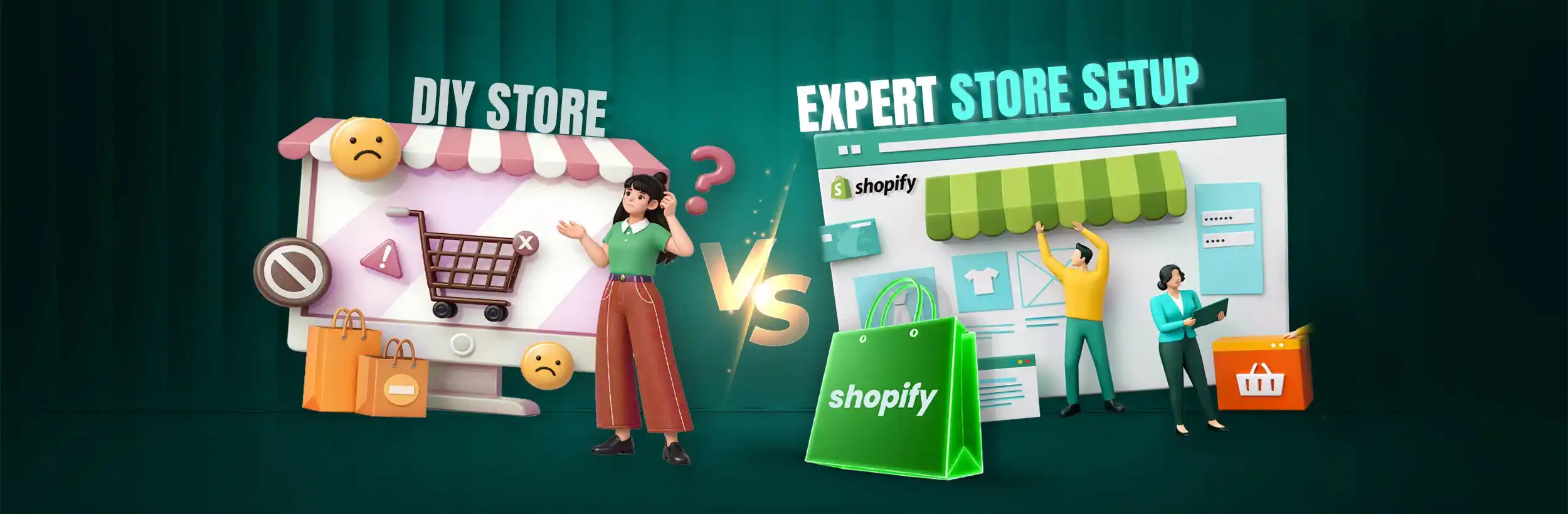
This is typically when merchants start comparing DIY Vs Shopify experts. The sections ahead unpack the DIY Vs Shopify Agency analysis closely to help you choose the path that best supports your business goals.
Why Setup Isn’t Just a One-Time Task?
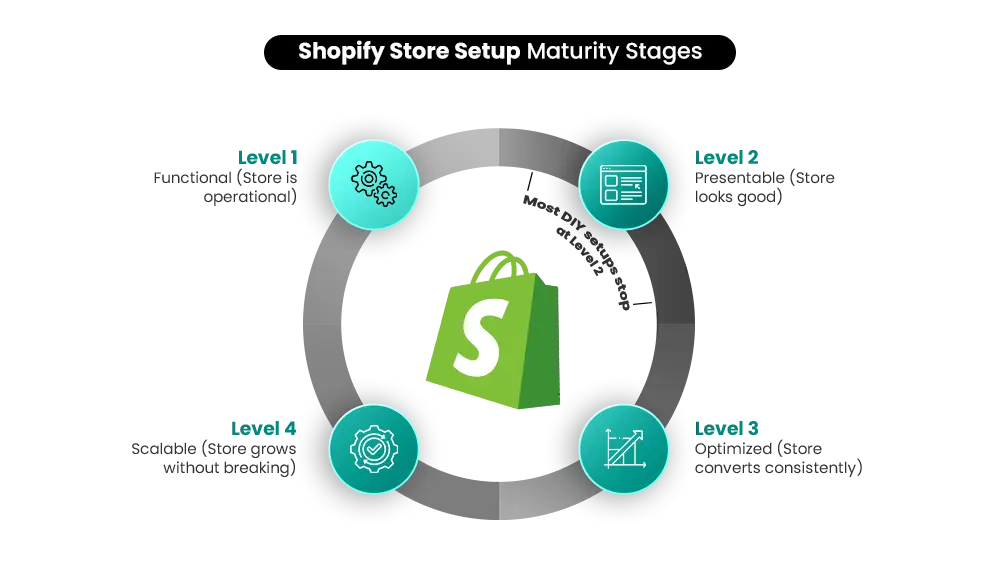
One of the most common assumptions in e-commerce is: If the store looks good and can take orders, it must be ready.
But setup isn’t just about making the site functional. Real readiness is about building something that can handle growing traffic, transactions, and scaling. This broader perspective usually differentiates a basic setup from the approach a Shopify development agency takes.
Here’s what “setup” actually includes:
- Selecting the Right Theme – isn’t just about aesthetics. It’s about build quality, adaptability, and future scalability. In some cases, this extends into custom Shopify theme development, which simply means modifying the theme’s underlying structure for flexibility rather than only adjusting colors and fonts.
- Structuring Navigation Intentionally – Arranging collections, filters, and menu hierarchies around how customers think and actually shop in reality.
- Designing the Product Page Flow – Here, you decide the exact sequence in which information appears. The flow should be like – building interest, reinforcing trust, and nudging people toward buying. This structured sequencing becomes the base for later Shopify conversion rate optimization work.
- Curating the App Stack Carefully – Adding apps, thinking your store might need it, is FOMO behaviour. Install ones that actually improve your functionalities and don’t slow down your store. Careful decisions here contribute to better Shopify speed optimization.
- Configuring Tracking from Day One – Track user action data and analytics from day one so you can base decisions around structure, conversions, and Shopify speed optimization on real insights rather than assumptions.
- Setting Up Checkout Logic – Aligning shipping rules, payment options, taxes, and conditional flows in a way that’s easy to understand for buyers. Experienced professional Shopify developers usually review this configuration carefully because checkout friction often goes unnoticed initially.
- Reviewing the Entire Mobile Experience – Not just checking if it “fits,” but how easy and intuitive it feels on phones. Review spacing, readability, scroll behavior, and tap precision.
- Preparing for Future Testing – Structuring layouts so you can adjust offers, pricing, and messaging without big redesigns. This kind of structural flexibility is a core part of Shopify performance optimization.
- Laying Technical SEO Foundations – Organize URLs, metadata, and internal linking before search engines begin indexing. Without this groundwork, Shopify SEO optimization later starts with corrections instead of strategies.
These are not post-launch fixes. They’re setup-stage decisions that shape long-term performance — the kind a Shopify development agency considers from the very beginning.
What DIY Shopify Store Setup Usually Cover?
To be fair, most DIY Shopify store setup approaches cover the essentials. Many merchants starting with DIY Shopify development focus on getting operational quickly, ticking off the Shopify Store Launch Checklist – which is reasonable.
DIY Shopify store development covers:
- Shopify Theme Setup – Adjusting colors, fonts, banners, and layouts to match the brand identity and make the storefront look good.
- Uploading products – Adding titles, descriptions, images, pricing, and variants so customers can browse and purchase.
- Installing required apps – Integrating reviews, email pop-ups, upsells, or shipping tools to extend basic functionality.
- Setting up shipping and payment – Configuring shipping zones, rates, and connecting payment gateways to process transactions.
- Creating main pages – Publishing essential pages like About Us, Contact, FAQs, and policy pages to establish legitimacy.
- Connecting a custom domain – Linking the brand domain to make the store look professional and trustworthy.
From an operational standpoint, this is sufficient. But going live and building a store that consistently converts, handles expanding traffic, and scales is a different story.
This distinction often becomes clearer when merchants compare DIY Vs Shopify experts. Some merchants only revisit these gaps months later, sometimes consulting a Shopify development agency for evaluation rather than a full rebuild.
The Performance Gaps DIY Setup Often Misses
By this stage, the store is live, and orders may even be coming in.
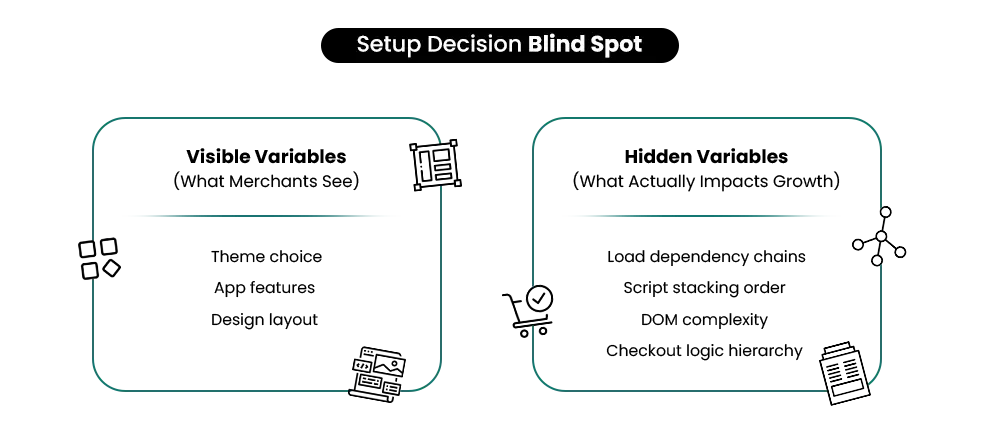
But when growth slows or conversions plateau, most merchants look at marketing first — ads, creatives, targeting. Rarely do they revisit setup decisions. However, structural decisions cause most of the performance issues, which is why discussions around Shopify store development go beyond design.
Site Speed and App Load
It’s easy to install multiple apps to “improve” the store, such as reviews, bundles, pop-ups, and analytics tools. What’s not always obvious is that each app adds scripts that can slow down load time, especially on mobile. Over time, this affects Shopify store performance. Industry observation shows that the average Shopify store runs 6–10 apps, often adding 2–3 seconds to load time and costing up to 40% of conversions.
Product Page Decision Gaps
Adding content isn’t the same as structuring persuasion. Without a clear hierarchy like benefits first, objections handled, trust signals reinforced, visitors may read everything but hesitate at decision points. This is part of deeper Shopify store development, where content hierarchy supports decisions.
Checkout Drop-Off
Unclear shipping logic, surprise costs, or unnecessary steps in checkout introduce friction at the final stage. When abandonment rises, the instinct is to tweak ads, but often the issue lies in checkout flow.
Lack of CRO Readiness
What’s CRO readiness?
It simply means building your store in a way that allows you to test and improve things like headlines, pricing blocks, offers, or layouts without redesigning the entire page every time. In other words, the structure is flexible enough to evolve as you learn what works. This foundation supports structured Shopify conversion rate optimization later.
These aren’t marketing failures. They’re structural gaps that show up once real traffic starts flowing in. And this is often where the DIY Vs Shopify Agency comparison becomes practical.
To avoid these gaps and gain deeper insights on store setup read – The Ultimate Guide to Shopify Store Setup and Optimization (Start from Scratch)
What Does An Expert Shopify Store Setup Focus On?
A Shopify store isn’t just assembled; it should be built with conversion in mind.
Most DIY vs Shopify development agency discussions highlight this structural difference — assembly versus architecture.
So what changes when someone experienced steps in? Not just someone who knows how to use Shopify, but someone who has seen hundreds of stores go live, struggle, grow, and evolve.
The focus shifts from getting it live to getting it right.
Role of Shopify development company in store setup typically looks like this:
- Development-backed theme configuration – The theme isn’t just installed. It’s refined through what’s often considered custom Shopify theme development. Code bloat is reviewed, unnecessary elements are stripped, and the structure is adjusted with performance in mind.
- Choosing Tools With Restraint – Instead of installing apps based on “we might need this,” experts evaluate what’s essential, what overlaps, and how each addition affects performance. This restraint is a recurring differentiator in many DIY vs Shopify experts comparisons.
- Mobile-first layout setup – Not “mobile adjusted,” but mobile considered first, since that’s where most traffic will judge your store within seconds.
- Technical troubleshooting from the start – Broken scripts, layout glitches, or hidden loading issues often fly under the radar for beginners. Within structured Shopify development services, these are identified and resolved early, keeping the store stable from day one.
- Conversion-focused page structure – Pages are carefully structured so attention flows naturally, trust builds at every step, and each element leads toward a confident buying decision. An approach typical of a Shopify development agency.
- Checkout refinement – Every step of the checkout is reviewed, from payment options and shipping logic to clarity of instructions, because even small friction here can undo all the effort put into attracting and guiding the customer.
- Accurate analytics configuration – As part of Shopify website development, events, attribution, and tracking are mapped correctly so scaling decisions later aren’t based on assumptions.
- Keeping the Store Ready to Evolve – The entire structure is built with experimentation in mind. Something a Shopify development agency plans for from the start. So testing messaging, pricing, or offers doesn’t require rebuilding the foundation.
- ROI-Conscious Store Architecture – An expert plans the store so the Shopify development cost can realistically be recovered. That includes building clear average order value boosters (like intentional product bundling logic or quantity breaks placed strategically, not randomly) and embedding reorder prompts or complementary product suggestions inside confirmation and thank-you flows. The idea isn’t just to secure one sale, but to increase the revenue generated per customer from the very first transaction.
This is where working with a Shopify-focused team like Mastroke can make a real difference.
For many merchants, the DIY vs Shopify development agency decision doesn’t feel urgent at launch — it becomes relevant when performance pressure increases.
Hiring a Shopify expert is like having someone think ahead: what happens when traffic spikes, or when to test pricing, bundles, or messaging? How do you make sure nothing breaks, and every click and interaction is measurable?
Mastroke builds for performance from day one, eliminating hidden issues that slow down sales. And even when traffic starts coming in but conversions remain inconsistent, a structured Shopify Store audit helps pinpoint where friction is developing — in product flow, collection hierarchy, or checkout clarity — guaranteeing the Shopify store’s long-term growth.
Their support extends beyond launch day. With Shopify post-launch support, the updates, new integrations, and campaign-driven changes are handled without destabilizing the store.
Build your dream Shopify store today
Bring your vision to life with Mastroke, an official Shopify Partner. We design and develop high-converting, scalable Shopify stores with clean structure and future-ready features—built to grow with your business.
DIY vs Expert Setup: Performance Comparison
| Setup Area | DIY Approach | Expert Approach |
| Shopify Theme Setup | Visual edits | Code-backed layout setup |
| App Installation | Feature-based, install apps as needed | Performance-focused, essential apps only |
| Mobile Optimization | Previewed on devices | Fully tested for usability, spacing, readability, tap precision |
| Checkout Flow | Default settings | Optimized for minimal friction, smooth conversions |
| Tracking Setup | Basic pixel installation | Verified and mapped for accurate analytics and decision-making |
| Speed Optimization | Post-launch fixes | Set up stage planning to prevent slowdowns |
| CRO Readiness | Not included | Built-in structure for easy testing of layouts, offers, pricing |
| Setup Time Required | Learning takes time, can take weeks | Completed within 3–5 days by experts |
| Learning Curve | High (everything needs to be learned) | Low, handled by experienced team |
| Cost Benefit Analysis | Low upfront cost, high risk of fixes later | Slightly higher upfront, saves time, prevents costly rework, scales better |
When Should You Consider Expert Setup?
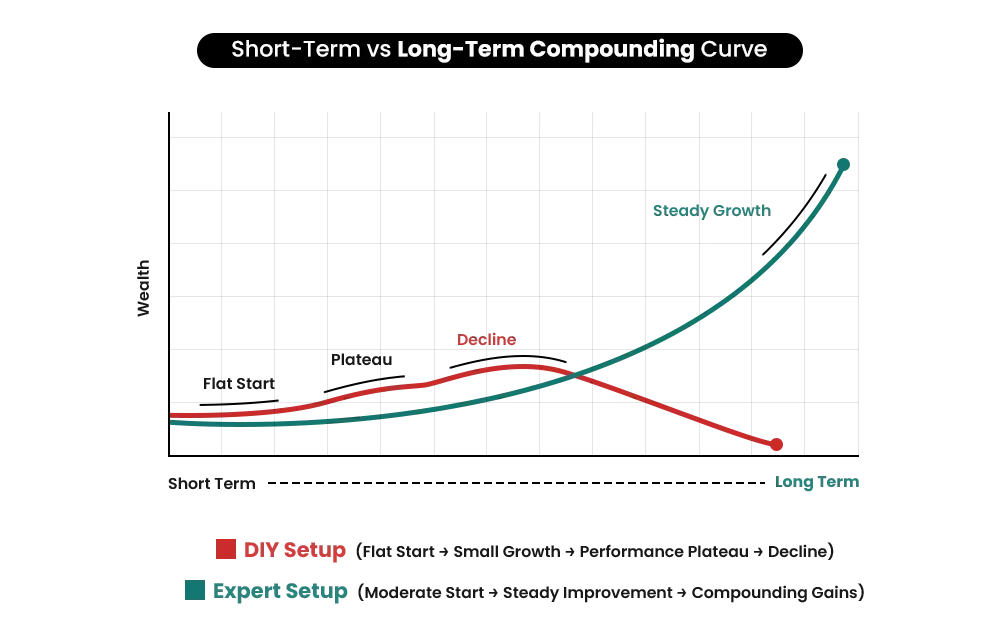
You’ve seen the gaps that DIY setups often leave behind and what an expert approach looks like. But how do you know when the right time is to bring in experienced help?
Ask yourself a few quick questions:
- Is this store more than a test project?
- Will you invest serious time or money?
- Do you need the store built to handle growth from day one?
- Could fixing issues later slow you down?
If your answer is ‘YES’ to most of these, it may be the right time to hire Shopify expert developers. When you’re hiring a Shopify developer don’t act on advice, act on a clear growth direction.
- Planning paid ads soon – Ask yourself: Do you want to opt for paid traffic after setup? If yes, can your store actually handle visitors at scale without slowing down, breaking, or confusing them? Every ad dollar counts.
- Scaling your product catalog – Do you plan to add more products soon? Without structured Shopify website development, expansion can lead to cluttered navigation, messy layouts, or slower checkout — all hurting user experience.
- Needing accurate performance data – Reliable analytics are essential if you want to clearly understand what’s working. But without properly configured tracking, events can misfire or underreport conversions, leaving you to make decisions based on incomplete or misleading data.
- Avoiding rebuilds in 3–6 months – You might think you can fix things after launch. But how much time and budget will you spend correcting what could’ve been done right from the start? Once traffic pours in and marketing begins, making structural changes becomes more expensive and time-consuming than setting it up properly the first time. Many merchants only revisit the Shopify development agency conversation after facing expensive rebuild cycles.
- Timeline Pressures – Setting up a store on your own often takes far longer than expected. What a Shopify development partner can have live and optimized in 3–5 days could take you weeks to figure out, troubleshoot, and refine.
- Constant Maintenance Checks – A Shopify store doesn’t run on autopilot after launch. Theme updates, app changes, new integrations, and small design edits all require regular maintenance. Without constant checks, these routine changes can gradually impact speed, tracking, or checkout flow. Ongoing Shopify expert maintenance keeps the technical side aligned with business growth.
When you look at all of this together, it becomes clear that having experienced guidance can make a difference.
A quick rule of thumb :
| Side hustle → | DIY setup works |
| Testing Project → |
DIY setup works |
| Growing brand → | Shopify Development Agency |
| Scaling brand → | Shopify Development Agency |
This all might feel overwhelming, but you don’t have to figure this out alone because that’s exactly why a Shopify development agency like Mastroke exists.
Mastroke is a Shopify partner who doesn’t just build your store, but also makes sure it’s built right and optimized to handle traffic over time. As a Shopify development agency, Mastroke aim to avoid setup gaps that often go unnoticed during the building stage and serve your Shopify store with long-term growth.
To better understand whether you need a Shopify expert read – 5 Clear Signs It’s Time to Hire a Shopify Agency.
Conclusion: Your Setup Choice Shapes What Comes Next
You’ve seen how quickly a store can go live. But going live isn’t the finish line.
It’s building a store that converts, scales, and handles growth without constant troubleshooting. Many performance gaps remain rooted in setup-stage decisions.
This is why the broader DIY vs Shopify development agency conversation isn’t just about who builds the store — it’s about how prepared that store is for what comes next.
A setup built with performance in mind today prevents costly fixes tomorrow. It gives you a foundation for a store that can convert, grow, and adapt as your business expands. Ask yourself – is your store ready to perform and convert, or just exist?
Plan Your Shopify Store Setup the Right Way
Going live is only the beginning. If you want your store to actually sell, tackle rising traffic, and grow without needing a rebuild, get the setup right from day one.
Whether you take the DIY route or turn to custom Shopify development services, what matters is building performance, scalability, and flexibility into the foundation.
Mastroke can help strategize and guide from day one with a Shopify store growth strategy. With Store Setup & Management services covering development, troubleshooting, and CRO readiness, Mastroke builds alongside you. For a Shopify development agency, the job description isn’t just to launch but to ensure the setup can handle growth.
Launch faster with Mastroke, an official Shopify Partner. We build structured stores with conversion-first design, clean setup, and features built to scale!!Build Your Shopify Store From Scratch With Mastroke
FAQs
1. Is it possible to set up a Shopify store without Professional Shopify Help?
A: Yes, Shopify allows merchants to set up their stores using pre-built themes and apps. However, a DIY setup may not always account for performance factors such as speed optimization, mobile layout, checkout flow, or tracking accuracy — areas often reviewed more deeply by Shopify experts.
2. How does store setup impact Shopify Store Performance?
A: Store setup decisions such as theme configuration, app selection, page structure, and checkout settings directly affect loading speed, user experience, and conversion rates, all of which influence overall store performance.
3. When should I Hire Professional Shopify Developers?
A: If you plan to invest in paid ads, scale your product catalog, rely on analytics for decision-making, or want to avoid rebuilding your store later, expert setup can help ensure your store is configured with performance in mind.
4. Can setup mistakes be fixed after launch?
A: Some issues can be resolved post-launch through troubleshooting or redesign. However, fixing foundational setup gaps later, when traffic is pouring in, requires your store to take a break and can be costly.
5. What’s included in an expert Shopify Store Setup Services?
A: An expert setup goes beyond design. It typically includes theme configuration, structured catalogue setup, performance checks, responsive layouts, payment and shipping integration, and tracking validation, ensuring the store is built to sell and scale.
6. Do I need a Shopify store development agency?
A: The answer depends on your goals. If you only want to launch and test the waters, a DIY setup can work. But if you’re preparing for paid ads, scaling, and long-term growth, expert support can help you build a stronger, performance-focused foundation from the start.