
Hiring the right partner can shape your store’s future. When you decide to hire Shopify agency support in 2026, the decision goes far beyond price. A polished proposal and a strong portfolio do not guarantee a safe Shopify agency contract. The Shopify ecosystem is crowded with experts, partners, and growth specialists. Many agencies look impressive on the surface.
But real problems usually start after the contract is signed. Scope gaps, unclear deliverables, and ownership issues can quietly limit your control. Technical shortcuts today can become expensive rebuilds tomorrow. In fact, World Commerce & Contracting reports that poor contract management can cost businesses up to 9% of annual revenue. For scaling merchants, that risk is too high to ignore.
This guide helps you protect what matters most. It covers what to ask before hiring a Shopify agency. It highlights common mistakes when hiring Shopify agencies. Most importantly, it helps you protect revenue, maintain control, and scale without hidden surprises.
Section 1 — Strategic Vetting Before You Hire Shopify Agency
Choosing a Shopify partner is more than just picking a name from a list. It is a major business decision that impacts your daily operations. You need to perform strategic vetting to ensure you hire Shopify agency teams that actually deliver. Start by digging into their core specialization to see if they fit your brand.
What Is Your Core Specialization?
Not all Shopify website experts are created equal. Some focus solely on design and development, while others prioritize conversion rate optimization (CRO). You must ask specific questions to find the right match:
- Do they specialize in Shopify Plus or standard Shopify builds?
- Have they managed large catalogs with 1,000 to 10,000+ SKUs?
- Do they have experience in your specific industry or niche?
Managing a small boutique is very different from managing a massive inventory. Ensure they have handled catalog complexities similar to yours before signing a Shopify agency contract.
How Do You Handle 2026 Shopify Technical Updates?
Shopify moves fast, and your agency must keep up with the latest tech. In 2026, you cannot rely on outdated Liquid hacks that slow down your site. Every Shopify website development project should prioritize the latest platform standards:
- Shopify Functions: Customizing backend logic without breaking your core theme.
- Hydrogen & Oxygen: Building fast, headless storefronts for better performance.
- Checkout Extensibility: Safely upgrading the checkout experience.
Demand clean code that follows modern standards to avoid future technical debt. This is one of the most important questions to ask a Shopify agency.
Can You Show Me Comparable Case Studies?
Don’t just look at pretty pictures in a portfolio. Ask for data from stores with your revenue range and traffic volume. A great Shopify partner should show a real lift in AOV and revenue.
- Look for a similar case study’s revenue range to ensure they can scale with you.
- Verify their experience with your specific traffic volume.
- Check for real results in conversion rate optimization and total sales.
Looking at these metrics is essential when deciding what to ask before hiring a Shopify agency. It proves they can handle the unique pressures of your business.
– Also Read: Shopify Plus for Enterprise Growth: Features & Benefits
Build Your Shopify Store From Scratch With Mastroke
Launch faster with Mastroke, an official Shopify Partner. We build structured stores with conversion-first design, clean setup, and features built to scale!!
Section 2 — Scope Clarity: What Exactly Am I Paying For?
Vague proposals lead to expensive disasters. Before you hire Shopify agency teams, you must define the boundaries of your project. Clarity now prevents awkward conversations later. Use this Shopify agency agreement checklist to protect your budget.
What Is Included in the Scope?
Never assume a service is included unless it is in writing. A basic Shopify store setup is different from a full site redesign. You must confirm if your Shopify agency contract covers these essentials:
- Speed optimization and SEO foundations.
- Data migration for customers, orders, and products.
- Detailed SEO redirects to prevent ranking drops.
- A set number of design revisions.
- A documented QA process to catch bugs before launch.
Ask your project manager for a list of every deliverable. If it isn’t listed, you aren’t paying for it.
What Is Explicitly Out of Scope?
Knowing what you aren’t paying for is just as important. Most merchants forget that an agency fee rarely covers external costs. These items are usually “out of scope”:
- Monthly third-party app subscription fees.
- Daily ad spend for marketing campaigns.
- Ongoing maintenance after the site goes live.
- Complex ERP or CRM integrations.
A true Shopify expert will be honest about these extra costs. Always ask about hidden fees during your first discovery call. This is one of the top things to clarify with Shopify agency partners.
How Are Change Requests Handled?
Project needs often change midway through a build. You need to know how the Shopify expert agency handles “scope creep.” Ask if they use hourly billing or fixed fees for new revisions. Ensure there is a clear change order documentation process. This prevents your bill from doubling without your permission.
Written approval should be required for any task that falls outside the original deal. This level of transparency builds trust and keeps your project on track.
– Also Read: Shopify Pricing: How much does it cost to build a Shopify website?
Section 3 — Contract Deep Dive: Shopify Agency Contract Questions
When you hire Shopify agency support, the contract protects your store, assets, and future flexibility. Many merchants focus on price but ignore ownership, exit rights, and billing clarity.
A well-written Shopify agency contract prevents disputes, protects intellectual property, and ensures long-term control of your online store. Before signing, review every clause carefully and ask direct questions.
Hear it directly from a merchant who went through the process, and you’ll know what the right partnership should feel like.
Intellectual Property & Ownership
Ownership determines who controls your custom Shopify store after the project ends. Never assume ownership transfers automatically without written confirmation. Ask these critical ownership questions:
- Do I own all custom Shopify code after full payment?
- Do I fully own the theme, including design and layout changes?
- Do I own checkout customizations and workflow logic?
- Who owns custom apps created during development?
- Are all design files, assets, and source code transferred after payment?
If ownership stays with the agency, your online store becomes dependent on them permanently. This creates risk if you want to switch providers or scale independently later.
Contract Length & Lock-In Clauses
Contract length affects flexibility and financial risk. Some agencies require long-term agreements that restrict your ability to exit. Review these contract terms carefully:
- Is the agreement month-to-month or locked for 6–12 months?
- Does the Shopify agency contract auto-renewal automatically?
- Are there early termination penalties or exit fees?
- Can you pause services if business priorities change?
Flexible agreements reduce risk, especially when you hire a Shopify SEO agency for ongoing optimization.
Termination & Exit Strategy
A safe contract always includes clear exit conditions and transition support. Without exit protection, merchants risk losing access to critical store assets. Confirm these exit protections:
- Required notice period before termination
- Handover documentation explaining the custom Shopify setup
- Access to GitHub or code repositories
- Full admin access to your online store
- Data export rights, including customer and order data
Exit clarity ensures business continuity after ending the partnership.
Payment Structure & Billing Transparency
Clear billing terms prevent unexpected costs and financial disputes. Transparent pricing builds trust and long-term partnership stability.
Ask these billing questions before signing:
- What upfront percentage is required before work begins?
- Are payments linked to milestones or deliverables?
- Is the pricing retainer-based or hourly billing?
- Are additional revisions billed separately?
- What is the refund policy if deliverables are incomplete?
Transparent billing ensures you understand exactly what you are paying for.
A strong Shopify agency contract protects your ownership, flexibility, and operational control. When structured correctly, it allows your online store to grow safely without legal or technical dependency.
– Also Read: Shopify Flow Features: What You Can Automate and How It Works
Section 4 — Reporting & Accountability Framework
Before you hire Shopify agency support, confirm how performance will be tracked and reported. A strong Shopify agency contract must define clear metrics, reporting frequency, and communication standards.
Without accountability, agencies may show activity but fail to deliver real business growth. Clear reporting protects your Shopify store and helps you measure real progress.
What KPIs Will Be Tracked?
Many agencies focus on vanity metrics like traffic, impressions, or clicks. These numbers look impressive, but don’t reflect real revenue growth. A reliable agency tracks business-driven metrics tied to profit and scalability.
Ask the agency to track these critical KPIs: 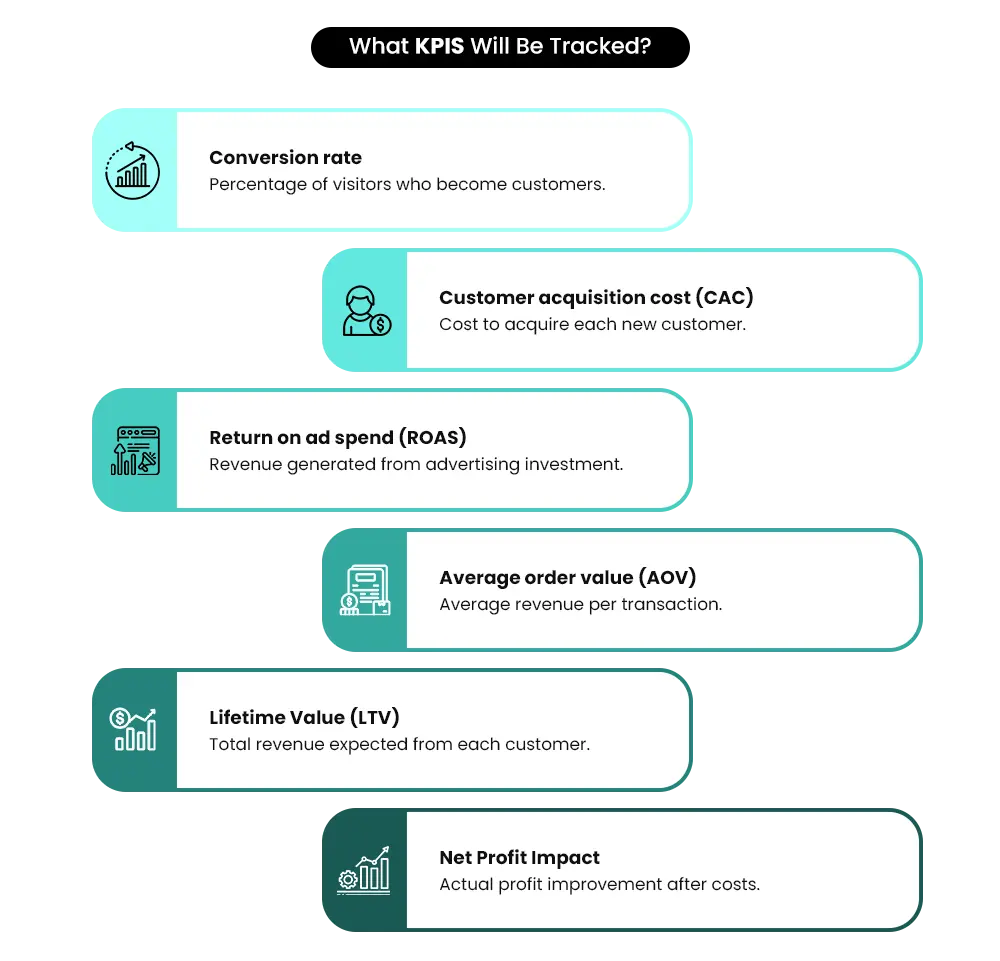
These metrics show whether Shopify store development and marketing efforts deliver measurable results. If an agency avoids discussing these numbers, its proposal may carry risk.
Reporting Transparency
Transparency ensures you understand exactly how your Shopify store performs. You should never depend only on agency summaries or screenshots.
Clarify reporting expectations clearly:
- Weekly or monthly reporting schedule
- Access to live dashboards for real-time performance
- Real-time performance access without delays
- Access to raw data from ad platforms and analytics tools
Raw data access protects your business from hidden performance issues. This also allows independent verification of results.
Communication Standards
Communication quality reflects agency professionalism and operational reliability. Poor communication often signals deeper project management risks.
Confirm these communication standards before signing:
- Dedicated project manager responsible for your Shopify store
- Direct Slack or communication channel access
- Defined response time SLA for questions or emergencies
- Escalation protocol if critical issues occur
Strong communication ensures faster problem resolution and better coordination.
Clear reporting and accountability reduce the risk of poor agency performance. When you hire Shopify agency support, demand full visibility into performance, data, and communication. This ensures your Shopify agency contract protects your revenue, growth, and long-term business control.
– Also Read: Shopify Plus Automation: Practical Ways to Automate Store Operations
Section 5 — Technical & Operational Risk Assessment
Technical mistakes can break your Shopify store and damage revenue instantly. Before you hire Shopify agency support, evaluate their technical safety and operational discipline.
A clear Shopify agency contract must define protection against launch failures and performance risks. Professional custom Shopify developers follow strict safeguards to prevent business disruption.
QA & Rollback Plan
Every Shopify store development project carries launch risk. Even small code errors can break checkout, payments, or product pages. You must understand how the agency protects your life.
Ask these critical questions:
- Is there a staging environment separate from the live Shopify store?
- Do they test updates fully before pushing them live?
- What happens if the launch fails or breaks functionality?
- Is rollback documented and tested in advance?
- How quickly can they restore the previous stable version?
A staging environment protects your revenue during development changes. Rollback procedures ensure your store can recover immediately if something fails. Experienced Shopify store experts never deploy untested code directly to live environments.
This reduces downtime, customer frustration, and lost sales.
App Strategy & Performance Philosophy
A poor app strategy can slow your Shopify store and create long-term technical debt. Some agencies install too many apps instead of building clean solutions. This weakens performance and increases operational complexity.
Ask these app strategy questions:
- Do they prioritize native Shopify features before installing apps?
- Are they stacking 20–30 apps without a clear performance justification?
- How do they evaluate app impact on speed and performance?
- What is their speed testing process before and after deployment?
Professional Shopify growth experts focus on efficiency, not app quantity. Fewer, optimized apps improve speed, stability, and scalability. Clean Shopify store development reduces future maintenance costs. This ensures your store remains fast and reliable.
Proprietary Platform Trap
Some agencies lock merchants into proprietary systems or custom infrastructure. This creates dependency and reduces your long-term control. Your Shopify agency contract must protect your ownership and flexibility.
Ask these ownership and control questions:
- Are they building on standard Shopify infrastructure or custom locked systems?
- Do you control your hosting, theme, and code access fully?
- Can another agency take over your Shopify store easily if needed?
- Are you locked into proprietary tools or private platforms?
You must retain full control of your Shopify store assets. Reliable Shopify store experts build transparent, transferable systems. This protects your business if you change agencies later.
– Also Read: How to Plan Your Shopify Store Growth in 2026?
Section 6 — Merchant Readiness Checklist Before Signing
Finalizing a Shopify agency contract is a major step for your brand. You must ensure your store build is in the right hands. Use this risk audit to vet your development experts before you sign.
Quick Risk Audit Table
| Area | Green Flag (Hire Them) | Red Flag (Walk Away) |
| Ownership | You own all code and assets. | The agency owns the core structure. |
| Communication | Dedicated PM and live access. | Generic ticket system only. |
| Scope | Written, detailed SOW. | Vague bulleted proposal. |
| Billing | Clear milestone breakdown. | Open-ended hourly ambiguity. |
| Strategy | Focuses on LTV and profit. | Only promises more traffic. |
| Tech | Clean code and speed focus. | Heavy app bloat. |
Before you hire Shopify agency teams, look for these specific signals. Shopify store experts should always offer a clear, written Scope of Work (SOW). If they promise a custom theme but rely on heavy apps, your speed will suffer.
Shopify growth experts prioritize your long-term profit over vanity metrics. Ensure your Shopify agency contract guarantees you own every line of code created. A generic ticket system is often a sign of poor communication. Demand a dedicated project manager to keep your project on track. This final check ensures your investment leads to a high-performing store.
– Also Read: How to Know It’s Time to Redesign Your Shopify Store (10 Clear Signals)
Section 7 — Should You Hire Shopify Agency or Build In-House?
Deciding whether to hire Shopify agency teams or build an internal department is a pivotal choice for your brand. Both paths impact your store build differently based on your current resources. Use this comparison to see which model fits your goals.
Agency vs. In-House Comparison
| Factor | Agency | In-House |
| Speed | Faster execution | Hiring delays |
| Skill Coverage | Multi-specialist | Limited coverage |
| Control | Shared | Direct |
| Cost Model | Retainer | Salary + overhead |
| Scalability | Flexible | Fixed capacity |
Choosing development experts from an agency gives you instant access to a full team. You get Shopify store experts without the long wait of traditional hiring. This is ideal if you need a custom theme delivered on a tight deadline.
However, an in-house team offers direct control over every daily task. You avoid the terms of a Shopify agency contract but incur high overhead costs. Shopify growth experts at an agency can scale their efforts up or down quickly.
In-house staff have a fixed capacity that may limit rapid pivots. Review your long-term budget before making the final call. Most successful brands use a hybrid model to balance speed and control effectively.
Common Mistakes Merchants Make When Hiring Agencies
Avoiding common mistakes during a store build saves you thousands of dollars and months of frustration. Many brands hire Shopify agency teams based only on the lowest price. This often leads to hidden costs and poor code quality. You must vet your development experts beyond their sales pitch.
Watch out for these common traps before signing your Shopify agency contract:
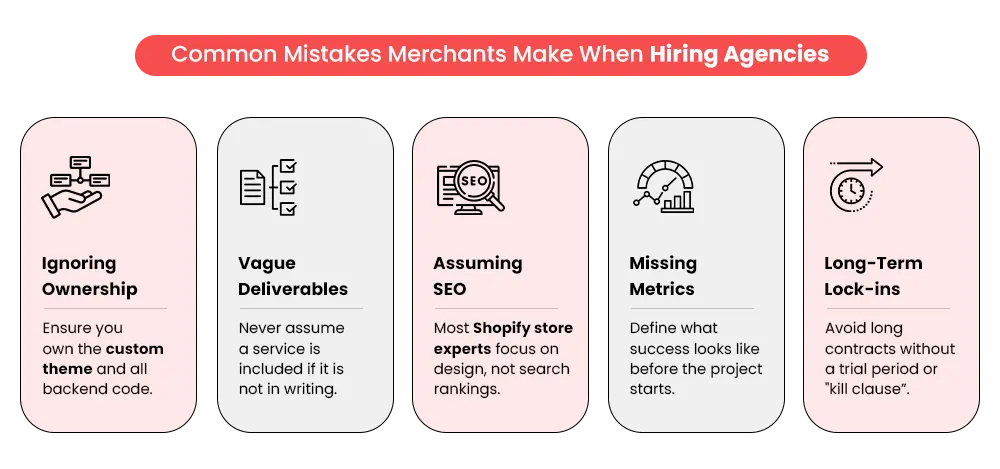
Shopify growth experts should be transparent about their process and results. If an agency dodges questions about ownership, it is a major red flag. Always verify that their strategy aligns with your profit goals. A cheap project often turns into an expensive fix later. Take your time to find a partner who values your long-term success.
If you’re unsure whether your current agency setup is structured correctly — or you’re about to sign a new contract — a second opinion can prevent expensive mistakes.
Conclusion
Choosing to hire Shopify agency experts is a major milestone for your business. It marks the transition from a simple store to a scalable brand. However, success depends on the questions you ask before signing. Protect your vision by ensuring your Shopify agency contract is clear and fair.
Do not rush into a partnership based on a flashy portfolio alone. Focus on technical expertise, clear communication, and total code ownership. A great partner will respect your boundaries and prioritize your profit. Use the checklists in this guide to get every potential candidate. Your store deserves a foundation built on trust and clean architecture.
Now that you have the right tools, you can hire with total confidence. If you’re a Shopify merchant looking to scale profitably, I highly recommend booking a strategy call with Mastroke!
Build your dream Shopify store today
Bring your vision to life with Mastroke, an official Shopify Partner. We design and develop high-converting, scalable Shopify stores with clean structure and future-ready features—built to grow with your business.
FAQs
What should I ask before hiring a Shopify agency?
Ask about their specialization, case studies, scope of work, reporting process, timeline, ownership terms, and who will actually work on your store.
What should be included in a Shopify agency contract?
The contract should clearly define scope, deliverables, timelines, payment terms, ownership rights, reporting standards, and exit or termination conditions.
How do I avoid hidden costs when I hire Shopify agency support?
Request a detailed scope document that lists inclusions, exclusions, third-party costs, revision limits, and hourly rates for out-of-scope work.
Can I exit a Shopify agency agreement early?
Yes, most agreements allow exit with a notice period, but always check termination clauses, penalties, and handover obligations before signing.
How do I verify if an agency is a certified Shopify Partner?
Check their listing in the official Shopify Partner Directory and review verified case studies, certifications, and real client references.
What happens to my data if I terminate the agency contract?
You should retain full ownership of store data, code, and assets, and the agency must transfer access and credentials during handover.