
Many Shopify merchants start with a simple mission — sell great products online. But as revenue grows, so does complexity. At this stage, standard setups often reveal limitations.
What once worked smoothly begins to strain under higher traffic, global demand, advanced integrations, and growing backend complexity — making it clear that managing a storefront is no longer enough for enterprise brands on Shopify. They need scalable systems that can support marketing, operations, and checkout performance as the business grows.
That’s where Shopify Plus makes the difference. Built for high-growth brands, it helps enterprise teams automate workflows, customise checkout, and manage multiple storefronts without performance slowdowns during peak demand.
So what exactly makes Shopify Plus the right choice for enterprise brands looking to scale without operational bottlenecks? Let’s take a closer look at the Shopify Plus features that support enterprise growth.
What Is Shopify Plus?
Shopify Plus is the enterprise-level version of Shopify, built for fast-growing and high-volume brands. While standard Shopify plans work well for small and mid-sized businesses, Shopify Plus is designed to handle complex operations, large catalogs, and global demand without performance issues.
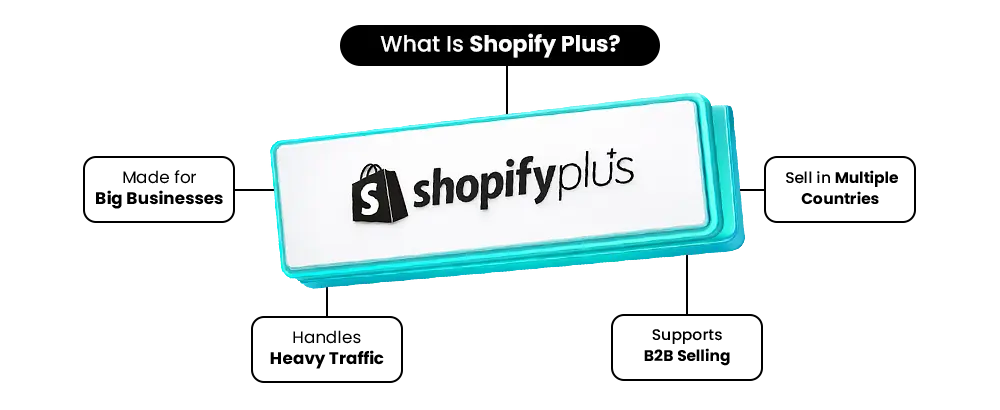
The difference becomes clear as businesses scale. Standard plans provide strong e-commerce tools, but Shopify Plus offers more control, flexibility, and infrastructure. For example, it includes:
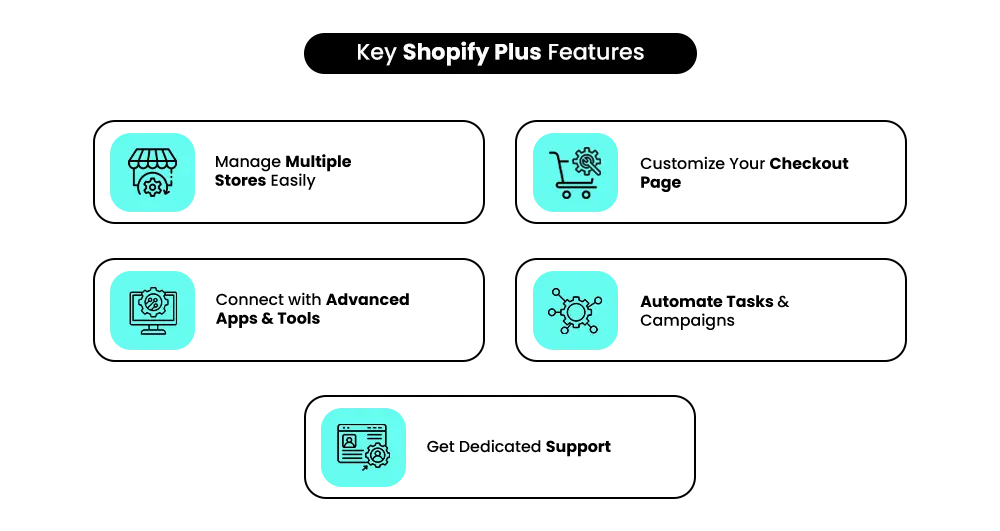
- Higher API limits for complex integrations
- Advanced checkout customization
- Automation tools like Shopify Flow and Launchpad
- Dedicated account management and priority support
- Multi-store management from a single dashboard
Shopify Plus is built for enterprise and high-growth brands that need more than just a storefront. It supports:
- Global expansion with multi-currency and multi-language
- B2B and wholesale operations
- Seamless ERP and CRM integrations
- High-traffic events like flash sales
For enterprise ecommerce growth, these Shopify Plus features help brands optimize operations and scale with greater flexibility.
For a deeper perspective on enterprise scalability and ROI, also read our detailed blog “Is Shopify Plus Overhyped or Actually Worth It?” to evaluate whether Shopify Plus truly delivers long-term value for growing brands.
Enterprise Challenges Shopify Plus Solves
As Shopify merchants grow into enterprise brands, the real challenge is no longer selling products — it’s managing scale. Here are the key challenges Shopify Plus is built to solve:
1. Managing Massive Traffic and High Transaction Volumes
Flash sales, viral campaigns, and peak-season traffic can overwhelm standard setups. Enterprise brands need infrastructure that can support large transaction volumes during peak traffic without performance slowdowns.
2. Handling Multi-Store and Multi-Region Operations
Operating across different countries means managing multiple storefronts, currencies, tax structures, and customer experiences. Without a centralized system, operations become fragmented and inefficient.
3. Complex ERP, CRM, and Third-Party Integrations
Enterprise brands often rely on systems like ERP, CRM, 3PL, inventory management, and marketing automation tools. Limited API access or unstable integrations can block growth.
4. Global Expansion Requirements
International growth requires multi-currency, multi-language, and localized checkout experiences. Scaling globally demands flexibility and strong backend support.
5. Security and Compliance Risks
Enterprise brands handle large volumes of customer data and payments. Strong PCI compliance, fraud prevention, and secure infrastructure are essential — not optional.
6. Operational Inefficiencies Without Automation
Manual workflows slow down teams. Without automation for inventory, marketing, and backend operations, scaling becomes expensive and chaotic.
7. Limitations of Legacy or Self-Hosted Platforms
Many enterprise brands outgrow outdated systems that require heavy maintenance, constant developer support, and high infrastructure costs.
Shopify Plus features address these challenges through enterprise-grade scalability, automation, security, and flexibility — making it a powerful foundation for modern growth.
What Happens When Enterprise Stores Outgrow Standard Shopify?
As brands move beyond mid-market scale, the limitations of standard Shopify plans often show up in day-to-day operations — not just storefront performance.
Teams may begin to rely on manual workflows to manage inventory, promotions, or order routing across regions. Marketing campaigns may require developer support for even minor checkout changes. Expanding into new markets can introduce complexity around localized pricing, currency display, and tax configuration.
Over time, these limitations can lead to:
- Slower campaign execution
- Increased operational overhead
- Checkout friction during peak traffic
- Integration delays with ERP or CRM systems
- Reduced agility in global expansion
At enterprise scale, even small inefficiencies can impact revenue or customer experience. Shopify Plus features are designed to reduce this operational strain by enabling automation, advanced checkout logic, and scalable infrastructure — helping teams focus on growth rather than backend complexity.
Key Shopify Plus Features
When enterprise brands choose Shopify Plus, they are not just upgrading their plan — they are upgrading their infrastructure. Below are the core Shopify Plus features that make it powerful for enterprise ecommerce and Shopify growth.
Unlimited Bandwidth and Global CDN
Enterprise brands often run high-volume campaigns such as product launches, influencer-driven drops, or seasonal sales.
Shopify Plus features like unlimited bandwidth and global CDN infrastructure ensure performance remains stable during these traffic spikes — helping protect checkout experience and conversion rates during peak demand.
Advanced Checkout Customization and Extensibility
Shopify Plus features allow enterprise brands to extend checkout using Checkout Extensibility and Shopify Functions.
This enables teams to customize shipping logic, apply dynamic discounts, create region-specific checkout rules, and streamline payment flows — without modifying core platform code.
API Access and Headless Commerce Capabilities
Shopify Plus provides higher API limits and flexibility, enabling seamless integrations with ERP, CRM, PIM, and other enterprise systems. For brands wanting complete front-end freedom, headless commerce allows custom storefront experiences while keeping Shopify’s powerful backend.
This allows enterprise teams to connect Shopify with backend systems like ERP or marketing platforms without slowing down site performance or campaign execution.
- Automation Tools (Shopify Flow, Launchpad, Scripts)
- Automation is critical at scale. Shopify Plus includes tools like:
- Shopify Flow for workflow automation
- Launchpad for scheduling campaigns and flash sales
- Shopify Functions for advanced discount logic and backend customization
These Shopify Plus features reduce manual effort and support operational efficiency at enterprise scale.
Multi-Store and Multi-Currency Support
Enterprise brands often operate across multiple regions. Shopify Plus enables enterprise brands to manage multiple storefronts through expansion stores within a centralized organization admin — helping teams coordinate regional operations more efficiently.
It also supports:
- Multi-currency selling
- Localized pricing
- Region-specific storefronts
These Shopify Plus features make global expansion smoother and more structured.
B2B and Wholesale Functionality
Shopify Plus supports wholesale and B2B models with custom pricing, volume discounts, and gated storefronts.
For brands running both DTC and wholesale channels, this flexibility is a major advantage.
Enterprise-Grade Security and Level 1 PCI Compliance
Security is non-negotiable for enterprise brands. Shopify Plus provides:
- Level 1 PCI DSS compliance
- Secure payment processing
- Reliable hosting infrastructure
- Fraud analysis tools
This reduces risk and builds customer trust.
Dedicated Support and Merchant Success Program
Shopify Plus merchants receive priority support and access to a dedicated Merchant Success Manager.
This ensures:
- Faster issue resolution
- Strategic guidance
- Platform optimization support
These Shopify Plus features ensure enterprise merchants receive strategic platform support and faster issue resolution. To better understand how enterprise brands leverage these capabilities, also read our blog “Shopify Plus: What Big Brands Know That You Don’t.”
Core Shopify Plus Capabilities at a Glance
| Feature Category | Enterprise Value |
| Performance | Unlimited bandwidth, global CDN, stable high-traffic handling |
| Checkout & Conversion | Advanced checkout customization and extensibility |
| Integrations & Flexibility | Higher API limits and headless commerce support |
| Automation Tools | Flow, Launchpad, and Scripts for operational efficiency |
| Global Commerce | Multi-store management and multi-currency selling |
| Wholesale | Custom pricing and gated wholesale storefronts |
| Security & Support | Level 1 PCI compliance and dedicated merchant support |
Shopify Plus Benefits for Enterprise Brands
For enterprise merchants, the real value of Shopify Plus features lies in the outcomes they deliver. The platform is designed to remove growth barriers and create stability at scale.
Scalability Without Replat forming
Enterprise growth should not require rebuilding your technology stack every few years. Shopify Plus allows brands to scale traffic, orders, product catalogs, and regions without migrating to another platform. The infrastructure is designed to handle enterprise volume, eliminating the disruption and cost of frequent replat forming.
Faster Time to Market
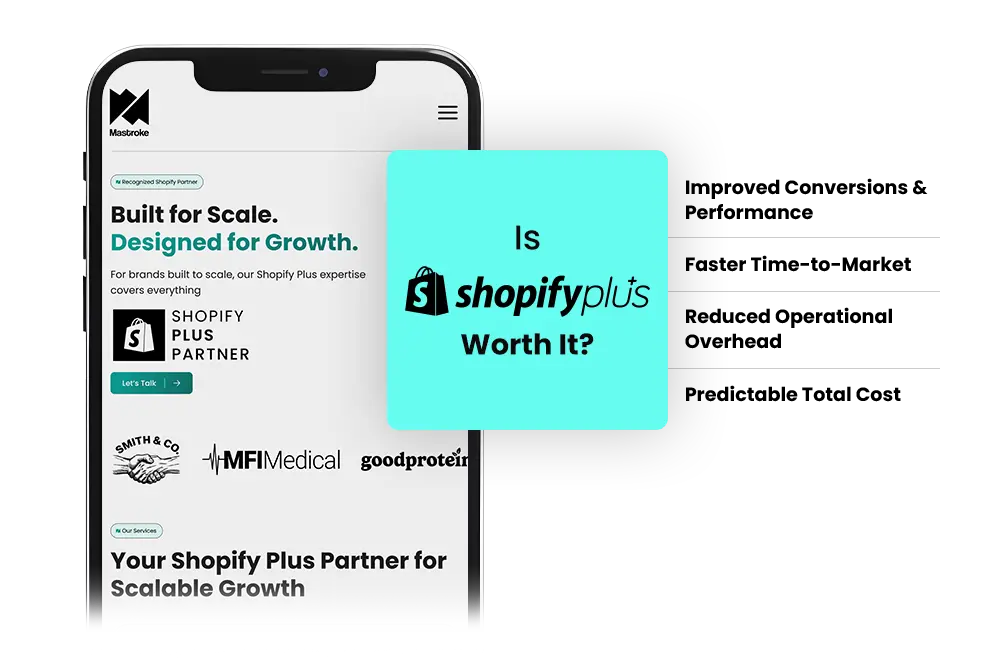
Speed matters at the enterprise level. Whether launching a new campaign, entering a new market, or rolling out a product line, Shopify Plus enables faster execution. Pre-built architecture and flexible development capabilities reduce deployment timelines and help brands move ahead of competitors.
Improved Performance and Conversion Rates
Performance directly impacts revenue at scale. Shopify Plus provides optimized hosting, stable checkout experiences, and global content delivery. This ensures consistent speed during peak traffic, which helps protect conversion rates and customer experience.
Reduced Operational Overhead
As operations grow more complex, manual processes become expensive and inefficient. Shopify Plus supports automation across workflows, reducing repetitive tasks and backend strain. Enterprise teams can focus more on strategy and growth rather than operational firefighting.
Lower Total Cost of Ownership
Legacy and self-hosted systems often require heavy investment in hosting, maintenance, security, and development resources. Shopify Plus consolidates these costs into a predictable SaaS model. Over time, many enterprise brands find the total cost of ownership lower and easier to manage.
Greater Flexibility for Innovation
Enterprise brands need the freedom to experiment with new business models, integrations, and customer experiences. Shopify Plus provides API access and extensibility without unnecessary backend complexity. This balance allows innovation without operational risk.
Competitive Advantage in Global Markets
With built-in support for multiple currencies, storefronts, and localized experiences, Shopify Plus enables confident global expansion. Enterprise brands can operate across regions while maintaining centralized control and consistent brand standards.
Shopify Enterprise Pricing Explained
When evaluating Shopify Plus features alongside pricing, enterprise brands should consider how the base platform fee works and how additional costs factor into the total investment. Shopify Plus follows a structured pricing model designed for high-growth and high-volume brands.
1. Base Platform Fee
Shopify Plus follows a pricing model designed for high-growth and high-volume brands. Every Shopify Plus merchant pays a base platform fee of $2,000 USD per month. Once monthly revenue increases, pricing may shift to a revenue-based model calculated at approximately 0.25% of monthly revenue — whichever is higher than the base fee.
For example, if a brand generates $1,000,000 USD in monthly revenue, 0.25% would equal $2,500 USD for that month, replacing the $2,000 minimum platform fee. Shopify Plus also typically requires a 12-month minimum contract, with payments billed monthly.
2. Revenue-Based Scaling
This pricing model allows platform costs to grow alongside your business — helping enterprise brands avoid overpaying for infrastructure before it’s needed.
3. Transaction Fees
Transaction costs depend on the payment gateway used. Brands using Shopify Payments may benefit from more favorable rates, while third-party gateways can include additional transaction charges. For enterprise brands processing large order volumes, payment optimization becomes a key profitability factor.
4. App and Integration Costs
Enterprise ecommerce ecosystems often include ERP systems, CRMs, PIMs, marketing automation platforms, and analytics tools. While Shopify Plus offers strong native functionality, many brands invest in additional apps or custom integrations. These costs vary depending on operational complexity.
5. Development and Migration Investment
Migrating to Shopify Plus or customizing the platform for enterprise needs may involve development expenses. This can include data migration, theme development, checkout customization, and backend integrations. While this is often a one-time or phased investment, it should be factored into budgeting.
6. ROI Perspective
Enterprise brands should evaluate Shopify Plus pricing through an ROI lens. Improvements in conversion rates, performance stability during high traffic, reduced operational workload, and faster go-to-market timelines often justify the platform investment.
7. Total Cost of Ownership
Compared to legacy or self-hosted platforms, Shopify Plus consolidates hosting, security, infrastructure, and compliance into a managed SaaS environment. This reduces hidden IT costs, ongoing maintenance burdens, and technical risk, making overall ownership more predictable and scalable.
Shopify Plus vs Other Enterprise Platforms
Enterprise brands comparing e-commerce platforms typically evaluate Shopify Plus alongside Magento (Adobe Commerce), BigCommerce Enterprise, and Salesforce Commerce Cloud. The primary differences lie in time to market, infrastructure complexity, maintenance requirements, and overall operational overhead.
Some enterprise platforms allow deeper backend customization but often require dedicated IT teams to manage hosting, security, and performance. Shopify Plus features give brands flexibility through APIs while reducing long-term technical overhead.
Quick Comparison Table
| Platform | Hosting & Maintenance | Time to Market | Customization | Complexity Level |
| Shopify Plus= | Fully managed SaaS | Fast | High (API & headless) | Moderate |
| Magento (Adobe Commerce) | Self-managed / Cloud | Slower | Very high | High |
| BigCommerce Enterprise | SaaS | Moderate | High | Moderate |
| Salesforce Commerce Cloud | Managed | Slower | High | High |
When to Consider a Shopify Plus Agency
Reason No. 1: Strategic Planning and Technical Architecture
While Shopify Plus features provide a strong enterprise foundation, implementation strategy can influence how effectively brands scale. A Shopify Plus agency helps define technical architecture, expansion strategy, integration planning, and scalability frameworks. Without a clear roadmap, even the best platform can underperform.
Reason No. 2: Custom Development and Complex Integrations
Enterprise brands often require ERP, CRM, PIM, and marketing automation integrations. A specialized agency ensures seamless API connections, custom checkout logic, and advanced functionality without breaking performance or scalability.
Reason No. 3: Migration and Re-platforming Support
Moving from Magento, Salesforce, or another system requires structured data migration, SEO preservation, and backend configuration. Agencies reduce risk, prevent downtime, and ensure smooth transition to Shopify Plus.
Reason No. 4: Conversion Rate Optimization
Enterprise revenue growth depends on checkout optimization, UX improvements, and performance enhancements. Agencies continuously test and refine the storefront to improve conversion rates at scale.
Reason No. 5: Ongoing Growth and Performance Optimization
Shopify Plus is not a one-time setup. Enterprise brands need ongoing optimization, feature rollouts, automation refinement, and international expansion support. Agencies provide long-term partnership beyond launch.
Reason No. 6: Enterprise Brands Shouldn’t Implement Alone
At enterprise scale, mistakes are costly. Internal teams may lack deep platform expertise or time for experimentation. A Shopify Plus agency reduces technical risk, accelerates implementation, and builds a structured foundation for sustainable growth.
How to Get Started with Shopify Plus
Step 1: Assess Enterprise Readiness
Evaluate your revenue, traffic volume, operational complexity, and global expansion plans to confirm Shopify Plus aligns with your growth stage.
Step 2: Contact Shopify Plus
Connect with the Shopify Plus team to discuss pricing, eligibility, and platform fit for your business model.
Step 3: Plan Migration and Roadmap
Define timelines, data migration strategy, integrations, and technical architecture before implementation begins.
Step 4: Store Setup and Customization
Configure storefronts, checkout, automation, and integrations based on enterprise needs.
Step 5: Testing and Launch
Conduct performance, payment, and UX testing before going live.
Step 6: Choose the Right Shopify Plus Agency
Partner with experts to ensure smooth implementation and scalable growth.
Key Considerations Before Upgrading
- Business Size and Annual Revenue: Ensure your current revenue and operational scale justify an enterprise-level platform investment.
- Growth Trajectory: Evaluate whether your brand is scaling rapidly enough to benefit from advanced infrastructure and automation.
- Customization and Integration Needs: Consider if your business requires complex integrations, custom checkout logic, or headless capabilities.
- Budget Alignment: Confirm that platform fees, development costs, and ongoing investments align with your financial strategy.
- Long-Term Ecommerce Strategy: Assess whether Shopify Plus supports your global expansion, B2B plans, and multi-store growth vision.
Conclusion
Shopify Plus is more than an upgrade — it’s a strategic growth engine for enterprise brands. With scalable infrastructure, advanced automation, global storefront capabilities, checkout extensibility, and B2B functionality, Shopify Plus features provide you with the foundation required to operate at scale without operational chaos.
Shopify enterprise pricing, starting at $2,000 USD per month with revenue-based scaling beyond $800K, aligns platform investment with business growth. When evaluated against legacy systems, the total cost of ownership is often more predictable, efficient, and innovation-friendly.
Enterprise e-commerce Shopify adoption continues to rise because it balances performance, flexibility, and speed to market. However, implementation at this level demands expertise. Partnering with a specialized Shopify Plus agency ensures strategic execution, seamless integrations, and ongoing optimization.
Ready to scale with Shopify Plus? Mastroke can help you plan, migrate, and implement the platform to support your growth goals. Let’s Grow Your Shopify Store Next.
FAQs
What is Shopify Plus, and how is it different from Shopify?
Shopify Plus is the enterprise version of Shopify designed for high-growth and high-volume brands. It offers advanced customization, higher API limits, automation tools, multi-store capabilities, and dedicated support that are not available on standard Shopify plans.
How much does Shopify Plus cost?
Shopify Plus starts at approximately $2,000 USD per month. Pricing may scale based on monthly revenue at around 0.25% — depending on your contract — with platform fees typically increasing as your business grows.
What business benefits does Shopify Plus offer for enterprise brands?
Shopify Plus features support enterprise growth through advanced checkout customization, automation tools, multi-store management, and improved performance during high traffic events.
Who should use Shopify Plus?
Shopify Plus is ideal for enterprise brands, high-growth businesses, global sellers, and companies requiring complex integrations or B2B functionality.
Is Shopify Plus worth it for enterprise brands?
For brands scaling rapidly or managing complex operations, Shopify Plus is often worth the investment due to its infrastructure stability, flexibility, automation capabilities, and long-term cost efficiency.
When should a business consider upgrading to Shopify Plus?
Businesses should consider Shopify Plus when they begin experiencing operational challenges such as managing high traffic volumes, expanding globally, requiring advanced integrations, or needing more checkout customization and automation.