📌 Key Takeaways
This section highlights the most important insights:
- Start with your numbers: Document your baseline metrics, such as conversion rate, average order value, cart abandonment, and traffic sources, before setting goals.
- Set clear, measurable goals: “Sell more” is not enough. Define specific, time-bound targets that your team can track and improve.
- Focus on conversion first: Improving conversion rate is often more cost-effective than increasing traffic and can significantly boost revenue.
- Fix product pages and checkout early: These are the highest-impact areas. Strong visuals, clear copy, simple checkout, and transparent pricing make a big difference.
- Prioritise speed and mobile experience: Most traffic is mobile. Fast loading and smooth navigation are essential for conversions.
- Build owned channels: Email, SMS, and loyalty programs help reduce dependence on paid ads and drive consistent revenue.
- Strengthen trust signals: Reviews, clear policies, and visible support options increase buyer confidence and improve conversions.
Most Shopify store owners start the year with the same intention: sell more. But “sell more” is not a goal. It is a wish, and wishes do not come with a roadmap.
Shopify stores usually do not struggle because of their product or ad budget. The real issue is how well they set and track their goals. Stores that understand their numbers, identify what is driving or blocking sales, and follow a clear, structured plan consistently perform better.
The average Shopify store converts only 1.4% to 1.8% of its visitors into paying customers, while top-performing stores reach 3.2% to 4.7% or more. (Source)
That gap can translate into significant revenue growth. In most cases, the difference is not more spending but better optimization, realistic goals, and disciplined execution.
This guide is for Shopify store owners who want to get more sales on Shopify in 2026 without wasting budget on tactics that are not measurable.
You will learn how to benchmark performance, set practical sales goals, and focus on strategies that actually improve conversions.
Why Most Shopify Stores Struggle to Grow: The Goal-Setting Problem
Ambition is not the issue. Most Shopify sellers are motivated. The problem is that motivation without measurement leads to effort without direction.
Vanity Goals vs. Revenue Goals
There is a clear difference between vanity goals and revenue goals. A vanity goal sounds like, “I want to increase traffic.”
A revenue goal sounds like, “I want to increase my mobile conversion rate from 1.2% to 1.8% by the end of Q2 2026.”
The first creates activity. The second creates results. When goals are measurable, they are easier to act on and easier to evaluate when something is not working.
The Math That Changes Everything
Many store owners underestimate the impact of small improvements. Even a 1% increase in conversion rate can significantly boost revenue without increasing ad spend.
For example, a store generating $20,000 per month at a 2% conversion rate can grow to $30,000 per month by improving to 3%, with the same traffic. That is a major increase driven purely by better conversion, not more acquisition.
This is why goal-setting should always start with your current numbers, not assumptions.
The 2026 Ecommerce Reality
The ecommerce domain has changed. Advertising costs continue to rise, and customer acquisition is becoming more expensive across channels. At the same time, customer expectations for speed, personalization, and experience are higher than ever.
Stores that rely only on paid traffic are more exposed to rising costs and platform changes. The brands growing consistently are those that invest in owned channels like email, SMS, and loyalty programs, while continuously improving their conversion rates.
Watch this to learn how high-growth Shopify stores set clear, data-driven yearly goals and scale consistently.
📌 Key Video
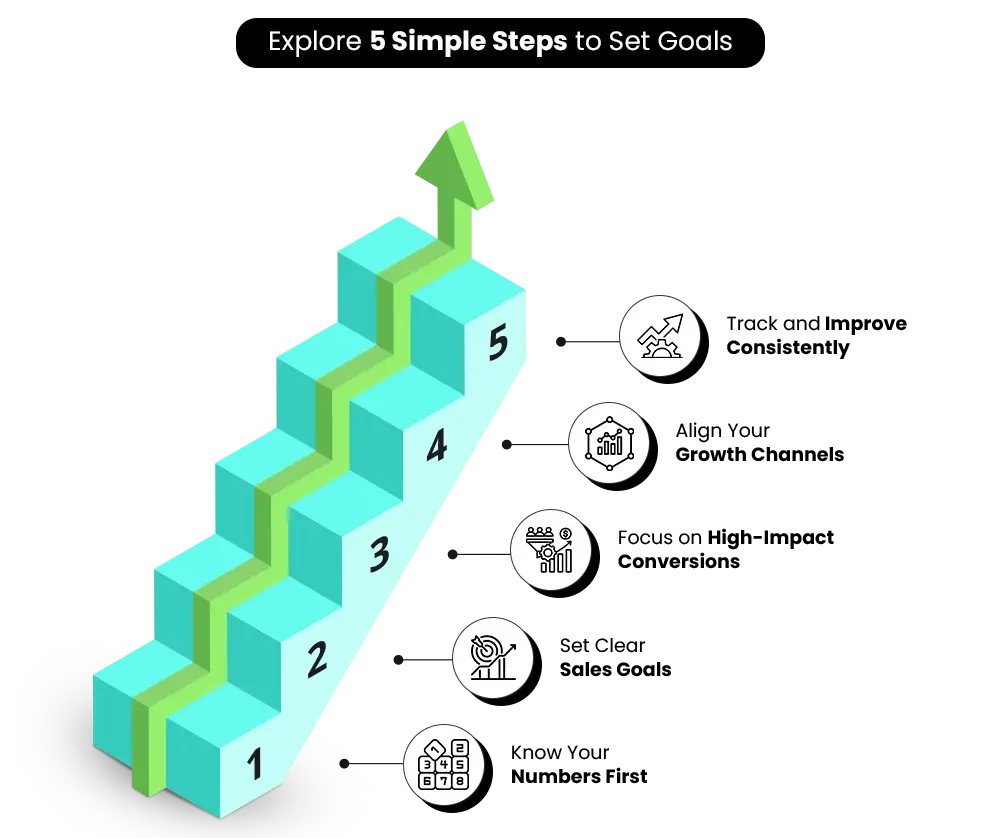
Let’s explore 5 steps to get more sales on Shopify with clear, actionable goal-setting.
Step 1: Know Your Baseline Before You Set Any Goals To Get More Sales On Shopify
Realistic goals require real data. Before setting a single target, you need to understand where your store currently stands across the metrics that matter most.
The Core Metrics to Track
These are the numbers that directly reflect the health of your Shopify store’s conversion funnel.
| Metric | What It Tells You | Where to Find It |
| Conversion Rate | Percentage of visitors who complete a purchase | Shopify Analytics / GA4 |
| Add-to-Cart Rate | How well your product pages are engaging visitors | Shopify Reports |
| Cart Abandonment Rate | The level of friction in your checkout process | Shopify / Klaviyo |
| Average Order Value (AOV) | How much each transaction is worth | Shopify Analytics |
| Customer Lifetime Value (CLV) | The long-term profitability of your customer base | Shopify / CRM tool |
| Traffic by Source | Which channels are driving revenue vs. just clicks | Google Analytics 4 |
Tracking these consistently at a minimum weekly rate gives you a baseline to measure progress against. Without a baseline, you cannot tell if a change you made helped, hurt, or had no effect at all.
Shopify Conversion Rate Benchmarks by Category
Industry benchmarks help you understand whether your store is underperforming relative to comparable businesses or simply operating in a naturally lower-converting category.
- Fashion and Apparel: 1.0% to 3.0%
- Health and Beauty: 2.5% to 5.7%
- Home and Garden: 1.2% to 1.9%
Conversion rates above 4.7% place a store in the top 10% of all Shopify stores globally. If you are sitting below 1%, something fundamental needs attention before optimisation begins; this typically points to a technical issue, a trust problem, or a traffic quality issue.
How to Audit Your Funnel Quickly?
Go to Shopify Admin, then Analytics, then the Online Store Conversion Funnel report.
This shows you how visitors move or fail to move from product views to add-to-cart, from add-to-cart to checkout initiation, and from checkout initiation to purchase completion.
Look for the stage with the steepest drop-off. That is your highest-priority fix. Pair this data with session recordings from tools like Hotjar or Microsoft Clarity.
These tools show you visually where users hesitate, what they scroll past, and where they abandon. The combination of quantitative funnel data and qualitative session recordings gives you a clear picture of what to fix and why.
If your 2026 Shopify goals feel off, this video explains what’s wrong and how to set targets that actually drive growth.
📌 Key Video
Step 2: Setting SMART Sales Goals for Your Shopify Store in 2026
Once you have your baseline, goal-setting becomes a much more structured exercise. The SMART framework, specific, Measurable, Achievable, Relevant, and Time-bound, is the most reliable way to turn an intention into an actionable target.
Applying SMART to Ecommerce Goals
- Specific: “Increase mobile conversion rate” rather than “sell more on mobile.”
- Measurable: “from 1.2% to 1.8%”, a number you can track week over week
- Achievable: Based on your current traffic volume and funnel data, not on aspirational benchmarks
- Relevant: Tied directly to revenue, not traffic or social followers
- Time-bound: “by the end of Q2 2026”, a deadline creates urgency and accountability
Three Tiers of Shopify Sales Goals
Not all Shopify stores are in the same position, and goals should reflect where a store actually is, not where the owner wishes it were.
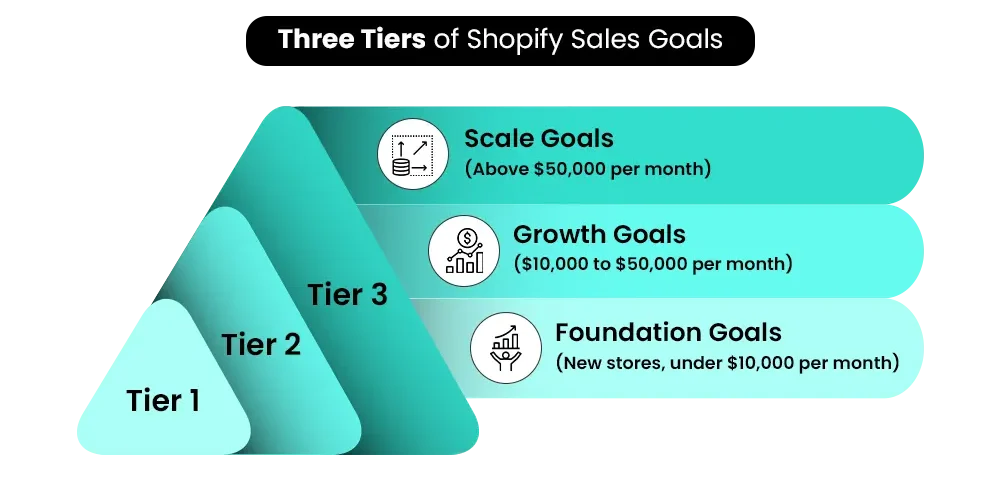
Tier 1 — Foundation Goals (New stores, under $10,000 per month)
At this stage, the priority is building credibility and fixing the basics.
- Accumulate at least 10 reviews per product
- Achieve an overall conversion rate of 2%
- Build an email list of 500 or more subscribers
- Set up a 3-email abandoned cart recovery sequence
Tier 2 — Growth Goals ($10,000 to $50,000 per month)
Here, the focus shifts to maximising revenue from existing traffic while building retention infrastructure.
- Increase average order value by 15% through bundles and upsells
- Reduce cart abandonment rate below 65%
- Grow email-attributed revenue to 20% to 30% of total monthly revenue
- Hit an overall conversion rate of 3% or above
Tier 3 — Scale Goals (Above $50,000 per month)
At scale, the priority is efficiency, retention, and compounding customer value.
- Implement advanced customer segmentation VIP, at-risk, high-AOV segments
- Achieve a repeat purchase rate above 30%
- Optimise CLV by 20% through loyalty programs and post-purchase flows
- Expand to two or more active sales channels (marketplace, social commerce, or wholesale)
The Compound Effect of Stacked Goals
Here is what most Shopify sellers miss: these goals do not add; they multiply.
A 0.5% improvement in conversion rate, combined with a $10 increase in average order value, and a 5% improvement in repeat purchase rate, does not equal 15% revenue growth. It can produce 40% or more revenue growth because these improvements interact with each other at every order.
This compounding effect is precisely why goal-setting matters so much. When goals are aligned across the funnel rather than separated by channel or tactic, the result is exponential rather than linear growth.
Step 3: The 6 Conversion Strategies That Directly Help You To Get More Sales On Shopify
With your baseline set and goals defined, the next step is execution. These six strategies focus on the highest-impact areas for getting more sales on Shopify in 2026.
Start with product pages and move step by step.
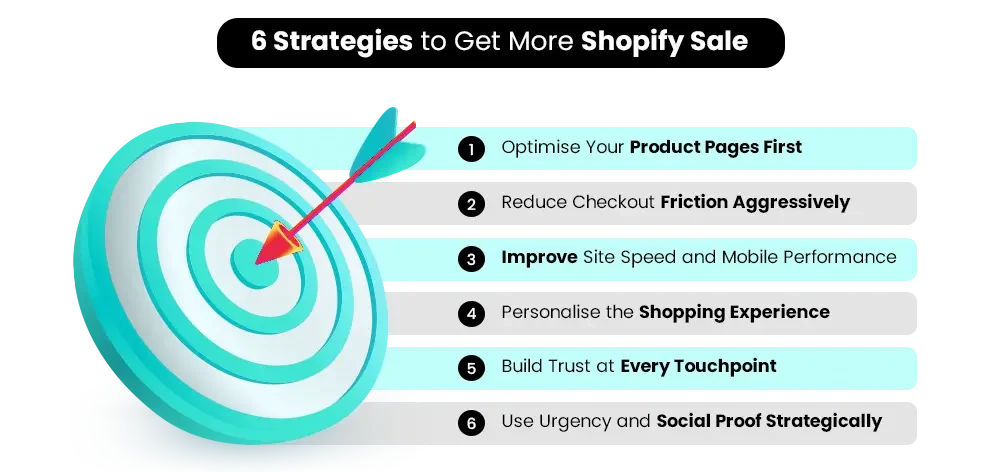
1. Optimise Your Product Pages First
Product pages are the most important pages on your store. Around 40% to 60% of visitors land directly on them, skipping the homepage entirely. This makes product page performance the biggest driver of your conversion rate.
High-converting pages quickly answer key questions:
Can I trust this store? Is the product worth it? What if I do not like it? Why buy now? Is this legit?
What to implement:
- Use 5 to 7 product images, including angles, lifestyle shots, and close-ups
- Add short product videos under 60 seconds
- Lead descriptions with benefits, not just specs
- Keep the add-to-cart button visible above the fold and sticky on mobile
- Show reviews, ratings, and trust badges near pricing
Compress all images to under 200KB to maintain speed and performance.
2. Reduce Checkout Friction Aggressively
Even strong product pages cannot compensate for a poor checkout. Cart abandonment averages around 70%, which means a large portion of potential revenue is lost at the final step.
Reducing friction even slightly can significantly increase revenue without increasing traffic.
What to implement:
- Enable guest checkout
- Offer multiple payment methods like cards, PayPal, Shop Pay, Apple Pay, and buy-now-pay-later options
- Show shipping costs early
- Add a checkout progress indicator
- Remove unnecessary form fields
Set up a three-email abandoned cart flow at 1 hour, 24 hours, and 72 hours to recover lost sales.
3. Improve Site Speed and Mobile Performance
Speed directly impacts conversions. Even a one-second delay can reduce conversions noticeably. With most traffic coming from mobile, performance on phones is critical.
What to implement:
- Compress images using tools like TinyPNG or TinyIMG
- Remove unused apps regularly
- Use fast Shopify 2.0 themes like Dawn, Impulse, or Turbo
- Test performance using Google PageSpeed Insights
- Ensure lazy loading is enabled
On mobile, keep navigation simple and CTA buttons easy to reach.
4. Personalise the Shopping Experience
Personalisation helps customers find what they want faster and increases the likelihood of purchase. When done right, it can significantly improve conversion rates.
What to implement:
- Use tools like Rebuy, LimeSpot, or Nosto for product recommendations
- Add quiz-based tools like Octane AI for new visitors
- Sync email and on-site behaviour for consistent experiences
- Show personalised messages for returning visitors
Segmented email campaigns tend to perform far better than generic ones.
5. Build Trust at Every Touchpoint
Trust often determines whether a visitor becomes a customer. Stores that clearly communicate credibility perform better than those relying only on pricing or discounts.
What to implement:
- Use review apps like Judge.me or Loox
- Display clean and professional trust badges
- Make shipping, returns, and refund policies easy to find
- Offer live chat for higher-value purchases
- Maintain a clear and authentic About page
More reviews and real customer feedback directly improve buying confidence.
6. Use Urgency and Social Proof Strategically
Urgency and social proof are powerful when used honestly. Overusing them or making them feel fake can hurt trust.
What to implement:
- Show low-stock indicators when inventory is actually limited
- Use real-time purchase notifications if order volume supports it
- Promote genuine time-bound offers like launches or seasonal sales
- Highlight verified buyers and real customer photos
The goal is to create a store experience that feels active, credible, and trustworthy rather than pushy.
Step 4: Channel-Specific Goals to Get More Sales on Shopify in 2026
Conversion rate optimisation improves on-site performance, but real growth in 2026 requires a coordinated approach across owned channels. Setting clear goals for each channel helps your team focus and measure what is actually driving revenue.
Email Marketing: Your Highest-ROI Owned Channel
For established Shopify stores, email can drive 20% to 30% of total revenue. It remains one of the most cost-effective channels because the audience has already opted in.
Essential flows include a welcome series, abandoned cart emails, post-purchase follow-ups, and win-back campaigns.
Tools to consider:
- Klaviyo for advanced segmentation
- Omnisend for combined email and SMS
- Privy for smaller stores
Goal example: Grow your email list from 800 to 2,500 subscribers by Q3 and generate 25% of total revenue from email by the end of 2026.
SMS Marketing: High Open Rates, Low Competition
SMS offers extremely high open rates and works well for time-sensitive communication like flash sales, restocks, and order updates.
Always ensure proper opt-in and follow regulations to avoid compliance risks.
Goal example: Set up abandoned cart and post-purchase SMS flows and achieve at least an 8% click-through rate by Q2 2026.
Paid Advertising: Smarter Spending, Not Bigger Budgets
Success with paid ads comes from efficiency, not just higher spend. Focus on improving return on ad spend (ROAS) and lowering acquisition costs.
Meta is effective for targeting and retargeting, Google captures high-intent searches, and TikTok supports discovery through short-form content.
Goal example: Achieve a 3.5x ROAS on Meta campaigns while keeping cost per acquisition under $18 by Q2 2026.
Organic and Community-Led Growth
Organic channels build long-term, compounding traffic. SEO content, user-generated content, and influencer collaborations help reduce reliance on paid ads.
Publishing consistent, keyword-focused content can drive steady traffic over time, while community engagement builds trust before purchase.
Goal example: Publish two SEO-focused blog posts per month and reach 500 organic search sessions per month by Q4 2026.
Step 5: Track, Test, and Iterate — The 90-Day Sales Growth Framework
Knowing the right strategies is one thing. Sequencing them correctly is what actually produces results. This 90-day framework gives you a structured path to implement everything in an order that compounds rather than overwhelms.
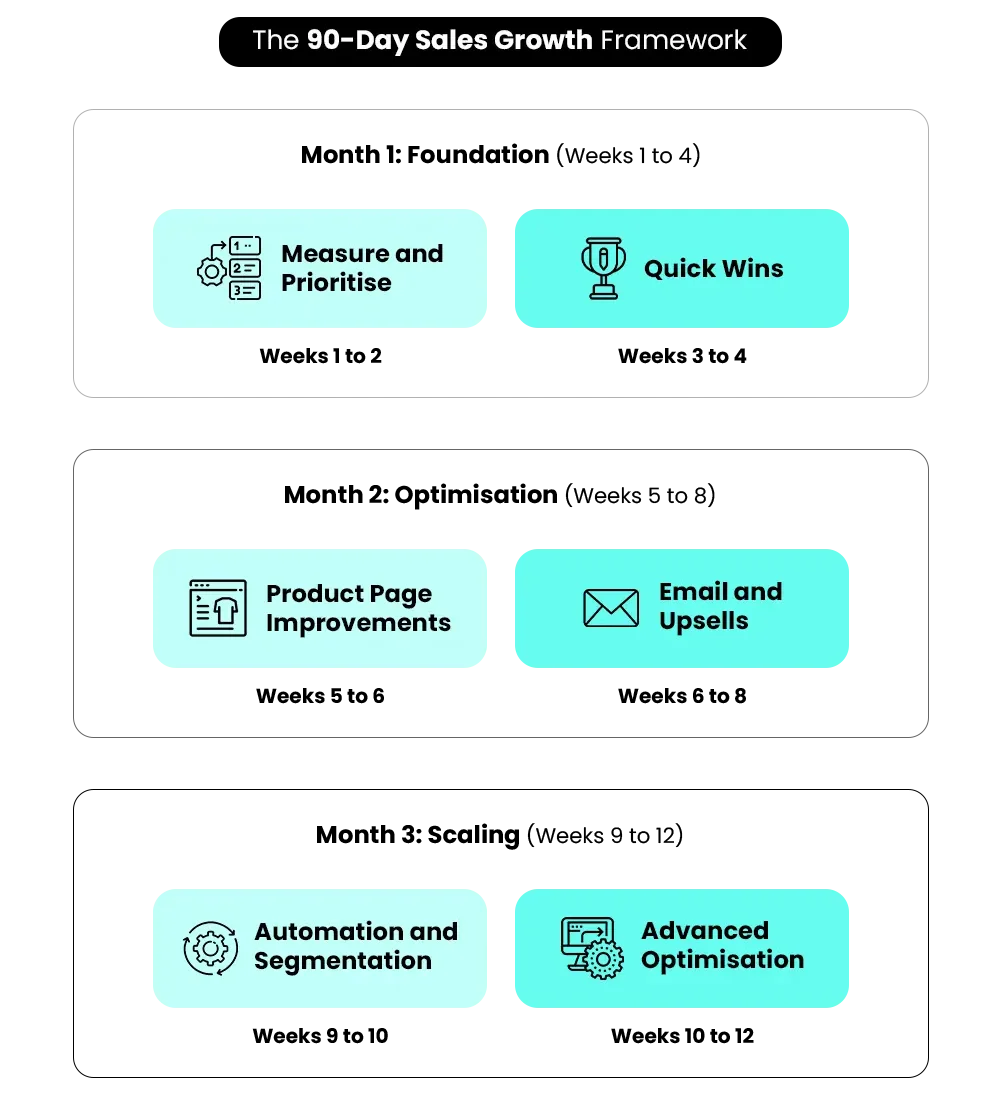
Month 1: Foundation (Weeks 1 to 4)
Weeks 1 to 2 — Measure and Prioritise
- Set up GA4 properly if it is not already tracking all conversion events
- Document your baseline metrics: conversion rate, AOV, cart abandonment rate, and top five traffic sources by revenue
- Audit your top 10 product pages, which have the lowest conversion rates relative to their traffic volume?
- Test the checkout flow on both mobile and desktop to identify friction points
Weeks 3 to 4 — Quick Wins
- Install Judge.me and import any existing reviews from previous platforms
- Compress all product images to under 200KB
- Add at least three additional product images to your top 10 products
- Set up a basic three-email abandoned cart sequence at one hour, 24 hours, and 72 hours
Expected impact: 0.3% to 0.5% conversion rate improvement
Month 2: Optimisation (Weeks 5 to 8)
Weeks 5 to 6 — Product Page Improvements
- Rewrite product descriptions for your top 20 products, leading with benefits over specifications
- Add or improve product videos for your five best-selling products
- Enable and test Zoom functionality on all product images, especially on mobile
- Set up automated review request emails to trigger seven days after confirmed delivery
Weeks 7 to 8 — Email and Upsells
- Expand the abandoned cart sequence from three to five emails
- Install a post-purchase upsell app like ReConvert to capture revenue immediately after the first transaction
- Launch a pop-up to begin actively building the email list
- Test “frequently bought together” recommendations on your top product pages
Expected impact: An additional 0.4% to 0.6% cumulative conversion improvement
Month 3: Scaling (Weeks 9 to 12)
Weeks 9 to 10 — Automation and Segmentation
- Implement customer segmentation: tag VIP customers (above $500 lifetime value), repeat buyers (two or more purchases), and at-risk customers (inactive for 90 or more days)
- Set up automated low-stock alerts for high-demand products
- Create segmented email campaigns for each customer tier; VIPs get early sale access, at-risk customers get a win-back offer
Weeks 11 to 12 — Advanced Optimisation
- A/B test key product page elements: CTA placement, pricing display, and hero image selection
- Conduct a full app audit and remove everything unused
- Add a social proof app if your order volume supports it (at a minimum, 10 orders per day)
- Build two to three high-converting landing pages specifically for paid ad campaigns
Expected impact: An additional 0.3% to 0.5% improvement (cumulative total of 1.0% to 1.6% over 90 days)
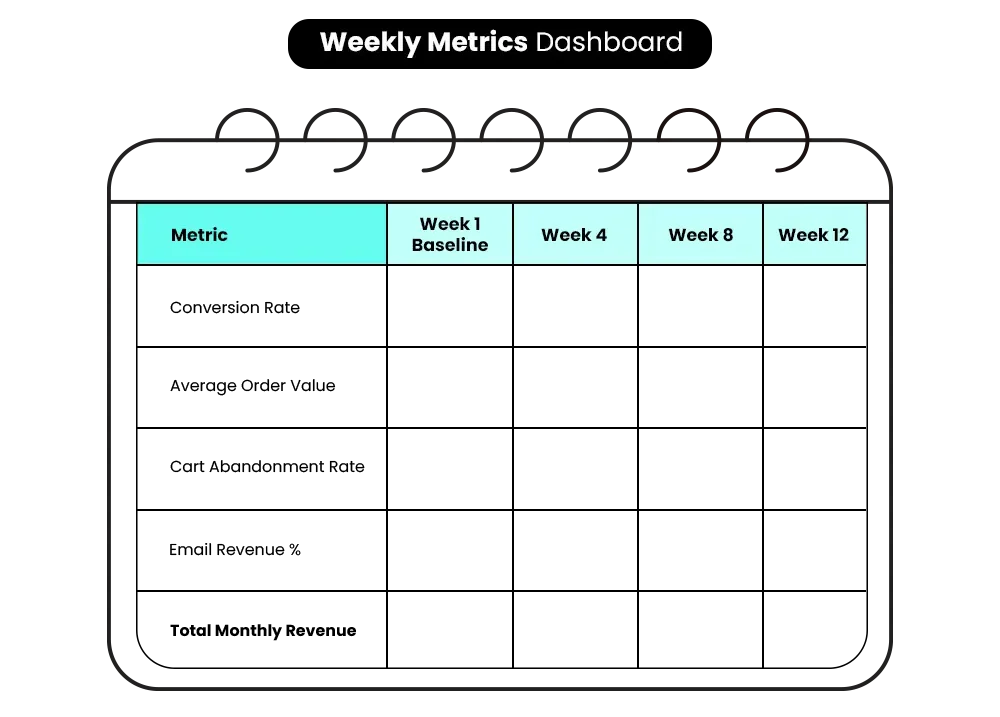
Track these weekly, but compare month-over-month rather than day-to-day. Conversion rates fluctuate naturally. Trends are what matter, not individual data points.
For a store doing $20,000 per month at a 2% conversion rate, a 1.5% cumulative improvement moves the conversion rate to 3.5%, generating $35,000 per month.
That is $15,000 in additional monthly revenue, or $180,000 per year, from the same traffic.
Common Goal-Setting Mistakes Shopify Store Owners Make
Understanding what works is important. Understanding what to avoid is just as valuable.
1. Setting goals without a baseline
You cannot improve what you have not measured. Committing to a goal before documenting your starting point makes it impossible to evaluate whether your efforts are working.
2. Optimising for traffic instead of conversion
More visitors do not automatically mean more sales. Sending 10,000 unqualified visitors to a store with a leaky checkout is expensive. Sending 5,000 qualified visitors to an optimised store is profitable.
3. Installing too many apps at once
The Shopify App Store has thousands of options, and the temptation to install multiple apps simultaneously is understandable. The problem is that every app adds code to your store. An app audit should happen monthly, and remove anything unused.
4. Chasing competitor benchmarks instead of your own data
A 2% conversion rate might be strong in one category and weak in another. Start with your numbers. Improve from your baseline. Competitor data is context, not a target.
5. Abandoning strategies too quickly
Conversion rate optimisation requires a minimum of two to four weeks of data per test to draw reliable conclusions. Changing course after three days because a metric dipped slightly is one of the most common and costly mistakes in ecommerce.
6. Ignoring post-purchase entirely.
The easiest customer to sell to is one who has just completed a transaction. Their trust is established, their payment information is on file, and their satisfaction with the first purchase is the foundation for the second.
Stores that ignore post-purchase flows are leaving repeatable, high-margin revenue on the table every single day.
Most Shopify merchants repeat this goal-setting mistake every year. Watch this to avoid it and set smarter goals.
📌 Key Video
About Mastroke
Mastroke is a results-driven Shopify agency focused on conversion rate optimisation, ecommerce growth strategy, and full-funnel execution for brands at every stage.
Our team combines data, design, and automation to help store owners move beyond guesswork and build systems that drive consistent, measurable revenue.
Our core expertise includes product page optimisation, checkout CRO, email marketing automation, paid media strategy, Shopify performance, and organic growth.
As a Shopify CRO agency, Mastroke takes a structured and analytical approach to growth. The focus is not on isolated campaigns, but on building a conversion system that improves performance over time and supports long-term sales goals.
Conclusion
Getting more sales on Shopify in 2026 is not about one tactic. It is about building a system where goals are based on real data, strategies are prioritised correctly, and results are tracked consistently.
The stores that grow are not always the ones spending the most. They are the ones who understand their numbers, identify where their funnel is leaking, set clear goals, and execute consistently over time.
- Start by documenting your current metrics to get more sales on Shopify.
- Set focused goals based on your stage, then work through the key strategies step by step, starting with product pages and moving through checkout, speed, personalisation, trust, and urgency.
When these improvements are applied consistently over 90 days, they can realistically increase revenue by 20% to 40% without increasing ad spend. That is the impact of treating conversion optimisation as a structured system.
Ready to Turn Your Shopify Store Into a Consistent Sales Machine?
Stop guessing and start growing with a clear, data-backed strategy built around your store’s actual numbers.
Our team at Mastroke will analyse your full conversion funnel, identify key revenue gaps, and provide a practical roadmap aligned with your 2026 goals.
Book your free Shopify audit with Mastroke today.
Frequently Asked Questions
1. How do I get more sales on a Shopify store without spending more on ads?
Focus on improving your conversion rate. Fix slow pages, weak product content, complex checkout, and missing trust signals. Even a small improvement can significantly increase revenue from the same traffic.
2. What is a good conversion rate for a Shopify store in 2026?
Most stores convert between 1.4% and 2.5%. Above 3% is strong, but benchmarks vary by industry, so compare within your category.
3. Why are visitors not buying from my store?
Common reasons include low trust, unclear product value, high checkout friction, or slow mobile performance. Tools like session recordings can help identify drop-offs.
4. How long does it take to see results from optimisation?
Quick fixes can show results in a few weeks. Larger changes usually take 60 to 90 days. Ongoing optimisation delivers the best results over time.
5. What apps are most important for increasing Shopify sales?
Start with a review app, an email marketing tool, and a post-purchase upsell app. Avoid adding too many apps, as they can slow down your store.