This blog post explains how rising costs on Meta and Google are hurting Shopify merchants' returns, while TikTok Shop presents a major untapped growth opportunity. It covers how the Shopify-TikTok Shop integration works and why merchants should prioritize this platform in 2026.
Most Shopify merchants are spending more on Meta and Google every year and getting less back.
According to Triple Whale’s 2025 benchmark report covering nearly 35,000 ecommerce brands, the median Meta CPM hit $13.48 in 2025 — up 20% year-over-year — and every single industry saw costs rise.
Organic reach keeps declining. The budget required to stay visible keeps climbing. The return on that spend keeps flattening.
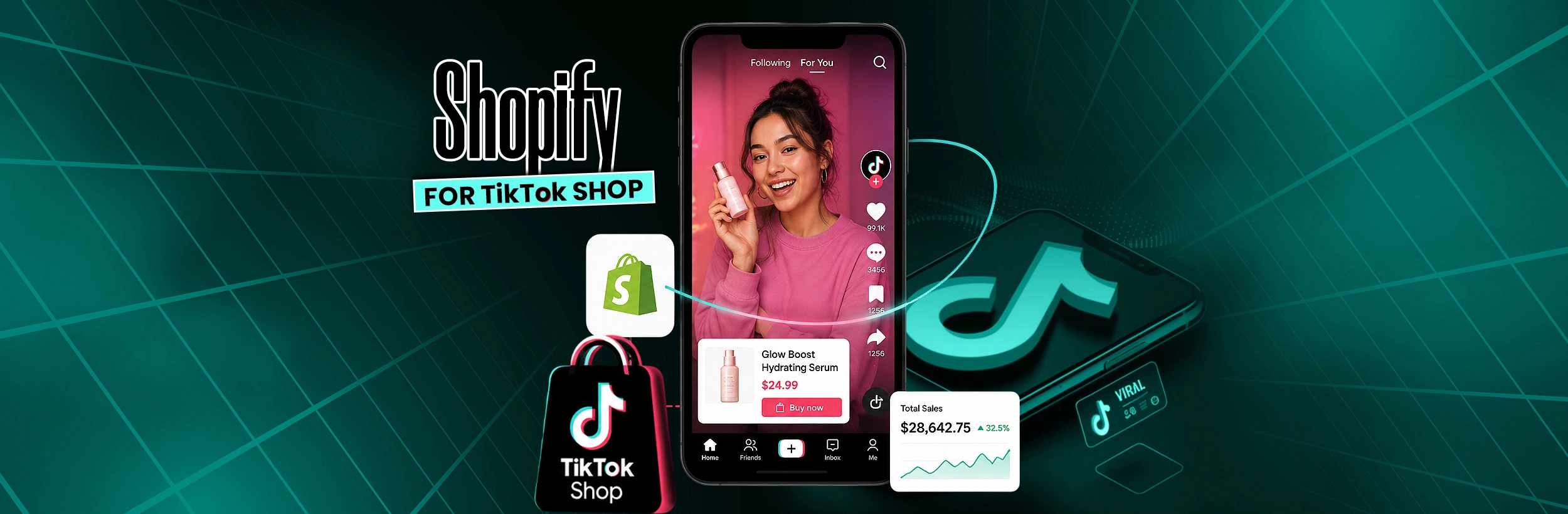
Meanwhile, Shopify for TikTok Shop has become one of the most significant growth opportunities in ecommerce right now — and most merchants still haven’t touched it properly.
This guide covers how the integration works, how to connect it step by step, what products are actually selling, and how to drive early traction without a large ad budget.
What Is TikTok Shop and Why Shopify Merchants Should Care in 2026?
What TikTok Shop Actually Is?
TikTok Shop is an in-app ecommerce system built directly into TikTok. Users discover products, tap a product tag in a video or live stream, and complete checkout — all without leaving the app.
It’s not a storefront you browse. It’s commerce that happens inside content. That’s the fundamental difference from every other channel a Shopify merchant typically runs.
The platform supports three selling formats: shoppable videos with product tags embedded in regular content, live shopping sessions where selling happens in real time, and a product catalog that surfaces in TikTok’s own search results and Shop tab.
Why TikTok Shop Matters for Shopify Stores Right Now?
TikTok Shop generated $64.3 billion in global GMV in 2025 — nearly doubling year-over-year across 16 markets. In the US specifically, it hit $15.1 billion in GMV, up 68% year-over-year, according to the Momentum Works and Tabcut 2025 annual report. The US remained TikTok Shop’s single largest market globally.
According to eMarketer’s inaugural TikTok Shop forecast, the platform commands 18.2% of all US social commerce — a share projected to reach 24.1% by 2027. US sales are forecast to exceed $23 billion in 2026.
Over 475,000 shops are active on TikTok in the US — and the merchants seeing the best results aren’t the biggest brands. They’re small-to-mid-size Shopify stores that understand how the platform works and move fast.
For Shopify merchants specifically, the opportunity is practical: your product catalog syncs automatically. You don’t rebuild listings. You don’t manage a separate inventory system. Shopify stays the operational backbone while TikTok drives discovery and sales.
The Rise of Social Commerce and Why TikTok Is Leading It
TikTok has approximately 153 million monthly active users in the US alone, according to DemandSage and Business of Apps data. The majority of active buyers sit in the 18–34 bracket, and 45.5% of US TikTok users made at least one ecommerce purchase on the platform in 2025.
Younger shoppers increasingly use TikTok to discover and evaluate products, not just to watch content. TikTok has built something unusual: a platform that functions simultaneously as a search engine, a content feed, and a storefront. Merchants who recognize that shift early — and position their products inside it — are acquiring customers at a fraction of what Meta or Google currently costs.
What Makes TikTok Shop Different From Every Other Sales Channel?
The Traditional Funnel Has Too Many Steps
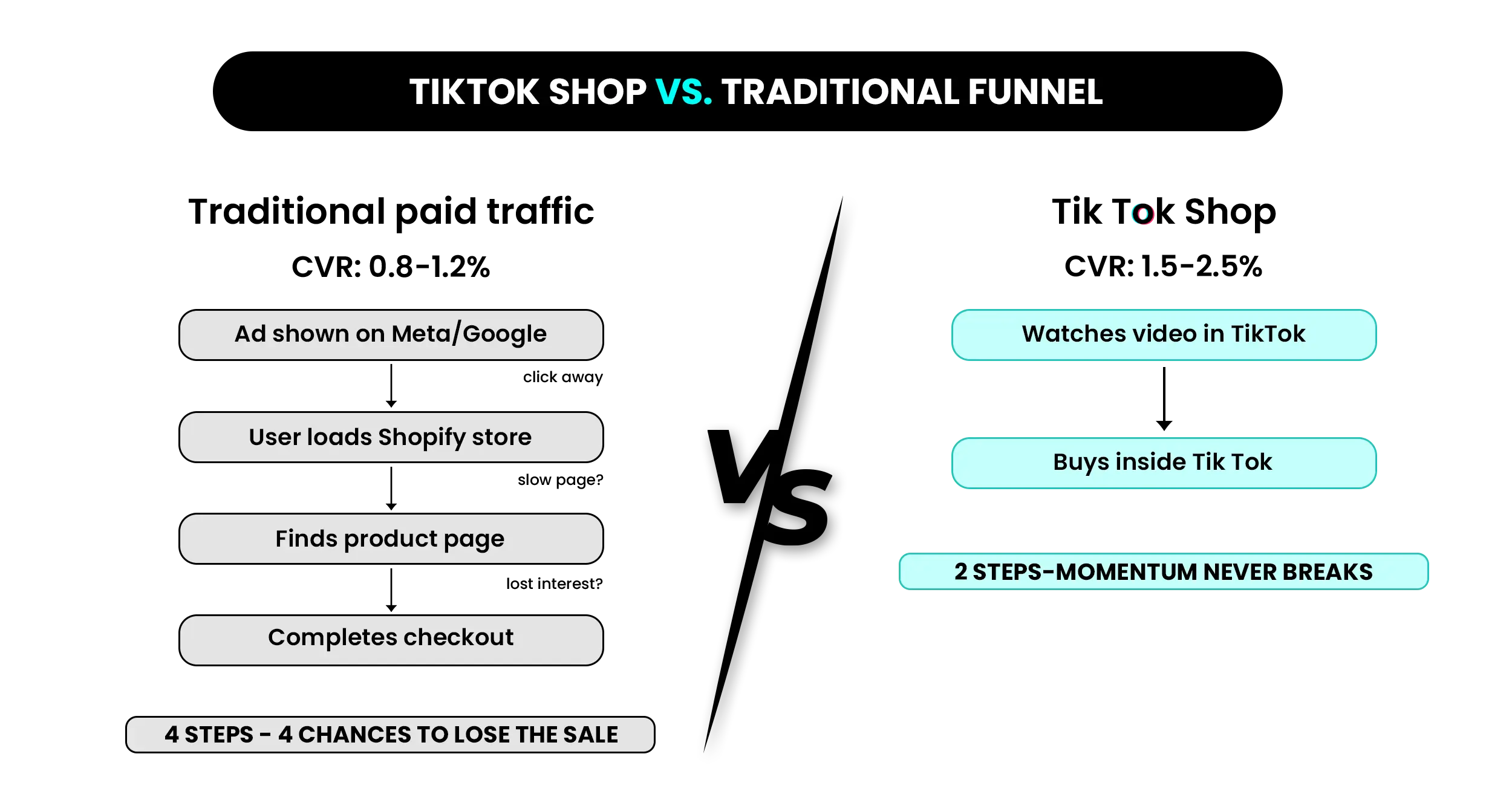
The classic paid traffic model runs like this: run an ad → user clicks to your website → user finds the product page → user goes through checkout. Four steps. Four moments where someone can leave.
TikTok Shop collapses entirely. A user watches a video → taps the product tag → checks out inside TikTok. One step. No redirect. There is no new page to load. No abandoned cart because the site was slow.
That reduction in friction is why in-app conversion on TikTok Shop runs measurably higher than conversion rates on traffic redirected from TikTok ads to an external Shopify storefront. The checkout doesn’t interrupt the momentum of the content.
Three Mechanics That Make It Work
a). Discovery-driven purchasing. Users don’t open TikTok to shop — they open it to be entertained. Products succeed when they feel like content, not ads. A skincare product showing a visible before-and-after. A kitchen gadget doing something surprising. A fashion piece styled in a way that makes someone think, “I need that.” The product wins because the video is genuinely interesting — not because an ad was served.
b). Creator-powered distribution. TikTok’s affiliate program lets creators promote your products to their audiences for a commission you set — typically 10–20%. You pay only when a sale is made. It’s performance-based influencer marketing at scale, not a media buy upfront.
c). Algorithmic reach. Unlike Meta, where paid amplification is effectively required even to reach your own followers, TikTok’s algorithm can surface a product video to millions of users regardless of your follower count. A single well-performing creator video can generate thousands in sales in 24 hours. The algorithm does the distribution — you provide the products and content.
Who Is Actually Buying on TikTok in 2026?
TikTok’s US buyer base skews young and moves fast. Beauty and Personal Care is the largest TikTok Shop category by GMV in the US, followed by Women’s Wear and Underwear, and Sports and Outdoors — per Momentum Works’ 2025 full-year US data. These shoppers act on impulse, often within seconds of seeing something that clicks.
Want More Sales From TikTok Shop and Social Commerce?
How Shopify and TikTok Shop Work Together?
What the TikTok Shopify Integration Actually Does?
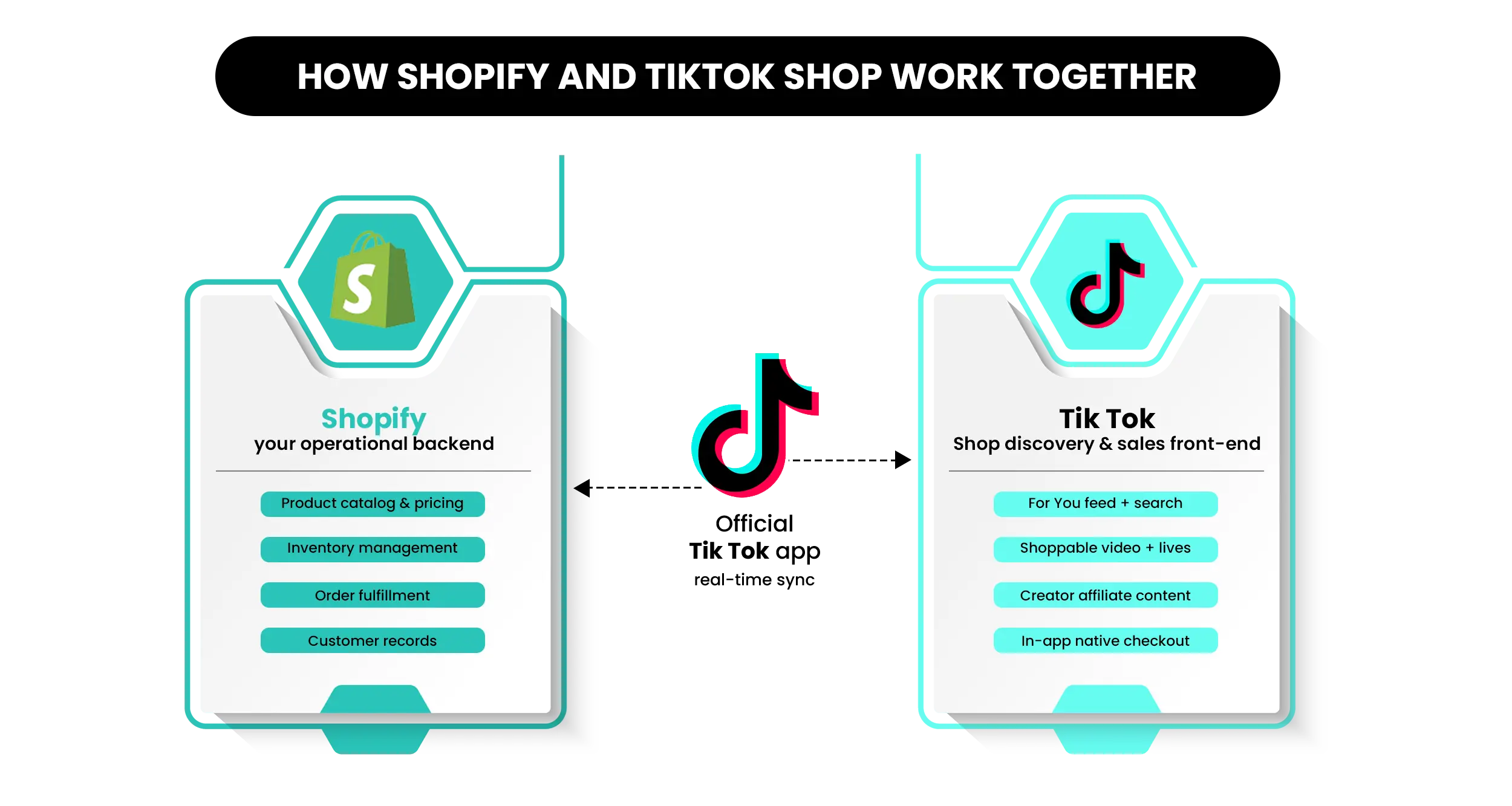
The official TikTok app for Shopify creates a direct link between your Shopify product catalog and your TikTok Shop. Update pricing in Shopify — it updates on TikTok. Inventory drops — both platforms reflect it. A TikTok Shop order comes in — it flows into your Shopify order management system like any other order.
No rebuilding product pages from scratch. There is no separate inventory tracking. No duplicate order management. Shopify handles operations. TikTok handles discovery and sales.
Shopify as the Backend, TikTok as the Front-End
The division is clean. Shopify handles everything operational — product data, inventory levels, fulfillment workflows, customer records, and returns management. TikTok handles everything discovery-related — the For You feed, search results, live shopping sessions, creator content, and in-app checkout.
This is the right setup. Managing operations inside TikTok’s seller center when you can manage them in Shopify adds unnecessary complexity. The integration keeps things clean as volume scales.
What Happens After a TikTok Shop Sale?
Orders placed through TikTok Shop sync into your Shopify admin. Inventory updates automatically. Your existing fulfillment workflow picks up the order just like any other Shopify order.
One important limitation to plan around: TikTok owns the customer relationship at checkout. You don’t automatically receive the buyer’s email address for your Shopify customer list. If email retention is part of your long-term strategy — and it should be — you’ll need a separate mechanism to capture those customers post-purchase.
For a broader look at building a multi-channel Shopify growth system that holds up as volume scales, read our guide on how to plan your Shopify store growth in 2026.
How to Connect Shopify for TikTok Shop — Step-by-Step Setup?
What You Need Before You Start?
- A Shopify store on any paid plan with a verifiable business address in an eligible country (US, UK, and select markets)
- A TikTok Business account — separate from a personal TikTok account
- A valid EIN or business license and an active bank account
- A published returns policy on your storefront — TikTok Shop requires this for seller eligibility
- US sellers: ability to ship within 2 business days (TikTok’s stated requirement)
Step 1 — Install the TikTok Sales Channel App
Go to the Shopify App Store and search for “TikTok.” Install the official TikTok app for Shopify. This is the only app that creates the native product sync between your Shopify catalog and TikTok Shop. Once installed, your product data — titles, images, pricing, inventory — pushes to TikTok automatically and stays synchronized going forward.
Step 2 — Create and Connect Your TikTok Shop Seller Account
Visit seller.tiktok.com (US sellers) and complete the seller application. You’ll need your business name, EIN, registered business address, and bank account details. Approval typically takes 2–5 business days.
Once approved: go to Shopify Admin → TikTok app → click “Connect” in the TikTok Shop section → log in with your TikTok Business account → review and accept the terms → verify your shop information → upload required business documents → complete setup.
Step 3 — Sync and Optimize Your Product Listings
Listings sync automatically from Shopify — but syncing is the starting point, not the finish line. Listings need optimization for how TikTok surfaces and ranks products.
Add at least one short video (15–30 seconds) showing the product in use. Listings with video get significantly more visibility. A static product photo in a video-native environment is essentially invisible.
Write product titles that describe function and outcome, not just brand or product name. “Portable Blender for Smoothies on the Go” surfaces better in TikTok search than “The Classic Blender.”
Fill in every available product attribute — material, dimensions, weight, care instructions, and compatibility. TikTok’s algorithm uses this structured data for product discovery inside search and the For You feed.
Products under $50 with free shipping convert best. Price point is one of the clearest predictors of whether an impulse buy happens at all.
Step 4 — Install and Verify the TikTok Pixel
The Shopify-TikTok integration handles most of the pixel installation automatically. But verification is not optional. Confirm the pixel is firing correctly on both your checkout page and the post-purchase thank-you page.
Without accurate pixel data, TikTok’s algorithm can’t learn who your buyers are and can’t optimize your ad delivery. Running paid Shop Ads without a verified firing pixel is spending money without letting the algorithm do its job.
TikTok Shop Fees — What to Factor Into Your Margins
Before listing, understand what each sale actually costs. Note that as of March 31, 2026, independent shipping ended for US sellers — all orders must now go through Fulfilled by TikTok (FBT), Upgraded TikTok Shipping, or Collections by TikTok. Factor fulfillment costs into your margin calculations from the start (Dashboardly TikTok Shop Fee Guide, 2026):
| Fee Type | Cost |
| Referral (commission) fee | 6% per order (US standard rate) |
| New seller promotion rate | 3% for the first 30 days after the first sale |
| FBT fulfillment | From $2.86/unit (4+ unit orders) to $3.58/unit |
| Refund administration fee | 20% of the original referral fee, capped at $5 per SKU |
| Creator affiliate commission | 10–20% (set by merchant) |
The creator affiliate commission is the cost most merchants underestimate. Running a 15% affiliate rate on a product with 40% margins means the volume needs to justify the per-unit economics before you scale. Work this out before setting commission rates — not after.
What Products Actually Sell on TikTok Shop — and Why?
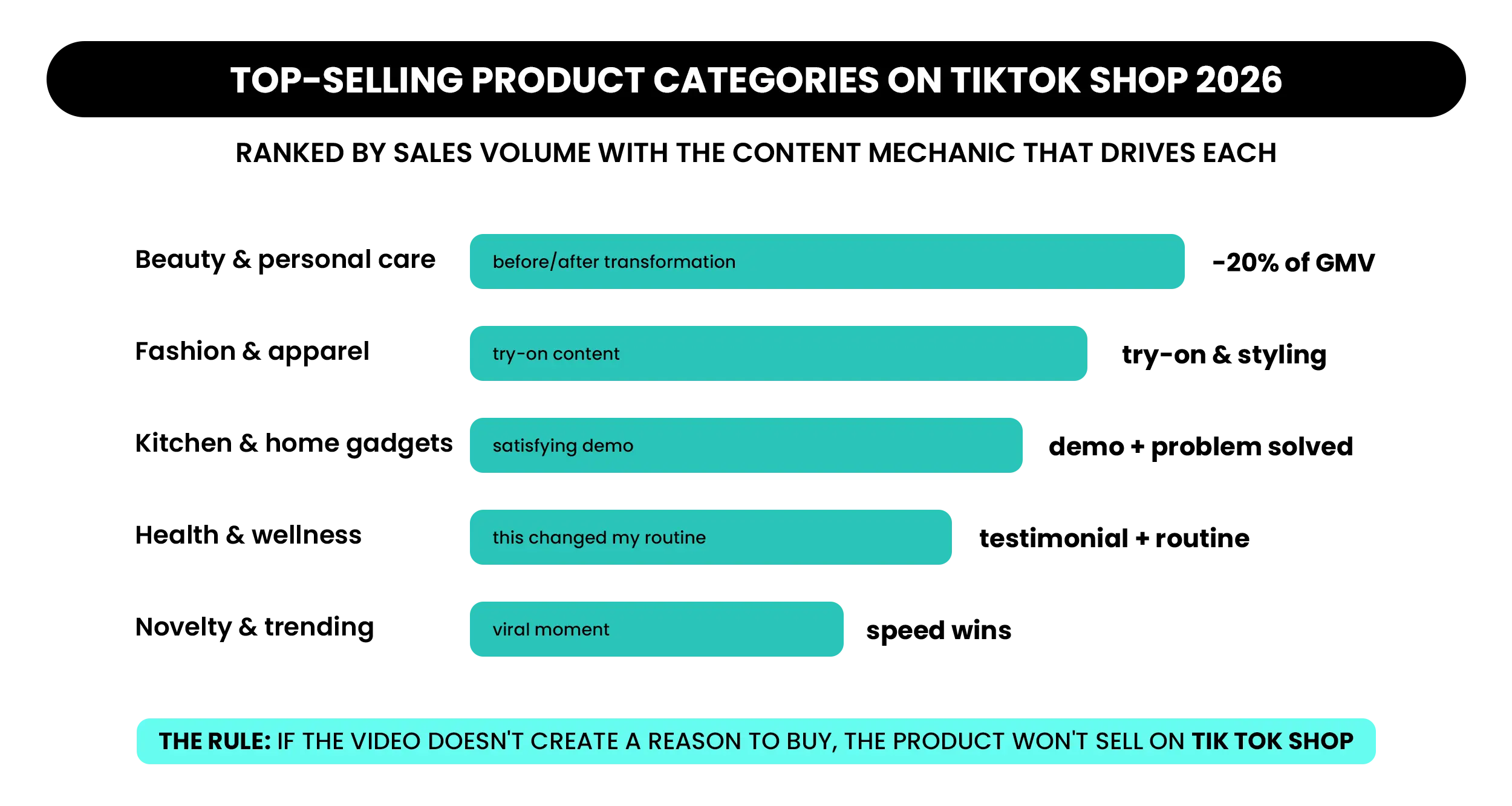
The Core Rule: The Video Has to Be the Reason to Buy
TikTok Shop is not a product catalog — it’s a stage. Products win when watching the video is itself the reason someone reaches for their card.
“Before and after” products perform because the transformation is visible. Products that solve a problem in a satisfying way to watch. Products with a reveal moment — the result of a recipe gadget, the fit of a dress, the before-and-after of a stain remover — convert because the video creates desire before the shopper clicks anything.
If your product doesn’t have a natural demonstration moment, TikTok Shop will be an uphill channel. If you want to see the kind of TikTok-style product content that actually grabs attention and drives clicks, this quick example explains it perfectly:
>
>
Product Categories Performing Strongest in 2026
- Beauty and personal care. The largest US TikTok Shop category by GMV, per Momentum Works’ 2025 data. Skincare routines, serums, lip products, hair tools, scalp treatments. Visual transformation is the content format — and it drives impulse purchases consistently.
- Fashion and apparel. Try-on videos, outfit styling, and “get ready with me” content drive this category. Casual dresses, bodysuits, loungewear, and accessories perform especially well. Fit and style communicate in 30 seconds of video better than any product description.
- Kitchen and home gadgets. Satisfying demos, problem-solving tools, and space-saving products. High share value — “you need to see this” — makes these naturally spreadable. The “does it actually work?” format converts reliably.
- Health and wellness. Supplements, fitness tools, posture correctors, recovery products. The “this changed my routine” content format drives strong conversion, particularly when backed by creator testimonials that feel authentic rather than scripted.
- Novelty and trending items. Speed matters here. If something is trending, the window to ride it is often 2–4 weeks before saturation. Merchants who move fast win disproportionately.
Products That Struggle on TikTok Shop
High-AOV items requiring research or comparison — furniture, electronics over $150, complex tools — don’t fit the impulse-buy mechanic. If a customer needs 20 minutes to decide, they won’t decide inside an app.
B2B products have the same problem. TikTok’s audience is consumer-first, full stop.
Products with complex sizing or fit questions that can’t be answered in 30 seconds generate returns and seller metric damage over time. Items with no natural visual demonstration — purely functional products with no “moment of use” — struggle to generate the content that drives TikTok discovery in the first place.
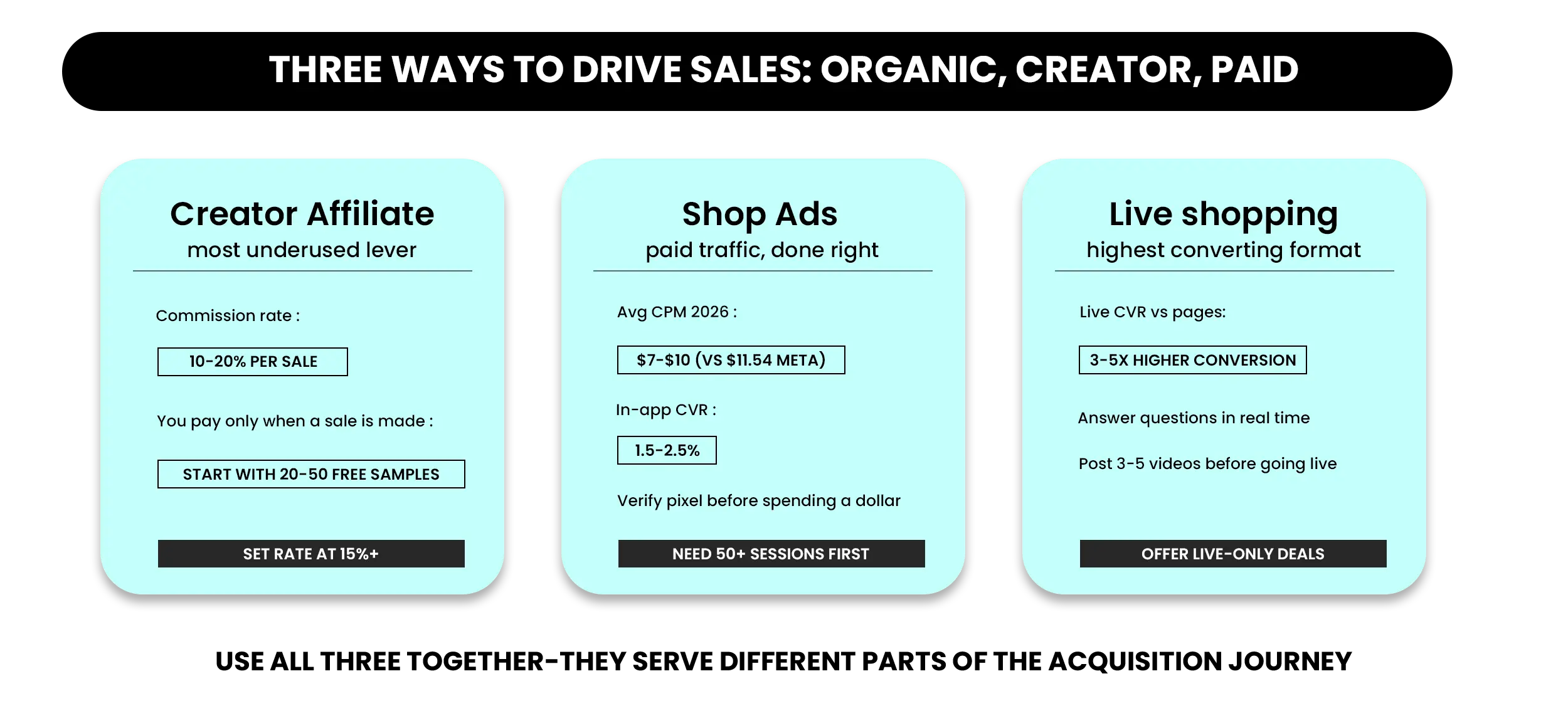
Three Ways to Drive Sales Once You’re Connected
1. The TikTok Creator Affiliate Program — the Most Underused Growth Lever
Set a commission rate on your products — 10–20% is standard — and creators can add your products to their content. Every sale through their video earns them the commission. You pay nothing until a sale is made.
Send free product samples to 20–50 creators across different niches and let the algorithm decide which content performs. One viral creator video can generate tens of thousands in sales in 24 hours. This is not a hypothetical — it’s a documented pattern on the platform.
Setting commission rates below 10% is one of the most common mistakes new TikTok Shop merchants make. Creators browse commission rates before deciding what to promote. A 7% rate gets passed over for a 15% rate every time. Start at 15–20% to build early creator momentum, then adjust once you have traction.
Use TikTok’s Creator Marketplace to find creators aligned with your product category. Shopify Collabs also connects Shopify merchants to TikTok creators — a practical starting point for merchants setting up their first creator program.
2. TikTok Shop Ads — When and How to Use Paid Traffic
Shop Ads appear natively in the For You feed with a product card. The creative rule is identical to organic: raw, authentic, UGC-style video outperforms polished brand content on click-through rate by a significant margin. Film on a phone. Show a real person using the product. Skip the studio setup.
Don’t run paid ads until your pixel is verified and you have at least 50 organic sessions logged. The algorithm needs conversion data to optimize toward your actual buyers — without it, paid spend targets the wrong audience and disappears with little to show for it.
3. Live Shopping — the Highest-Converting Format Most Merchants Ignore
TikTok Live shopping converts at a higher rate than standard product listings. Real-time demonstration, live Q&A, and session-exclusive urgency close purchases that static pages don’t. Show the product in use, answer viewer questions in the moment, and offer live-only bundles that create genuine scarcity.
Live Shopping works especially well for beauty, fashion, and gadget categories where seeing the product in action — and having questions answered on the spot — overcomes hesitation that a product page can’t resolve.
Post 3–5 product-focused videos per week before going live to build algorithmic momentum. Going live on a channel with no recent activity is less effective than going live on a channel that the algorithm is already surfacing to new viewers.
TikTok Shop vs. Running TikTok Ads to Your Shopify Store
A lot of merchants get stuck on this question. Here’s the honest comparison:
| Factor | Shopify for TikTok Shop | TikTok Ads → Shopify Store |
| Checkout friction | Low — native in-app checkout | Higher — user leaves TikTok |
| Customer data ownership | Limited — TikTok owns checkout data | Full — your own email and purchase history |
| Platform fees | 6% commission + creator affiliate | Standard Shopify + payment fees |
| Organic discovery | Yes — products surface in search + For You | No — paid traffic only |
| Best for | Volume, impulse buys, and new customer acquisition | Building email list, high-AOV products, brand building |
The smart play isn’t either/or. Use TikTok Shop for volume and new customer acquisition — especially for products under $50. Run TikTok Ads to your Shopify store for higher-ticket items, where owning the email address and purchase data matters more than frictionless checkout. Many successful merchants run both simultaneously. They’re not competing strategies — they serve different parts of the customer lifecycle.
Common Mistakes Shopify Merchants Make with TikTok Shop
Listing products with no video content.
TikTok Shop is video-first. A static image in a video-native environment doesn’t get surfaced or clicked. Even one 15-second demo video per listing changes visibility dramatically.
Setting commission rates too low.
Creators check commission rates before deciding what to promote. Below 10% and most skip it without a second look. Start at 15–20% to build early creator momentum.
Running ads before the pixel is verified.
Without confirmed conversion tracking, TikTok’s algorithm optimizes toward the wrong audience. Verify pixel firing on checkout and thank-you pages before spending a dollar on paid ads.
Treating the setup as a one-time task.
Merchants who connect TikTok Shop and then go quiet see declining visibility. The algorithm rewards fresh content and active sellers. Post weekly. Update listings seasonally. Engage with creator content when it performs.
Ignoring TikTok product SEO.
TikTok is a search engine. Include relevant keywords in product titles, descriptions, and video captions. Use 3–5 relevant hashtags per listing. This is how your products surface when someone searches “portable blender” or “dry skin serum” inside TikTok’s search bar.
For a broader look at building search and AI visibility across your entire Shopify store, read our guide on AI SEO for Shopify stores.
What Successful Shopify Brands Do Differently on TikTok Shop?
Merchants consistently generating strong GMV on TikTok Shop share a few clear patterns.
They build creator systems, not one-off campaigns. An ongoing roster of 30–100 creators who have their products and can produce content continuously — that’s what keeps the algorithm fed. A single creator partnership is a bet. A system of 50 is a distribution channel.
They prioritize volume over polish. Five imperfect videos per week beat one perfect video per month. The algorithm rewards consistency and experimentation. You need enough attempts to learn what actually works for your specific product.
They use Shopify to protect their seller metrics. Inventory accuracy and fulfillment speed feed directly into TikTok Shop’s seller performance scores. Sellers with strong metrics — orders shipped on time, low cancellation rates — get better algorithmic placement over time. Shopify’s inventory sync is what keeps those metrics clean when volume spikes overnight after a viral video.
They treat TikTok as a discovery engine, not an ad platform. The goal isn’t to run campaigns — it’s to build a content and creator presence that consistently puts products in front of buyers. That mindset shift separates merchants who get consistent results from those who try TikTok Shop once and move on.
How Mastroke Helps Shopify Merchants Set Up and Scale TikTok Shop?
Getting connected is one thing. Getting TikTok Shop working is another.
The most common scenario: a merchant connected TikTok Shop months ago, has zero sales, and doesn’t know why. Usually, it comes down to three things: the pixel isn’t firing correctly, product listings have no video content, and the commission rate is too low to attract any creators.
The second most common: listings are live, but products aren’t surfacing because titles aren’t written for TikTok search, and there’s no creator content generating traffic to those listings.
Mastroke works with Shopify merchants on channel expansion — including TikTok Shop integration, product listing optimization, and creator strategy. Every engagement starts with diagnosing where the setup is breaking down, then fixing it systematically before scaling anything.
Conclusion
TikTok Shop is not a future opportunity — it’s a current one, and it’s still early enough for small and mid-size Shopify stores to compete and win. The merchants seeing the best results right now aren’t big brands with large content teams. They’re Shopify stores that understood the platform quickly, got their products in front of creators, and let the algorithm do the distribution work.
Connecting Shopify for TikTok Shop takes less than a day. Doing it well — optimized listings, a verified pixel, a creator commission that actually attracts partners — takes a little longer. But the compounding effect starts from day one.
Start with 5–10 of your most visually demonstrable products. Get the pixel firing correctly. Set a creator commission at 15% or higher. Post content consistently. Then see what the algorithm does with it.
Ready to Scale Your Shopify Brand Through TikTok Shop?
Frequently Asked Questions About Shopify for TikTok Shop-
Q: Do you need Shopify for TikTok Shop?
A: You can set up a TikTok Shop directly through seller.tiktok.com without Shopify. But the Shopify integration gives you automatic catalog sync, inventory updates across both platforms in real time, and TikTok Shop orders flowing directly into your existing Shopify fulfillment workflow — the same system handling all your other orders. Without Shopify, you’re managing two completely separate operational systems, and any inventory discrepancy between them creates fulfillment errors that damage your seller metrics over time.
Q: How do I export Shopify products for TikTok Shop?
A: Install the official TikTok app from the Shopify App Store. Once connected to your TikTok Shop Seller account, your product catalog syncs automatically — no manual export, no rebuilding listings. The sync stays live as you update products in Shopify.
Q: Can I connect TikTok Shop to Shopify for checkout?
A: TikTok Shop uses its own native in-app checkout — customers don’t redirect to your Shopify store to complete the purchase. Shopify handles the back-end: orders sync into your Shopify admin, inventory updates automatically, and your fulfillment workflow picks up TikTok Shop orders like any other order.
Q: How do I handle returns for TikTok Shop orders in Shopify?
A: Returns and refunds for TikTok Shop orders are initiated through TikTok’s seller center, not Shopify. Once a return is processed on TikTok’s side, the inventory sync updates your Shopify stock levels automatically. Keep your returns policy clearly stated on your storefront — TikTok Shop requires a published policy for seller eligibility, and it’s the first thing buyers check before purchasing.
Q: Can I run TikTok Shop and TikTok Ads on my Shopify store at the same time?
A: Yes — and most successful merchants run both. TikTok Shop handles in-app discovery and impulse purchases, particularly for products under $50. TikTok Ads driving traffic to your Shopify store works better for higher-AOV products, where capturing the customer email and owning purchase data matters. They serve different parts of the customer journey and don’t compete with each other when set up correctly.