You’re getting traffic. People are adding products to their cart. But your Shopify sales still don’t reflect the effort you’re putting in. This is exactly where a Shopify store audit becomes important. Not because something is broken, but because your store is quietly losing revenue.
Most of the time, the issue is not your product or marketing. It is the experience inside your store. Small performance gaps like slow pages, confusing layouts, or a complicated checkout create friction. Customers do not complain. They just leave.
These are invisible gaps that are easy to miss but costly to ignore.
A Shopify store audit helps you uncover what you cannot see. It shows where your store is leaking revenue and how to fix it so you can turn existing traffic into actual sales.
In this blog, we will break down the most common conversion and performance gaps, how they impact your sales, and what you can do to fix them.
What a Shopify Store Audit Actually Reveals (Beyond Surface-Level Issues)?
A Shopify store audit is not just a quick scan of your website. It is a deep analysis of how your store performs, how users interact with it, and how well it converts visitors into customers. It looks at the full journey, from the moment someone lands on your store to the final checkout.
Many store owners think audits are about fixing broken links or making small design changes. But a real audit goes much deeper. It uncovers user behavior patterns, identifies friction points, and shows exactly where and why customers are dropping off.
In fact, studies show that nearly 70% of online shopping carts are abandoned, and a big reason behind this is poor user experience and checkout issues. These are not always obvious problems, but they have a direct impact on your revenue.
It is also important to understand the difference between specific types of audits:
- A Shopify conversion audit focuses on improving how many visitors actually make a purchase
- A Shopify CRO audit goes deeper by optimizing every step of the customer journey, from landing page to checkout
In simple terms, a Shopify store audit does not just tell you what is wrong. It shows you what is costing you sales and where the biggest growth opportunities are hiding.
The Most Common Conversion and Performance Gaps
Now that you understand what a Shopify store audit uncovers, the next step is identifying where things usually go wrong. These are not always obvious mistakes.
In fact, most of them are small gaps that slowly impact your Shopify sales and overall Shopify conversion rate optimization without you even noticing.
Let’s break down the most common areas where revenue quietly slips away.
1. When Speed Slows Down Buying Decisions
Speed plays a bigger role than most store owners realize. If your pages take too long to load, customers start losing interest before they even see your product. Even a 1-second delay can reduce conversions by around 7%, which adds up quickly over time.
Slow speed not only hurts user experience but also affects your SEO rankings. This means fewer visitors and fewer conversions at the same time.
2. When Mobile Experience Feels Like an Afterthought
Today, most users browse and shop on their phones. If your store is not fully optimized for mobile, you are creating friction where it matters the most.
Small issues like tiny buttons, broken layouts, or slow mobile speed feel much worse on smaller screens. As a result, users get frustrated and leave instead of completing their purchase.
3. When Navigation Makes Shoppers Work Too Hard
If customers cannot find what they are looking for within a few clicks, they will not spend time figuring it out. They will simply leave.
Confusing menus, poor category structure, and unclear navigation paths make the shopping experience harder than it should be. A smooth and intuitive browsing experience is a key part of a strong Shopify CRO.
4. When Product Pages Fail to Build Confidence
Your product page is where decisions are made. If it does not build trust, you lose the sale.
Missing reviews, weak descriptions, low-quality images, or a lack of detailed information create hesitation. In fact, products with reviews can convert up to 270% higher than those without. Customers need clarity and confidence before they buy.
5. When Checkout Becomes a Barrier Instead of a Bridge
The checkout process should be simple and fast. But many stores make it complicated without realizing it.
Too many steps, forced account creation, and unexpected costs can push customers away at the last moment. Around 28% of users abandon their cart due to complex checkout flows, directly impacting your revenue.
6. When SEO Keeps You Invisible
Even if your store is well-designed, poor SEO can limit your growth.
Without proper optimization, your store does not show up for high-intent searches. This forces you to rely heavily on paid ads instead of building consistent organic traffic. Over time, this increases costs and reduces profitability.
These gaps may seem small on their own, but together they create a significant impact on your conversions. Identifying and fixing them is where real growth begins.
Watch this quick video to run a one-minute Shopify store audit and instantly spot the gaps that might be affecting your sales.
What Does a Complete Shopify Store Audit Cover?
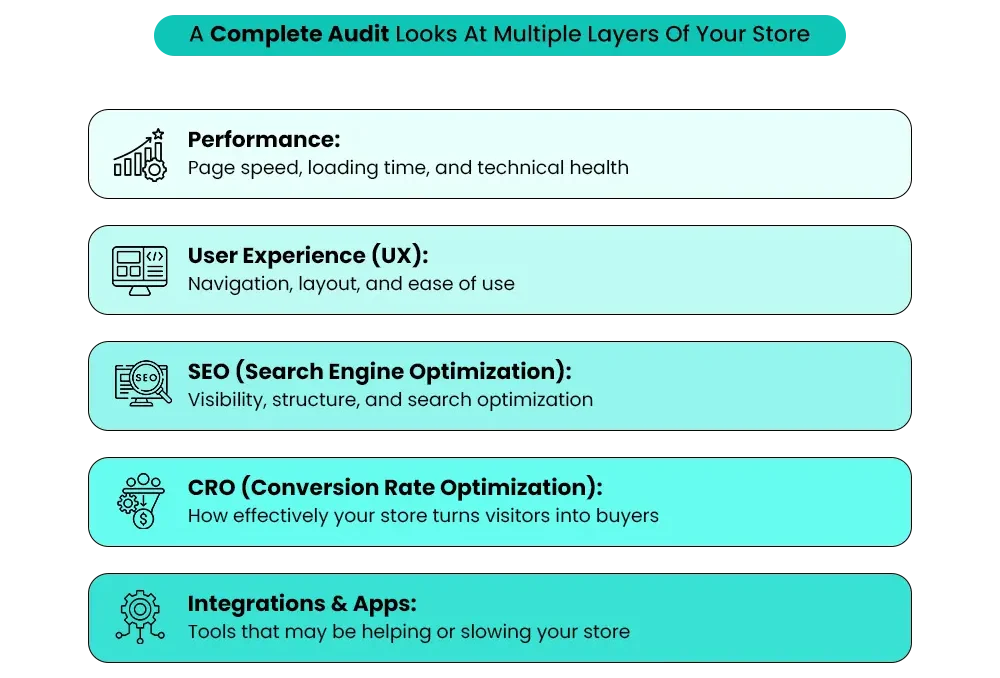
A complete Shopify store audit looks at every part of your store that affects performance, visibility, and conversions.
It is not limited to one area. Instead, it connects technical health with user behavior to give you a clear picture of what is working and what needs improvement.
Here is what a thorough audit typically covers:
1. Evaluating Site Speed and Technical Performance
Speed is one of the first things analyzed in any audit.
- Checking load time benchmarks across pages
- Optimizing images to reduce size without losing quality
- Identifying heavy apps and scripts slowing down your store
Even small delays can impact both user experience and conversions.
2. Identifying SEO Gaps That Limit Visibility
A Shopify SEO audit ensures your store is not missing out on organic traffic.
- Optimizing meta titles and descriptions
- Fixing keyword targeting issues
- Identifying indexing problems
- Removing duplicate content and broken links
- Using tools like Google Search Console for insights
Strong SEO brings high-intent visitors who are more likely to convert.
3. Understanding How Users Navigate and Interact
A store might look good, but still be hard to use.
- Reviewing menu structure and navigation flow
- Testing search functionality
- Checking if the homepage clearly communicates your value
This step helps uncover friction in how users move through your store.
4. Analyzing Conversion Paths Across the Store
A Shopify conversion audit focuses on how users turn into buyers.
- Evaluating CTA placement and visibility
- Analyzing product page performance
- Reviewing trust-building elements like reviews and guarantees
Every step is optimized to reduce drop-offs and improve conversions.
5. Testing Mobile Experience Where Most Sales Happen
Mobile performance is critical for modern stores.
- Checking responsiveness across devices
- Ensuring tap-friendly buttons and layouts
- Testing mobile checkout usability
- A smooth mobile experience is essential for a strong Shopify CRO.
6. Breaking Down the Checkout Experience
The checkout process is where many sales are lost.
- Identifying unnecessary steps and friction points
- Evaluating payment options and flexibility
- Ensuring clear and transparent pricing
A Shopify CRO audit focuses heavily on simplifying this stage.
7. Reviewing Apps and Integrations That Affect Performance
Apps can improve functionality, but too many can slow your store.
- Identifying unused or unnecessary apps
- Evaluating their impact on speed and performance
- Cleaning up integrations often leads to quick performance wins.
A complete Shopify store audit connects all these areas to give you a clear action plan. Instead of guessing what is wrong, you get precise insights into what is affecting your conversions and how to fix it.
Watch this quick video to uncover the one key audit insight that could be the reason behind your low Shopify store conversions.
Clear Signs Your Shopify Store Has Hidden Gaps
Not all problems in your store are obvious. In many cases, everything looks fine on the surface, but small issues underneath are quietly affecting your Shopify sales.
This is where a Shopify store audit helps you connect the dots and understand what is really happening.
Here are some clear signs your store has hidden performance gaps:
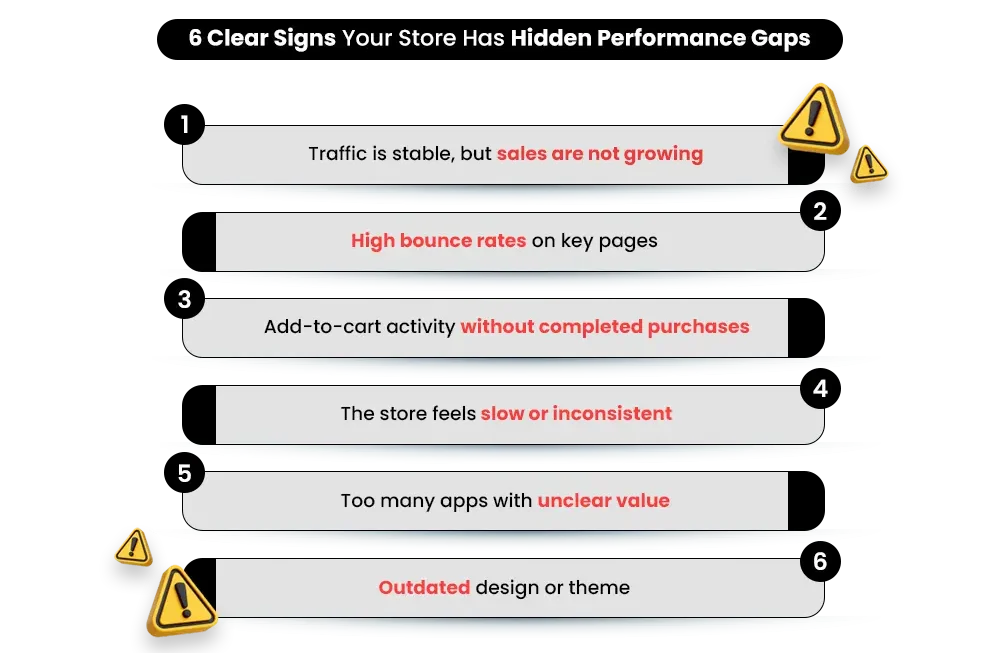
1. Traffic is stable, but sales are not growing
If your traffic numbers look healthy but your revenue is flat, the issue is likely not marketing. It usually means your store is not converting visitors effectively. This is a strong signal that your conversion flow needs attention.
2. High bounce rates on key pages
When users land on your homepage or product pages and leave within seconds, it shows a disconnect. Maybe your messaging is unclear, your design is not engaging, or the page is too slow. Whatever the reason, users are not finding what they expected.
3. Add-to-cart activity without completed purchases
This is one of the most important signals. Customers are interested enough to add products to their cart, but something is stopping them from completing the purchase. This could be due to checkout complexity, unexpected costs, or lack of trust.
4. The store feels slow or inconsistent
Even if your store works, small delays, lag, or inconsistent performance across pages can create doubt. Customers may not always notice it consciously, but it affects their decision to stay or leave.
5. Too many apps with unclear value
Many store owners keep adding apps over time without reviewing their impact. While some apps are useful, too many can slow down your store and create conflicts, leading to poor performance.
6. Outdated design or theme
Your store’s design plays a big role in building trust. If your theme looks outdated or inconsistent, visitors may question the credibility of your brand, even if your products are good.
If you are seeing even a few of these signs, your store is likely losing conversions without you realizing it. Fixing these gaps can help you get more value from the traffic you already have.
Click here to read: The Shopify Store Audit Checklist Every Brand Should Do in Q1 2026
Fixing the Gaps: Practical Ways to Improve Performance and Conversions
Once a Shopify store audit shows you where your store is losing customers, the next step is fixing those gaps in a smart and structured way.
The goal is not to change everything at once, but to focus on improvements that directly impact user experience and Shopify conversion rate optimization.
Here is how you can approach it:
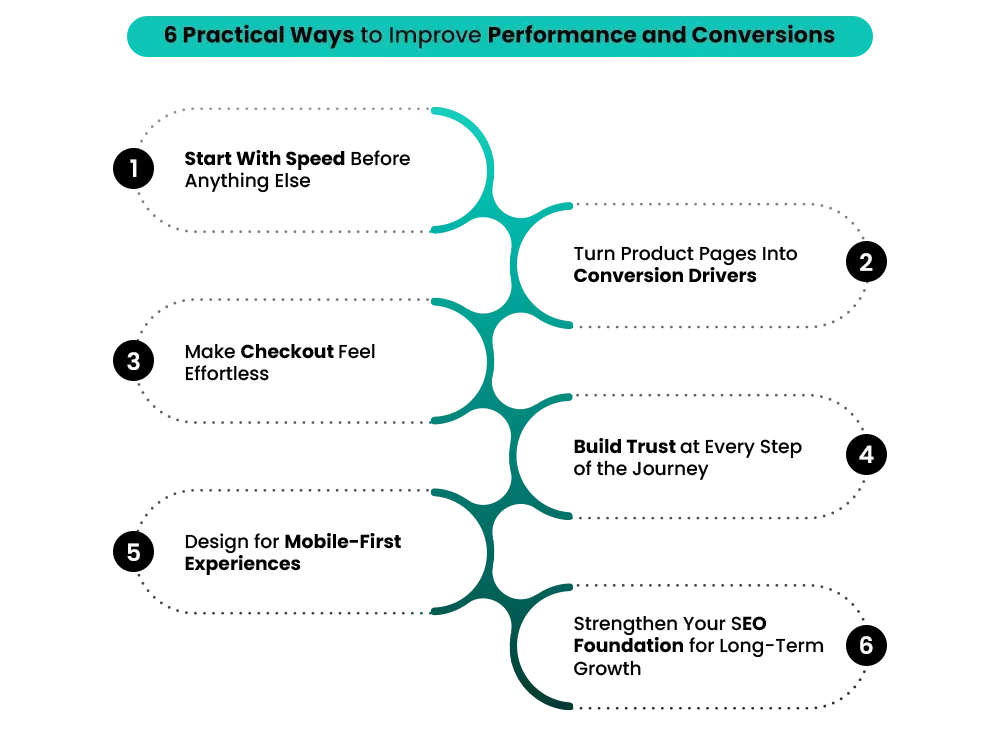
1. Start With Speed Before Anything Else
Speed is the foundation of your store’s performance. If your site is slow, nothing else will work as expected.
- Compress images so they load faster without losing quality
- Remove unused or heavy apps that add extra load
- Clean up unnecessary scripts and simplify backend processes
Even small speed improvements can reduce bounce rates and improve your overall Shopify CRO.
2. Turn Product Pages Into Conversion Drivers
Your product pages are where buying decisions happen. If they are not convincing enough, users will leave.
- Add high-quality images and videos to show the product clearly
- Write descriptions that explain how the product helps the customer, not just what it does
- Include reviews and ratings to build trust
A strong product page answers questions before the customer even asks them.
3. Make Checkout Feel Effortless
The checkout process should feel quick and simple. Any confusion here can lead to abandoned carts.
- Reduce unnecessary steps and form fields
- Allow guest checkout so users do not feel forced to sign up
- Offer multiple payment options to match customer preferences
The easier it is to complete the purchase, the higher your conversions will be.
4. Build Trust at Every Step of the Journey
Customers need to feel confident before they make a purchase, especially if they are new to your brand.
- Clearly show shipping, return, and refund policies
- Display reviews and testimonials across your store
- Keep your branding consistent so your store looks professional
Trust removes hesitation and helps customers move forward.
5. Design for Mobile-First Experiences
Since most users shop on mobile, your store should be designed with mobile in mind first.
- Use large buttons that are easy to tap
- Keep layouts simple and easy to navigate
- Make sure pages load quickly on mobile networks
A smooth mobile experience can significantly improve your conversions.
6. Strengthen Your SEO Foundation for Long-Term Growth
SEO helps bring in users who are already searching for your products.
- Optimize titles and descriptions with relevant keywords
- Fix broken links and outdated pages
- Create content that matches what your audience is searching for
This reduces your dependence on paid ads and supports long-term growth.
The key is to focus on practical improvements that directly impact how users experience your store. When you remove friction and make the buying journey smoother, your conversions improve naturally.
Build Your Shopify Store From Scratch With Mastroke
Launch faster with Mastroke, an official Shopify Partner. We build structured stores with conversion-first design, clean setup, and features built to scale!!
DIY Audit vs Hiring Shopify CRO Experts
A lot of store owners start with a DIY audit, and that is a good first step. It helps you catch obvious issues like slow pages, broken links, or missing information. You get a basic understanding of what might be going wrong in your store.
But this approach has its limits.
-
Lack of advanced tools
Most DIY audits rely on free tools or surface-level checks, which often miss deeper performance and behavior insights.
-
Bias from being too close to your store
When you know your store inside out, it is easy to overlook problems. What feels clear to you may be confusing for a first-time visitor.
-
Missing deeper user behavior insights
Without proper data analysis, it is hard to understand why users are dropping off or what is actually affecting conversions.
This is where working with Shopify CRO experts or a Shopify CRO agency makes a real difference.
What Shopify CRO Experts See That Most Store Owners Miss?
-
Data-backed analysis instead of guesswork
Experts rely on real data from user sessions, heatmaps, and analytics to identify what is working and what is not.
-
Identifying micro-frictions across the journey
Small issues like button placement, unclear messaging, or slight delays may seem minor, but they have a big impact on conversions. Experts know how to spot these details.
-
Applying proven CRO frameworks
Instead of random changes, they follow tested strategies that are designed to improve conversion rates in a structured way.
-
Faster implementation and testing
With experience and the right tools, experts can quickly implement changes and test what works best, saving time and effort.
A DIY audit can help you get started, but if you want to scale your results and truly optimize your store, working with experienced professionals can unlock opportunities you might not even realize exist.
Also read: DIY vs Shopify Development Agency: How Your Setup Choice Affects Store Performance
How Does a Shopify Store Agency Help You Grow Faster?
Once you understand the gaps in your store, the real challenge is fixing them the right way. This is where a Shopify store agency or a Shopify CRO agency can help you move faster and more efficiently.
Instead of guessing what to fix first, agencies follow a structured approach that focuses on results.
-
Structured audit process with clear priorities
A professional agency does not just point out issues. They break them down into clear action steps based on impact. This helps you focus on what will improve your conversions the fastest.
-
Focus on ROI-driven improvements
Every recommendation is tied to business results. The goal is not just to improve design or speed, but to increase revenue and get better returns from your existing traffic.
-
Combines SEO, UX, and CRO into one strategy
Growth does not come from one area alone. A strong strategy connects SEO for traffic, UX for a better experience, and CRO for higher conversions. Agencies look at your store as a complete system rather than isolated parts.
-
Helps avoid trial-and-error decisions
Many store owners waste time testing random changes without a clear direction. Agencies use data and proven methods to reduce guesswork and make smarter decisions from the start.
Working with a Shopify store agency helps you move from uncertainty to clarity. Instead of trying different things and hoping they work, you follow a focused strategy designed to grow your store faster and more consistently.
What Happens After a Shopify Store Audit?
A Shopify store audit does not just highlight problems. It gives you clarity and direction on what to do next so you can improve performance and grow your revenue with confidence.
Here is what you can expect after a complete audit:
1. A clear performance scorecard
You get a complete overview of how your store is performing across key areas like speed, SEO, user experience, and conversions. This helps you understand where you stand today.
2. A prioritized list of fixes
Not all issues are equally important. A good audit breaks them down into:
- Quick wins: Small changes that can deliver immediate improvements in conversions or performance
- Long-term improvements: Bigger changes that take more time but have a lasting impact on growth
3. A roadmap aligned with revenue growth
Instead of random fixes, you get a structured plan that focuses on actions that directly improve your Shopify sales.
4. Confidence in what to fix and why
You are no longer guessing or making blind changes. Every recommendation is backed by data and tied to a clear outcome.
In simple terms, a Shopify store audit turns confusion into clarity. It shows you exactly where to focus so you can grow your store with purpose instead of trial and error.
Build your dream Shopify store today
Bring your vision to life with Mastroke, an official Shopify Partner. We design and develop high-converting, scalable Shopify stores with clean structure and future-ready features—built to grow with your business.
Stop Guessing and Start Scaling Your Shopify Store
More traffic will not fix a store that is not converting. You can keep increasing your ad spend, but if your store experience has gaps, you will continue losing potential customers along the way.
The real opportunity lies in fixing what is already in front of you. When you remove friction, improve usability, and optimize key touchpoints, you unlock revenue from the traffic you already have. This is how sustainable growth actually happens.
A Shopify store audit is the smartest place to start. It gives you clarity, direction, and a clear path to improving your Shopify sales without relying only on more traffic.
Stop guessing what might work. Start fixing what is holding your store back and scale with confidence.
Meet Mastroke: Your Shopify Growth Partner
If you are serious about improving your store’s performance, you need more than quick fixes. You need a strategy backed by data and experience. That is where Mastroke comes in as your trusted Shopify CRO agency.
Mastroke focuses on Shopify conversion rate optimization, helping brands turn existing traffic into real revenue. Instead of guesswork, every decision is driven by data, insights, and proven strategies.
Here is how Mastroke helps you grow:
- Deep performance and SEO audits to uncover hidden gaps affecting your store
- Conversion-focused strategies tailored to your business and audience
- Data-driven decision making to improve results at every stage of the customer journey
The approach is simple. Identify what is holding your store back, fix it with precision, and focus on what actually drives growth. If your store is getting traffic but not enough sales, the opportunity is already there. You just need to unlock it.
Discover hidden gaps. Improve conversions. Increase revenue without increasing ad spend.
Book your Shopify store audit with Mastroke today and start turning missed opportunities into measurable growth.
Frequently Asked Questions
1. What is a Shopify store audit?
A Shopify store audit is a complete review of your store’s performance, user experience, SEO, and conversion flow to identify issues that may be affecting your sales.
2. How often should I do a Shopify store audit?
It is recommended to do a detailed audit every 3 to 6 months, or whenever you notice a drop in conversions or changes in performance.
3. What is the difference between a Shopify conversion audit and a Shopify CRO audit?
A Shopify conversion audit focuses on improving how many visitors turn into buyers, while a Shopify CRO audit goes deeper by optimizing every step of the customer journey.
4. Can a Shopify store audit really increase sales?
Yes, by identifying and fixing performance gaps and friction points, a Shopify store audit can significantly improve conversions and overall revenue.
5. Should I hire a Shopify CRO agency or do the audit myself?
You can start with a basic audit yourself, but hiring a Shopify CRO agency helps uncover deeper insights and implement strategies that deliver faster and more reliable results.