This blog post explains why fast-growing ecommerce brands are upgrading to Shopify Plus in 2026, focusing on the revenue and operational signals that indicate it's time to make the switch. It addresses the limitations that standard Shopify presents at scale and how these issues quietly impact growing businesses through missed revenue and operational bottlenecks.
Your store is growing. Orders are up, ads are working, the product is finally finding its audience. And somehow the platform that ran perfectly six months ago is starting to feel like the problem.
That’s the exact moment most brands start looking at Shopify Plus. At scale, small things stop being small. A checkout that handles 50 orders an hour buckles at 500. Manual workflows your team kept up with at two people can’t keep up at eight.
None of it fails dramatically — it just shows up as missed revenue, delayed launches, and a team that feels permanently behind.
This guide breaks down why fast-scaling brands are switching to Shopify Plus in 2026, the revenue signals that say the timing is right, and what actually changes once you’re on it.
The Short Answer: What’s Pushing Brands to Upgrade
For most fast-scaling brands, the switch to Shopify Plus comes down to three pressures hitting at the same time:
Revenue Scale
Monthly revenue consistently above $500K, where the standard plan’s limits start affecting growth.
Operational Strain
Too many manual processes, disconnected systems, and teams constantly firefighting daily issues.
Customer Experience Cracks
Checkout slowdowns, inventory errors, and slower support that quietly hurt repeat purchases.
When all three land in the same quarter, the cost of staying on the wrong plan starts to outpace the cost of upgrading. That’s when Shopify Plus stops being a “maybe later” conversation and becomes a real business decision.
What Shopify Plus Actually Is (Quick Version)
Shopify Plus is the enterprise tier of Shopify. Same admin panel underneath, same theme structure, same app library — but built for stores doing real volume.
If you want a fuller comparison of Plus features vs. standard plans, our honest take on whether Shopify Plus is worth it covers the evaluation side in depth.
This piece is focused on the brands that are already past that question and trying to figure out whether now is the right moment to make the move.
The Simple Version
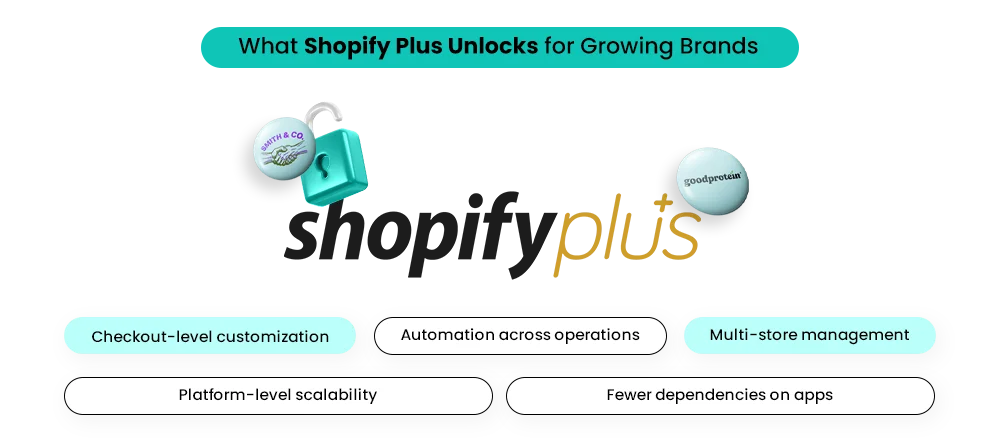
Shopify Plus gives you the infrastructure, automation, checkout control, and global setup that standard Shopify caps. It’s not a different product. It’s the same product without the ceiling.
What “Fast-Scaling” Actually Looks Like in 2026
Growth in 2026 isn’t gradual the way it was five years ago. A creator post, a successful ad launch, or a single PR moment can multiply your traffic in a week.
Fast-scaling brands tend to share a few traits:
Traffic Spikes
Sudden traffic spikes from paid campaigns, influencer drops, or content moments.
Rapid Expansion
Expansion into new countries or regions within months, not years.
Growing Catalogs
Product catalogs adding SKUs and variants every quarter.
Bigger Teams
Internal teams growing on both the marketing and operations side.
Higher Expectations
Customers expecting personalization, speed, and reliability everywhere.
If two or three of these describe your store right now, your platform decisions need to keep up with your growth — not lag behind it.
The Revenue Signals That Tell You It’s Time
Most brands don’t switch to Shopify Plus on a hunch. They switch when the numbers say it’s time. The patterns we see consistently:
$500K–$1M Monthly Revenue
Monthly revenue crossing the $500K–$1M mark steadily.
Single-Day Revenue Spikes
Single-day revenue spikes from launches, sales, or campaigns.
Retention Infrastructure Matters
Repeat customers driving 60–70%+ of revenue, which means retention infrastructure matters more than acquisition.
Operations Falling Behind
Order volume growing faster than your operations team can absorb.
Leadership Priorities Shifting
Leadership conversations shifting from “how do we grow” to “how do we keep growth from breaking things”.
When these signals stack, the upgrade pays back in months, not years. The real question isn’t whether Plus is worth it — it’s whether you can afford the revenue you’re already losing by staying where you are.
Where Standard Shopify Starts to Crack at Scale
Standard Shopify is excellent for the stage it’s built for. Once a brand crosses into real volume, the limits show up in predictable places.
Checkout Customization
Checkout customization is capped for B2B pricing, custom promotions, and complex shipping rules.
App Dependency
Automation depends heavily on apps, increasing cost, complexity, and performance drag.
API Limits
ERP, WMS, analytics, and customer support tools hit API limits faster than expected.
Multi-Region Management
Running separate regional stores creates duplicated admin work and disconnected inventory.
Basic Permissions
Larger teams need real role-based access instead of broad staff permissions.
None of this is a Shopify flaw. It’s the platform doing what it’s built for. The mismatch is on the merchant’s side — using a plan that no longer fits the size of the operation.
The Quiet Cost of Waiting Too Long
Platform limits don’t fail loudly. They fail in slow leaks:
Slower Checkout
A checkout that runs 0.8 seconds slower than it should, costing 2–3% conversion every day.
Flash Sale Failures
A flash sale crashing during the highest-converting window of the campaign.
Operational Waste
Manual fulfillment processes consuming 15+ hours every week.
Delayed Launches
Black Friday launches delayed because integrations aren’t ready.
Retention Problems
Customers churning because post-purchase systems aren’t firing reliably.
Checkout friction is where most of this hides. Baymard Institute‘s research on cart abandonment puts the average abandonment rate around 70%, with a meaningful share of those losses tied directly to checkout friction. For a brand doing $1M/month, even a 2% performance hit is $20K. Stretch that across a year and the math against upgrading stops working pretty quickly.
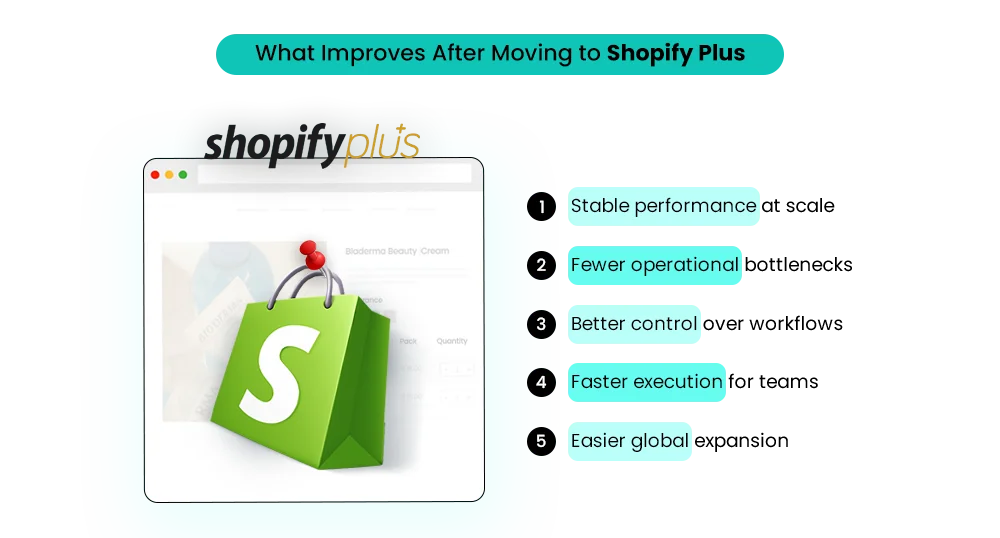
What Actually Changes After Upgrading to Shopify Plus
Here’s what fast-scaling brands actually get when they make the move.
Infrastructure That Holds Up Under Spikes
Shopify Plus runs on a different traffic tier than standard plans. Black Friday, product drops, and viral moments are exactly where regular Shopify stores begin struggling — while Plus is built to absorb the pressure. Checkout stays stable, pages keep loading, and the store keeps selling when it matters most.
Checkout You Can Actually Shape
This is where most of the conversion lift comes from. With Checkout Extensibility and Shopify Functions, brands can customize the buying flow instead of relying on rigid defaults.
Add custom fields and validation
Run conditional discounts and promotion logic
Surface upsells and cross-sells without adding more apps
Adjust shipping logic by product, customer, or cart value
Build a checkout around your actual buyer journey
According to Shopify’s data on Shop Pay, accelerated checkout consistently shows higher conversion than guest flows — and Plus gives you control to customize on top of those built-in advantages, not just accept the defaults.
Automation That Replaces Manual Work
Shopify Flow on Plus goes far deeper than standard accounts. Brands automate repetitive work that normally slows teams down as order volume grows.
Customer tagging and segmentation
Fraud routing for high-risk orders
Inventory alerts and restocking triggers
Scheduled launches via Launchpad
Brands moving to Plus often replace 6–8 separate automation apps with built-in Flow workflows. That cuts both monthly cost and the complexity of maintaining a bloated app stack. If sequencing your automation and growth work is where you’re stuck, our breakdown of design, speed, and automation priorities for 2026 covers the order of operations.
Multi-Store Expansion Without the Chaos
Shopify Plus lets brands run multiple expansion stores under one organization. Different currencies, languages, tax rules, and catalogs stay centralized instead of becoming operational chaos spread across disconnected stores.
B2B and DTC Running Together
Plus includes native wholesale functionality like company accounts, custom pricing, draft orders, and payment terms — helping brands run B2B and direct-to-consumer operations from the same ecosystem.
Real Permissions for Real Teams
Once your company grows past a small team, role-based access, SSO, and audit logs stop being optional. Shopify Plus includes them out of the box instead of forcing expensive workarounds.
When Headless Commerce Actually Makes Sense
Headless commerce is one of the most over-recommended decisions in ecommerce. Most brands don’t need it. But for some fast-scaling stores, Shopify Plus combined with Hydrogen genuinely makes sense.
Content-heavy storefronts that behave more like publications
Multi-brand ecosystems running several frontends
Performance demands beyond what traditional themes can handle
Deeply customized experiences and personalization flows
If you’re not operating in one of those categories, headless often creates more complexity than value. Most fast-growing brands are still better off pushing standard Shopify themes further before making the jump.
Thinking About Migrating To Shopify Plus?
From checkout customization and automation to multi-store expansion and Shopify Plus migrations, Mastroke helps brands build scalable ecommerce systems designed for long-term growth.
Security and Compliance Built In
At scale, security stops being something you bolt on later. Shopify Plus handles the infrastructure most growing brands eventually need anyway.
PCI DSS Level 1 compliance for secure payment processing
GDPR-compliant handling for international customers
Automated fraud detection and risk scoring
Daily backups and platform-level monitoring
For brands processing large volumes globally, this infrastructure alone can justify a meaningful part of the platform cost. Managing the same stack separately through vendors usually creates both higher expenses and more operational risk.
Note: Shopify Payments availability, tax handling, and compliance features vary by country. Always confirm what applies to your specific regions before relying on platform-level coverage.
Total Cost: How Plus Compares to the Alternatives
Compared to Magento, BigCommerce Enterprise, or Salesforce Commerce Cloud, Shopify Plus usually lands lower on total cost of ownership.
Hosting and infrastructure are already included
Security and PCI compliance stay managed at the platform level
Large app ecosystems reduce custom development costs
Migration timelines are usually shorter than traditional enterprise platforms
That doesn’t make Shopify Plus cheap. It simply changes the comparison. The real benchmark isn’t standard Shopify — it’s Magento plus hosting, security, maintenance, and an enterprise development team.
When NOT to Switch to Shopify Plus
Just as important as knowing when to upgrade is knowing when not to.
Revenue is still below
$500K/month
with no near-term growth path
Your real issue is product-market fit, not platform limitations
The team isn’t ready to actually use advanced Plus features
You’re chasing the “Plus” label instead of solving a business bottleneck
If you’re not actively feeling the limits of your current setup, you’re probably not ready for the upgrade yet. Most brands should fix conversion, retention, and operational issues before paying for enterprise-level capacity.
The Bottom Line
Fast-scaling brands aren’t moving to Shopify Plus because of marketing. They’re upgrading because staying on smaller plans eventually starts costing real revenue.
Slower checkouts. Missed launches. Manual workflows that don’t scale. Customer experience cracks that quietly compound over time. Once growth reaches a certainpoint, the upgrade stops being a luxury — it becomes infrastructure protection.
If you want a clear-eyed look at whether your numbers actually support the move — and what your migration would realistically involve — Mastroke runs Shopify Plus readiness audits grounded in your specific revenue, ops, and tech setup.
Book a Free Shopify Plus Readiness Call
We work as a Shopify Plus agency for fast-scaling brands and handle migrations from kickoff to launch, so the advice you get is based on what actually happens during the move — not just what sounds good in a sales deck.
We’ll review your store, identify the real bottlenecks, and send you a written assessment within 5 business days — including what to fix first, what migration would realistically involve, and whether the ROI actually makes sense.
FAQs
1. When does it actually make sense to switch from Shopify to Shopify Plus?
The clearest signal is monthly revenue consistently above $500K–$1M combined with operational strain — manual workflows piling up, checkout limits hurting conversion, or multi-region needs you can’t manage efficiently on a single store. If those pressures aren’t there yet, the upgrade is probably premature.
2. How much does Shopify Plus cost compared to standard Shopify in 2026?
Standard Shopify plans range from $39 to $399 per month. Shopify Plus starts around $2,300 monthly and scales with revenue. Total operating cost — including apps, custom development, integrations, and agency support — often lands between $4,000 and $15,000+ per month for actively scaling brands.
3. How long does a Shopify to Shopify Plus migration take?
For brands already on Shopify, migrations usually take 4–6 weeks. Brands moving from Magento, BigCommerce, or WooCommerce should expect 8–16 weeks depending on catalog complexity, integrations, SEO preservation, and custom functionality requirements. Enterprise migrations promised in two weeks are usually cutting corners somewhere important.
4. Does Shopify Plus actually improve conversion rates?
Indirectly, yes. Shopify Plus gives brands more control over checkout, automation, and personalization than standard plans allow. The platform itself doesn’t magically improve conversion — the systems and customer experiences built on top of it do. Most brands see measurable gains within the first six months when Plus features are implemented properly.
5. Can I run B2B and DTC on the same Shopify Plus store?
Yes. Shopify Plus includes native B2B functionality such as company accounts, custom pricing, draft orders, and net payment terms while still running a standard DTC storefront. Both can operate from the same backend without requiring duplicate inventory systems or separate platforms.
6. Do I need a Shopify Plus agency to migrate?
Not necessarily. Shopify Plus works out of the box, and straightforward upgrades from standard Shopify can often be handled internally. Agencies become valuable when migrations involve custom checkout development, multi-store architecture, ERP integrations, B2B setup, or platform moves from systems like Magento or WooCommerce.
7. Is Shopify Plus better than BigCommerce Enterprise or Adobe Commerce?
For many brands in the $1M–$50M revenue range, Shopify Plus offers a lower total cost of ownership and faster implementation. Adobe Commerce provides deeper customization but requires a dedicated development team. BigCommerce Enterprise competes well in some areas but has a smaller app ecosystem and agency network. The right choice depends on the business structure, technical requirements, and internal team capabilities.
8. What if I’m not ready for Shopify Plus but my current plan feels tight?
Start by identifying the actual bottleneck. If automation is the issue, build Shopify Flow workflows before upgrading. If apps are slowing performance, audit and consolidate the stack. If conversion is weak, improve product pages and checkout experience first. Shopify Plus should solve an existing operational problem — not create unnecessary overhead before the business is ready.