Choosing between building an internal team or partnering with a Shopify agency or Shopify marketing agency matters more in 2026 than ever before. Growth now isn’t just about managing a store — it’s about optimizing an AI-driven ecosystem where performance, automation, and rapid execution shape success.
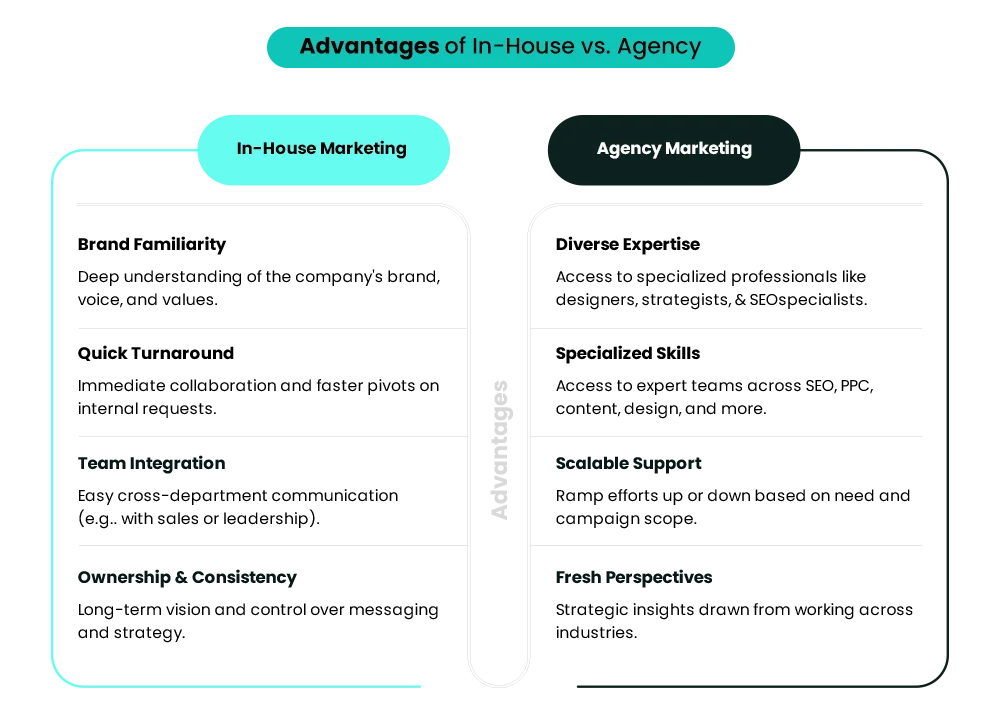
Many founders feel torn between total control and the speed that comes with specialized expertise. In-house teams offer deep brand understanding and daily alignment. Agencies bring instant access to multi-skill specialists and flexible execution.
According to a 2024 report, about 64% of companies say working with an agency gives them better access to specialized expertise than in-house teams alone. But “better” isn’t one-size-fits-all.
For Shopify merchants, it should be judged by ROI, scalability, and founder bandwidth — not just where the work gets done. In this guide, we break down those trade-offs so you can decide what path — internal, external, or hybrid — makes the most sense for your store’s growth plans in 2026.
Decoding the 2026 Landscape: In-House vs. Agency
The 2026 ecommerce market moves at lightning speed. Merchants often struggle with the choice of In House vs Agency for Shopify. Deciding how to manage your growth depends on your budget and technical needs.
The In-House Reality
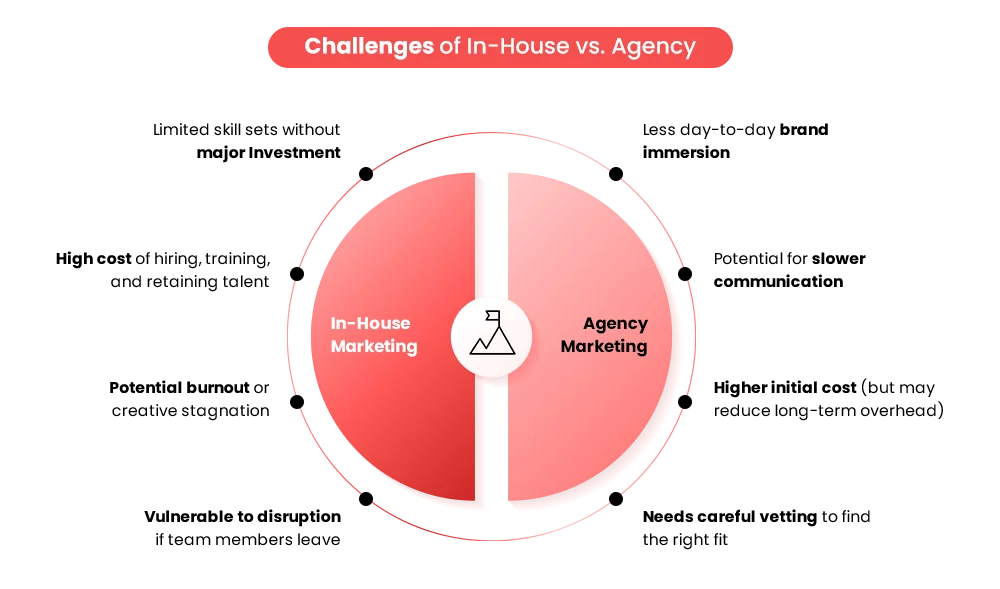
Building an internal team gives you total brand immersion. Your staff live and breathe your company values every single day. This model offers direct oversight of all daily tasks. However, it often creates a “single point of failure” risk. If your only developer leaves, your Shopify development projects may stall completely.
- Fixed Costs: High salaries and benefits add up fast.
- Hiring Lag: Finding top-tier talent in 2026 takes months.
- Narrow Focus: Internal teams can become siloed in their thinking.
The Shopify Agency Reality
Partnering with a Shopify agency provides immediate access to a “Full-Stack” team. You get experts in conversion rate optimization, SEO, and data analytics. A Shopify Plus agency specifically helps enterprise brands handle high traffic and complex B2B features. They offer ongoing support to keep your store fast and secure.
- Fast Scaling: Agencies deploy specialists in days, not months.
- Advanced Tools: A Shopify marketing agency brings high-end AI software to your store.
- Lower Overhead: You avoid the costs of recruitment and internal training.
Most high-growth brands now use a hybrid model. They keep brand strategy in-house but trust an agency for technical execution. This balance ensures your store remains both personal and high-performing.
– Also Read: 5 Clear Signs It’s Time to Hire a Shopify Agency
The Financial Breakdown: Cost vs. Value in 2026
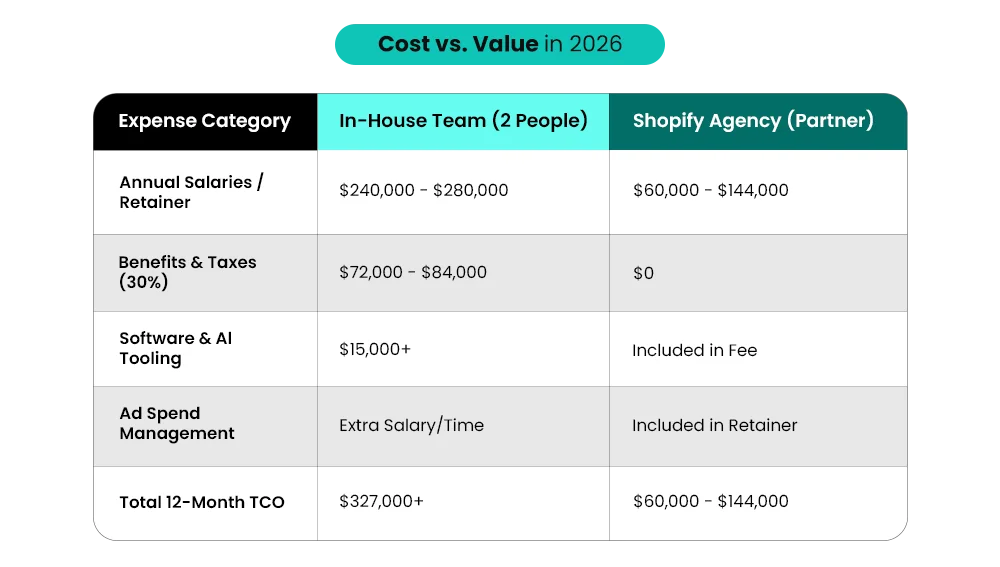
Evaluating the Cost of In House Shopify Team vs Agency requires looking past simple line items. In 2026, the financial gap has widened due to rising talent costs and technical complexity.
The True Cost of Internal Hiring
Hiring an in-house expert sounds ideal for brand control, but the “fully loaded” cost is steep. A mid-level developer in 2026 averages $110,000 to $135,000 in the U.S. When you add benefits, payroll taxes, and 401k matching, that number jumps significantly. Business owners also face “vampire costs” like:
- Recruitment Fees: Modern headhunters charge 15-25% of the first-year salary.
- Tech Stack Seats: Individual licenses for SEO tools, heatmaps, and design software cost thousands.
- Productivity Lag: New hires often take 3–6 months to reach full speed.
The Agency Retainer Model
A Shopify ecommerce agency or a specialized Shopify marketing agency offers a predictable monthly expense. You get a “fractional” team of seniors for the price of one junior hire. Most Shopify development agency retainers in 2026 range from $3,000 to $12,000 per month. This fee covers multiple experts who manage everything from pay-per-click (PPC) to site speed.
Choosing the best Shopify marketing agency allows you to pivot ad spend quickly without firing staff. This flexibility is essential for any Shopify store looking to survive a volatile 2026 market.
– Also Read: How to Choose the Right Shopify Store Setup Agency for Your Brand?
Speed, Skill Coverage, & Scalability
Managing a modern Shopify store requires a massive range of technical skills. In the 2026 ecommerce market, the complexity of a site has tripled.
The Skill Gap
One internal hire simply cannot master everything. They might be great at design, but struggle with Shopify Functions or headless commerce. Advanced GA4 tracking is now a full-time job. A Shopify growth agency provides a Shopify marketing expert for every specific niche. You get data-driven insights from specialists who only focus on their core strengths.
- Breadth: Agencies cover coding, SEO, and creative design simultaneously.
- Depth: They stay updated on the latest Shopify API changes for you.
Agility & Sprints
Internal teams often get bogged down in “meeting culture” and office politics. This slows down your ability to test new features. Marketing agencies use agile workflows to launch updates in two-week sprints. This speed is a key factor when comparing Shopify growth with the internal team vs agency.
Scaling for Peak Seasons
Your needs during Black Friday are much higher than in July. A Shopify marketing agency allows you to “burst” your resources during peak seasons. You can scale your support without hiring permanent staff you don’t need later. This flexibility helps you stay lean while maximizing your revenue. Partnering with a Shopify agency ensures you always have the right amount of power behind your brand.
– Also Read: Design, Speed, or Marketing — What Should Come First in Your Shopify Store Growth Plan for 2026?
Control, Culture, and Communication
Control, culture, and communication play a major role in how Shopify brands scale in 2026. Many founders struggle with the question, Should I hire in house or Shopify agency, because control feels deeply personal.
Why Founders Crave In-House Control
An in-house team feels like an extension of the founder’s vision. Employees live inside the brand every day and absorb its values naturally. There is comfort in direct oversight and instant feedback. Founders like being able to walk to a desk and solve problems quickly.
- Deep Cultural Alignment: Employees live inside the brand daily and naturally absorb the founder’s vision and core values.
- Instant Communication: Founders enjoy direct oversight and the ability to solve problems quickly with face-to-face feedback.
- Nuanced Understanding: In-house teams deeply grasp customer tone and product details, ensuring long-term brand consistency.
- Data Security: Sensitive growth plans and internal data stay protected within the company walls.
- Stable Workflows: This model provides a sense of safety and control for businesses with established, predictable routines.
- The Downside: High levels of control often result in slower execution and a lack of specialized expertise found in external teams.
Solving the Agency “Black Box”
The biggest fear with a Shopify agency is a lack of visibility. Founders worry that work happens behind closed doors. This fear was valid years ago, but not in 2026.
Modern Shopify marketing agency teams operate with full transparency. Communication tools now bridge the gap between internal and external teams. Strong agencies use:
- Slack channels for daily updates and quick questions
- Asana or ClickUp for task tracking and timelines
- Real-time dashboards for traffic, revenue, and conversion data
- Shared documents for roadmaps and reporting
A Shopify Plus partner agency often matches internal communication standards. You see progress clearly without micromanaging. This setup gives founders clarity without constant interruptions.
Transparency also improves results with search engines and performance tracking. Clear reporting helps Shopify growth experts adjust faster and stay data-focused.
Agencies bring structure that many internal teams lack. They document processes, set expectations, and follow repeatable systems. This consistency is valuable for a growing online store.
Control does not have to mean doing everything yourself. In 2026, smart brands balance ownership with visibility. When communication is clear, agencies feel like partners, not outsiders.
– Also Read: Is Shopify Plus Overhyped or Actually Worth It?
The 2026 Decision Framework (By Business Stage)
Choosing the right support for your Shopify store depends entirely on your current revenue and growth goals. In 2026, the question of What Is Better Agency or In House Ecommerce isn’t a simple “this or that.” It is about matching your team structure to your business stage.
Scaling Startups ($500k–$2M): The Hybrid Power Move
At this stage, you need to stay agile. Hiring a full team in-house is often too expensive and slow. The winning strategy is a “Lean In-House + Specialized Agency” model.
- Keep Brand In-House: Hire a dedicated Brand Manager who lives your culture.
- Outsource the Rest: Partner with a Shopify marketing agency for specialized tasks like paid ads or SEO.
- Focus on Speed: Use an agency for Shopify store development to launch new landing pages in days, not months.
This keeps your overhead low while giving you access to high-level web design and strategy.
Established Brands ($2M–$10M): Navigating the Transition
Once you cross the $2M mark, your Shopify store becomes more complex. You likely have thousands of orders and a growing customer list. Now, you need deep operational support.
- Internal Operations: Move inventory management and customer service in-house to ensure quality.
- The Hybrid Bridge: Use a partner agency as a fractional CTO or CMO.
- Systems Integration: Agencies help connect your store to ERPs or complex fulfillment networks.
Enterprise & Shopify Plus: Technical Mastery
For massive stores on the Shopify platform, the stakes are much higher. Enterprise brands use a Shopify agency to handle advanced “heavy lifting” that a generalist in-house team simply can’t do.
- Custom Logic: Using Shopify Functions to build unique discount engines or checkout flows.
- Headless Commerce: Implementing Hydrogen and Oxygen for sub-second load times.
- 24/7 Monitoring: Ensuring your store never goes down during viral flash sales.
At this level, your agency isn’t just a vendor; it is a technical architect. They ensure your tech stack is an asset, not a bottleneck.
– Also Read: The Shopify Store Audit Checklist Every Brand Should Do in Q1 2026
The Hybrid Model: The “Golden Middle” of 2026
In 2026, the In-House vs. Shopify Agency debate has a clear winner: the hybrid model. This setup creates a “Golden Middle” that balances speed with brand integrity. Instead of choosing one, smart brands use an internal lead to drive an external engine.
The Structure: The Internal Bridge
The heart of this model is an in-house Product or E-com Manager. This person acts as the guardian of the brand’s soul. They don’t necessarily write code or run every ad. Instead, they direct a Shopify marketing agency to ensure every move matches the company’s vision.
- Strategic Direction: Your internal lead sets the goals and KPIs.
- Brand Guardrails: They ensure digital agencies never drift from your core voice.
- Decision Speed: Issues get resolved faster because one person owns the agency relationship.
The Benefits: Utilizing “Bench Strength”
Hiring ten marketing experts in-house is expensive and slow. A digital marketing agency gives you instant access to a full “bench” of talent for a fraction of the cost.
- Specialized Skills: Get a senior SEO lead, a CRO expert, and a developer all at once.
- Scalable Effort: You can ramp up marketing efforts for BFCM and scale back in January.
- Fresh Perspective: Agencies see what is working across dozens of other stores.
This model keeps your core team lean. You avoid the “tunnel vision” that often plagues internal teams. By using a Shopify agency for the heavy lifting, your brand stays agile, expert-led, and deeply human.
– Also Read: New Year, New Targets: What Shopify Merchants Should Focus on in Q1 2026
Conclusion
In 2026, the choice between an in-house team and a Shopify agency isn’t about picking a side. It is about matching your team to your current growth stage. Small startups need the “bench strength” of a Shopify marketing agency to move fast without high overhead.
Mid-sized brands find success in the hybrid model. This setup keeps the brand’s soul inside while letting experts handle the technical heavy lifting. For enterprise stores, an agency is a vital technical partner for high-level custom logic.
There is no one-size-fits-all answer for ecommerce today. Start by looking at your internal gaps and your long-term revenue goals. The right decision will allow you to scale smoothly without losing control of your vision.
Schedule a call with Shopify experts at Mastroke today to learn more about the Shopify agency expertise for your store!
FAQs-
Is it cheaper to hire a Shopify developer or an agency?
A single developer may look cheaper upfront, but an agency often costs less long term by covering multiple skills without extra hires.
What are the biggest risks of outsourcing to a Shopify Agency?
The main risks are poor communication and misalignment, which can be avoided with clear goals, reporting, and ownership.
Can an agency handle my brand voice as well as an internal team?
Yes, a good agency can match your brand voice closely when given clear guidelines and ongoing feedback.
How do Shopify Plus brands typically structure their teams?
Most Shopify Plus brands use a hybrid model with a small in-house team and a specialized agency for execution and scale.