When brands compare Shopify vs. Shopify Plus, it’s usually not about features alone — it’s about the pressure to grow. Traffic is increasing, marketing campaigns are getting bigger, operations are becoming complex, and suddenly, the platform that once felt perfect starts feeling limited.
Shopify powers 4.82M+ websites across 175+ countries, supports 2.06M+ merchants, and holds 26% of the global e-commerce market share. On the enterprise side, Shopify Plus serves 13,000+ merchants, with stores generating $1M–$500M annually, and has grown 126% year-on-year — highlighting its strong adoption among high-revenue brands.
So what actually changes when you move from Shopify to Shopify Plus? Is it just pricing, or are you unlocking real business advantages?
In this blog, we’ll break down the practical differences between Shopify and Shopify Plus — from checkout control and automation to scalability, integrations, and flexibility for customization. We’ll also explain how Shopify store development evolves on both plans and how a Shopify marketing agency typically evaluates whether a Plus upgrade is worth it.
Understanding Shopify for Growing Brands
Before comparing Shopify with Shopify Plus, it’s important to understand why most brands begin with standard Shopify — and why it works so well in the early growth stages.
Shopify is built to make launching and running an e-commerce store simple. It handles hosting, security, updates, and infrastructure in the background so brands can focus on products, marketing, and sales. From payment gateways and mobile-optimized themes to multi-channel selling and app integrations, the platform covers everything a growing brand typically needs.
How Shopify Store Development Works on Standard Plans
With structured Shopify store development, brands can build a highly optimized storefront. Themes can be customized, product and collection pages can be refined for conversions, third-party marketing tools can be integrated, and performance improvements can be implemented.
For most small to mid-sized businesses, the flexibility is more than enough. You can create a strong brand experience without touching enterprise-level features.
When It Works Best — and When It Starts Stretching
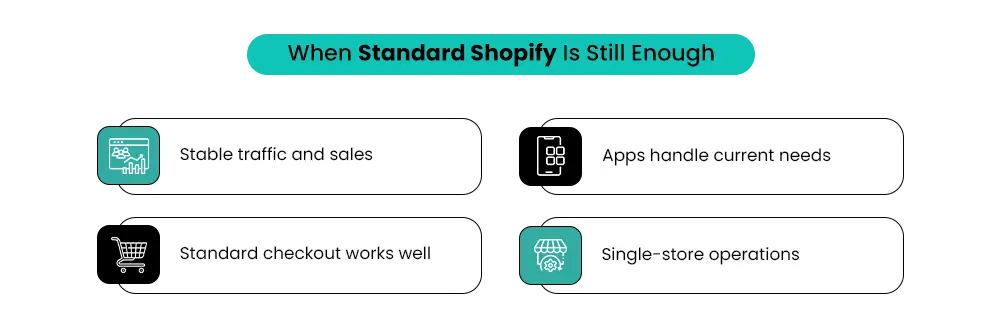
Standard Shopify is ideal for startups, D2C brands operating in one primary market, and businesses with relatively simple backend processes. If your catalog is manageable and your marketing campaigns are steady, the platform scales smoothly.
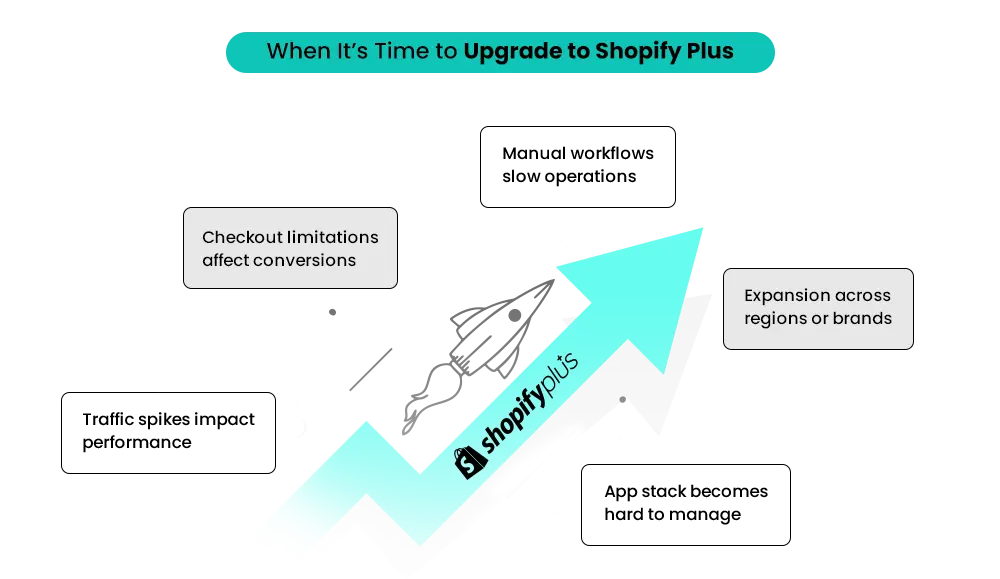
However, as revenue increases and marketing becomes aggressive, certain constraints begin to surface. Checkout customization is limited. Automation requires multiple apps. Complex integrations can hit API limits. Backend workflows may become harder to manage efficiently.
This is usually the stage when brands begin evaluating whether standard Shopify still supports their next phase of growth — or whether Shopify Plus offers the flexibility they now require.
What Makes Shopify Plus Different?
As brands move beyond steady growth into aggressive scaling, the conversation shifts from “Can Shopify handle this?” to “Do we need more control?”
That’s where Shopify Plus enters the picture. Shopify Plus is not a different platform — it’s an enterprise-level version of Shopify designed for high-growth and high-volume businesses. The core interface remains familiar, but the capabilities expand significantly.
Advanced Infrastructure for High-Growth Brands
At scale, infrastructure matters. Shopify Plus is built to support:
- High traffic spikes during sales and product drops
- Large transaction volumes
- International storefronts
- Complex backend integrations
For brands running heavy paid campaigns or influencer launches, this stability reduces risk during peak revenue moments.
Greater Flexibility for Custom Shopify Store Development
One of the biggest differences is checkout and backend flexibility. With Shopify Plus, brands gain:
- Advanced checkout customization
- Access to Shopify Scripts (for custom pricing, discounts, logic)
- Higher API limits
- More control over integrations
This allows deeper Shopify store development, especially when businesses need custom workflows, tiered pricing models, or region-specific buying experiences.
Built-In Automation Tools
Shopify Plus includes Shopify Flow — a powerful automation tool that helps brands:
- Automate inventory alerts
- Segment customers dynamically
- Trigger internal notifications
- Streamline operational workflows
Instead of stacking multiple apps, automation becomes more centralized and scalable.
Priority Support and Scalability
Enterprise growth requires faster response times and strategic guidance. Shopify Plus provides:
- Dedicated support
- Faster issue resolution
- Account management assistance
For brands operating at high revenue levels, this added support reduces operational downtime and risk.
In short, Shopify Plus is designed for businesses that have outgrown “basic flexibility” and now need deeper control, automation, and infrastructure built for scale. To better understand how it compares with standard plans, you can also check out our detailed How Shopify Plus Works, where we break down the key differences in features, pricing, and scalability
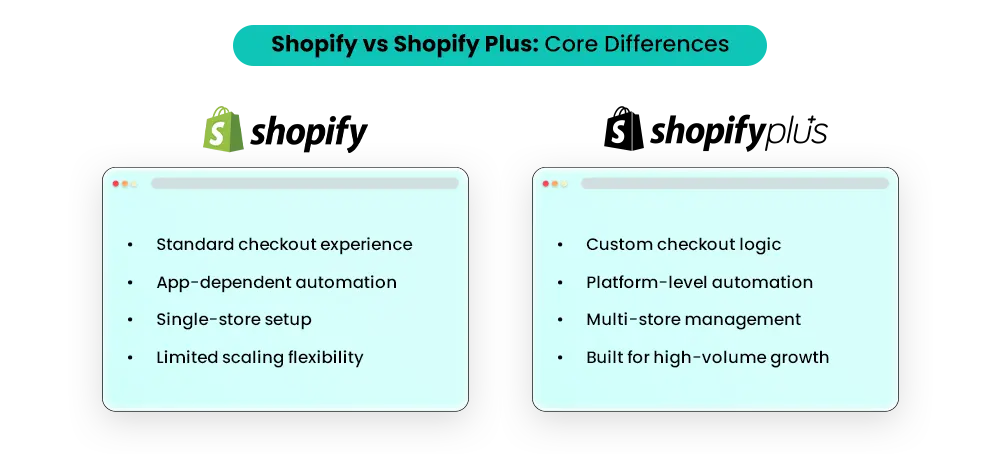
Shopify vs Shopify Plus — Key Differences
As brands scale, the differences between standard Shopify and Shopify Plus become more operational than cosmetic. The dashboard may look similar, but the flexibility, automation, and control available at the backend can significantly impact growth efficiency.
Below is a side-by-side comparison focused on areas that matter most to scaling brands.
As brands scale, the differences between standard Shopify and Shopify Plus become more operational than cosmetic. The dashboard may look similar, but the flexibility, automation, and control available at the backend can significantly impact growth efficiency.
Below is a side-by-side comparison focused on areas that matter most to scaling brands.
Core Differences at a Glance
| Feature Area | Standard Shopify | Shopify Plus |
| Checkout Customization | Limited customization | Advanced customization with checkout extensibility |
| Automation & Workflows | Basic automation via apps | Built-in Shopify Flow with advanced workflow automation |
| API Access | Standard API limits | Higher API limits for complex integrations |
| International Expansion | Basic multi-currency & markets | Advanced multi-store management and expansion flexibility |
| Support & Account Management | Standard support | Priority support + dedicated account management |
What These Differences Mean in Practice
Checkout customization is one of the biggest decision factors. Standard Shopify allows design adjustments, but deeper logic changes are restricted. With Shopify Plus, brands can implement advanced checkout rules, custom discount logic, and tailored buying experiences.
When it comes to automation, standard Shopify often relies on multiple third-party apps. Shopify Plus centralizes much of this with Shopify Flow, making large-scale operations smoother and less dependent on external tools.
For brands investing heavily in integrations and advanced Shopify store development, API limits matter. Higher API access in Shopify Plus allows more complex ERP, CRM, and marketing automation setups without performance slowdowns.
Internationally expanding brands also benefit from better multi-store and multi-region control under Shopify Plus. Finally, enterprise-level businesses value faster issue resolution and structured support, which is built into the Shopify Plus offering.
For scaling brands, the difference isn’t about “more features.” It’s about more control, efficiency, and operational flexibility.
Shopify vs Shopify Plus Pricing
Understanding the pricing difference between Shopify and Shopify Plus is not just about monthly cost — it’s about the scale of operations, customization needs, and long-term growth strategy. While both platforms operate within the Shopify ecosystem, their pricing structures are designed for very different business stages.
Shopify Pricing
Shopify offers fixed, transparent pricing plans suitable for small to mid-sized businesses. These plans provide predictable monthly expenses and are ideal for brands that are growing steadily.
Pricing:
- Fixed monthly plans ranging from $5 to $399
- Best suited for startups and SMBs
- Standard online and in-store transaction fees apply
- Additional fees for third-party payment gateways
- Limited automation and customization compared to enterprise solutions
- Self-serve setup with standard support
Shopify Plus Pricing
Shopify Plus follows a customized pricing model tailored to enterprise-level businesses. Instead of fixed tiers, pricing is determined through a quote based on your revenue and business requirements.
Pricing:
- Starts at $2,000 per month (customized quote)
- May include a revenue-based component
- Built for high-volume, fast-scaling brands
- Advanced automation and deeper checkout customization
- Dedicated support and launch assistance
- Additional costs may include integrations, third-party services, and development
In summary, Shopify offers predictable pricing for growing brands, while Shopify Plus represents a strategic investment for businesses requiring enterprise-grade scalability and performance.
Why a Shopify Marketing Agency Recommends Shopify Plus
When growth becomes aggressive, platform limitations start affecting marketing performance. This is usually when a Shopify marketing agency recommends evaluating Shopify Plus — not for prestige, but for measurable performance gains and operational efficiency.
Reason 1: Scaling Paid Ads Without Infrastructure Risk
As brands increase ad spend, traffic spikes become unpredictable. Shopify Plus provides stronger infrastructure stability during high-volume campaigns, flash sales, and influencer drops — reducing the risk of slowdowns during peak revenue moments.
Handles sudden traffic spikes during campaigns (e.g., 5–10x traffic surges)
- Maintains checkout stability during flash sales
- Minimizes revenue loss caused by slow load times
- Reduces bounce rates during peak campaign hours
Even a 1–2% drop in conversion during high ad spend campaigns can translate into significant revenue loss. Infrastructure stability directly protects marketing ROI.
Reason 2: Checkout Extensibility & Conversion Impact
Small checkout improvements can significantly impact revenue at scale. Shopify Plus allows deeper checkout extensibility, enabling brands to refine discount logic, custom fields, upsells, and user flows.
- Customize checkout UI with Checkout Extensibility
- Add dynamic upsells or bundle logic at checkout
- Implement advanced discount rules
- Optimize for mobile-first user flows
For example, improving checkout conversion by just 0.5–1% on a store generating $1M/month can result in $5,000–$10,000 in additional monthly revenue.
Reason 3: Automation Time Savings
Growing stores often spend hours managing manual workflows — from tagging orders to routing inventory and managing B2B logic. Shopify Plus includes advanced automation tools like Shopify Flow.
- Automate order tagging and fulfillment rules
- Trigger internal alerts based on order value
- Automate fraud checks and customer segmentation
- Reduce manual backend operations
Automation can save 10–20+ operational hours per week, allowing teams to focus more on marketing strategy instead of backend management.
Reason 4: Reduced App Dependency Through Smarter Development
As stores grow, they often rely on multiple third-party apps, increasing costs and technical complexity. Shopify Plus offers higher API limits and built-in enterprise tools.
- Replace multiple apps with native automation
- Reduce monthly app subscription costs
- Improve site speed by minimizing script load
- Enable cleaner, scalable custom development
Reducing even 3–5 paid apps can save hundreds of dollars monthly while improving performance and reducing technical conflicts.
Reason 5: Supporting Global Marketing Campaigns
For brands expanding internationally, Shopify Plus simplifies managing multiple regions, currencies, and storefronts.
Manage multi-store architecture
- Localize pricing and currency
- Support international campaigns from one admin
- Coordinate global product launches
This allows marketing teams to scale internationally without operational bottlenecks.
As growth becomes more complex, knowing when to seek expert support matters. You can also read our blog on 5 Clear Signs It’s Time to Hire a Shopify Agency to understand when strategic guidance can help scale performance effectively.
How Shopify Store Development Changes on Shopify Plus
When brands move to Shopify Plus, the shift in Shopify store development is not cosmetic — it becomes more strategic and backend-focused. Here’s how the development journey typically evolves.
Step 1: Upgrade the Checkout Experience
The first major change happens at checkout. On standard plans, customization is limited. With Shopify Plus, brands can implement advanced checkout logic, personalized discount structures, B2B pricing rules, and optimized conversion flows. Development moves from theme-level tweaks to revenue-focused engineering.
Step 2: Strengthen Integrations and API Capabilities
As operations scale, integrations become critical. Shopify Plus offers higher API limits, enabling smoother connections with ERPs, CRMs, inventory systems, and marketing platforms. Development becomes more integration-driven and less dependent on workaround apps.
Step 3: Replace Manual Workflows with Automation
Using tools like Shopify Flow, repetitive backend tasks — inventory alerts, tagging, fraud monitoring, customer segmentation — can be automated. This reduces operational load and improves efficiency.
Step 4: Optimize Performance for Campaign Moments
For large campaigns and traffic spikes, development focuses on speed optimization, stability, and scalability — ensuring the store performs consistently during high-revenue periods.
On Shopify Plus, development becomes infrastructure-led, automation-focused, and built for scale.
Is Shopify Plus Worth It for Your Business?
The value of Shopify Plus depends on how fast and how complex your business is growing. While the cost is higher than standard plans, the return often comes from improved scalability, deeper customization, and operational efficiency.
With advanced Shopify store development, brands can reduce app dependency, automate backend workflows, and optimize checkout for higher conversions. This directly impacts revenue and team productivity.
Shopify Plus also provides greater marketing flexibility and infrastructure stability during high-traffic campaigns. For brands planning long-term expansion, international growth, or complex operations, the investment supports structured, scalable growth rather than reactive fixes.
Who Should Stay on Standard Shopify?
Upgrading isn’t mandatory for every business. In fact, many brands operate successfully for years on standard Shopify with the right strategy and structured Shopify store development.
Standard Shopify is the right choice when growth is steady and operational complexity is still manageable.
- Early-stage brands: If you’re still validating products, building brand awareness, or growing gradually, standard Shopify provides more than enough infrastructure to support you.
- Simple store development needs: When your customization is mostly theme-level — layout changes, product page optimization, app integrations — standard plans offer strong flexibility without the cost of enterprise features.
- Lower marketing complexity: If your campaigns are controlled and don’t generate extreme traffic spikes, you likely don’t need advanced automation or checkout-level customization.
- Stable traffic patterns: For brands with predictable sales volumes and manageable backend workflows, standard Shopify remains efficient and cost-effective.
Until operations become complex, upgrading to Shopify Plus may not be necessary.
Shopify vs Shopify Plus — Strategic Summary
Choosing between Shopify and Shopify Plus is less about features and more about the growth stage. Standard Shopify works exceptionally well for early and mid-stage brands with streamlined operations and controlled marketing scale. It offers strong flexibility through structured Shopify store development, especially on the front-end.
As growth accelerates, the decision usually comes down to three practical factors:
- Operational complexity — Are integrations, workflows, and backend systems becoming harder to manage?
- Marketing intensity — Are paid campaigns and traffic spikes pushing infrastructure limits?
- Customization needs — Do you require deeper checkout logic or advanced automation?
The more advanced your development requirements become, the more strategic the platform choice becomes. The marketing scale also plays a direct role. When ad budgets increase and international expansion begins, infrastructure stability and automation directly impact performance. This is often where a Shopify marketing agency evaluates whether the current setup supports long-term growth.
Ultimately, Shopify supports steady scaling, while Shopify Plus is designed for structured, high-growth expansion with greater control and efficiency.
Preparing for a Shopify Plus Upgrade
Upgrading to Plus should be a strategic move — not a reactive one. Before making the transition, brands should evaluate their current setup, identify operational gaps, and align the upgrade with long-term growth goals. A structured approach ensures the shift supports both technical performance and marketing scalability.
Key Preparation Areas
| Focus Area | What to Evaluate | Why It Matters Before Moving to Shopify Plus |
| Shopify Store Development Audit | Theme structure, custom code, integrations, performance issues | Ensures your existing setup is optimized before expanding capabilities |
| Marketing Infrastructure Review | Paid ad scale, tracking setup, automation tools, funnel performance | Aligns the upgrade with campaign growth and conversion goals |
| App Stack Cleanup | Remove redundant or overlapping apps | Reduces dependency and prepares for cleaner automation under Plus |
| Growth Roadmap Alignment | Revenue targets, international plans, and operational expansion | Confirms that Shopify Plus supports future scaling, not just current needs |
Many brands work with a Shopify marketing agency during this phase to ensure the upgrade decision is backed by performance data, infrastructure readiness, and clear growth projections. A well-planned transition to Shopify Plus leads to smoother scaling and stronger long-term results.
Conclusion: Choose the Platform That Matches Your Growth Ambition
Standard Shopify is powerful, flexible, and ideal for brands that want structured growth with simple operations. With the right Shopify store development, many businesses scale successfully without needing enterprise features.
However, when traffic increases, marketing becomes aggressive, and backend workflows grow complex, Shopify Plus provides the control, automation, and scalability required to support long-term expansion.
The key is upgrading at the right time. A strategic Shopify marketing agency like Mastroke can evaluate your store performance, growth roadmap, and operational needs to guide that decision.
Not sure if Shopify Plus is necessary yet? Book a Shopify scalability audit with Mastroke before upgrading — and avoid overpaying or underbuilding.
FAQs
What is Shopify Plus, and who is it for?
Shopify Plus is the enterprise version of Shopify built for high-growth brands. It suits businesses handling large traffic volumes, complex operations, or multi-market expansion.
How does Shopify store development differ on Shopify Plus?
On Shopify Plus, Shopify store development allows deeper checkout customization, stronger integrations, higher API limits, and built-in automation tools.
When should a brand upgrade to Plus?
Brands should upgrade when growth increases operational complexity, checkout flexibility becomes limited, or high-volume campaigns require stronger infrastructure.
Can a Shopify marketing agency help with Plus migration?
Yes. A Shopify marketing agency can manage migration, optimize performance, streamline integrations, and align Shopify Plus with long-term growth goals.
What is the price difference between Shopify and Shopify Plus?
Shopify offers fixed plans ranging from $5 to $399 per month, ideal for small to mid-sized businesses. Shopify Plus starts at around $2,000 per month with custom pricing based on revenue and business needs, making it suitable for high-growth and enterprise brands.