A strong Shopify growth strategy is essential in 2026 as ecommerce competition continues to intensify. With millions of online stores selling similar products, success no longer comes from simply launching a website.
Brands now need strategic design, reliable technical performance, smart marketing, and SEO that works with modern search engines and AI-driven discovery.
As a result, many businesses turn to a Shopify agency for end-to-end support, from building high-performing stores to driving traffic, conversions, and long-term growth.
Choosing the right partner matters. The wrong agency can cost you time, budget, and valuable growth opportunities.
Use the checklist below to evaluate agencies, whether you need a Shopify Plus agency, a Shopify development agency, or a full-service Shopify marketing agency.
Why Hire a Shopify Agency in 2026?
Before we jump to the checklist, let’s understand why hiring a Shopify expert is crucial for business owners:
1. Shopify powers millions of merchants and huge global traffic volumes every year
According to data, Shopify merchants processed over $292.3 billion in global transactions in 2024 and support over 5 million active businesses worldwide.
That makes it one of the biggest ecommerce platforms on the planet. Shopify now powers brands of every size, from early-stage stores to global retailers. When a platform reaches that scale, competition inside the ecosystem increases.
That means brands need better:
- Store design
- Performance optimization
- SEO
- Conversion-focused UX
- Integrations and apps
This is why more stores require help from a professional Shopify expert instead of just using DIY templates.
2. Ecommerce marketing and paid media spend are growing rapidly
The global digital advertising market is projected to reach $843 billion by 2025. When ad spend keeps rising, competition for attention also increases.
Higher ad costs mean higher pressure to convert that traffic profitably.
That requires:
- Smarter targeting
- CRO (Conversion Rate Optimization)
- Funnel optimization
- Landing pages built for paid traffic
- Creative testing and analytics
A Shopify marketing agency helps brands avoid wasting money as media costs rise and become more complex.
Build Your Shopify Store From Scratch With Mastroke
Launch faster with Mastroke, an official Shopify Partner. We build structured stores with conversion-first design, clean setup, and features built to scale!!
3. Organic search remains a major traffic driver
Despite the growth of paid ads, over 90 percent of internet users begin their online journey using a search engine.
The catch in 2026 is that organic search is changing because of:
- AI SEO answers in search results
- Zero-click results
- Voice search queries
- Mobile-first index
So merchants need technical SEO + content + structured data, which is not easy to manage alone. A Shopify SEO agency helps stores stay visible on Google and AI-driven platforms.
4. Retailers and Shopify merchants are outsourcing more work
Retailers already juggle operations like fulfillment, inventory, customer service, accounting, and product sourcing.
On top of that, digital marketing now spans content, SEO, social, email, video, paid ads, GA4 tracking, attribution, CRO, and UX, which most founders cannot master alone.
That is why outsourcing is increasing. Shopify’s own data shows that outsourcing design, development, and marketing accelerates go-to-market and increases ROI when goals and tracking are aligned.
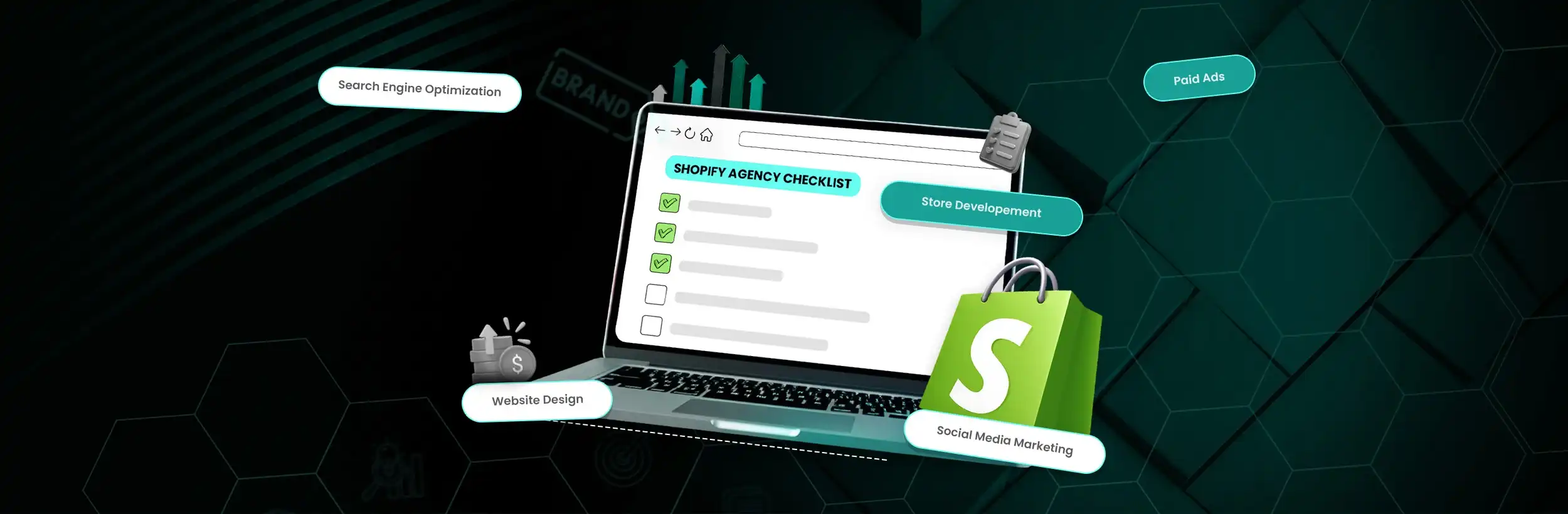
The Ultimate Shopify Agency Checklist for 2026
Here’s a practical, step-by-step checklist for choosing a Shopify team that delivers real results:
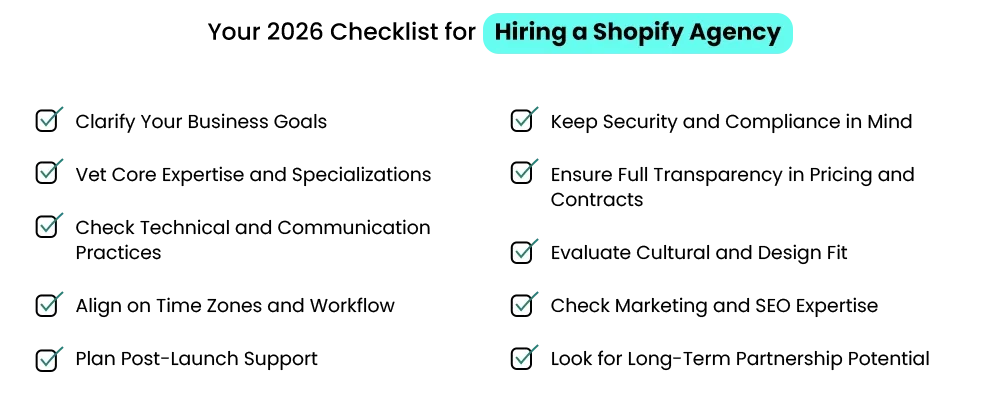
1. Clarify Your Business Goals
Before you start contacting agencies, get clear about what success actually means for your business.
Every Shopify agency operates differently, and some specialize in development, some in marketing, and some in full-service support.
When you know what you need ahead of time, you are more likely to find the right fit without guesswork or long evaluation cycles.
For example, do you want:
- A better-looking Shopify store that feels more premium and user-friendly?
- A migration to Shopify Plus so you can scale internationally or handle higher order volumes?
- Better visibility on Google and AI-driven search with Shopify SEO agency support?
- A complete marketing partner who can run ads, email, SMS, and content to drive revenue?
- CRO improvements to boost conversion rates without increasing ad spend?
- A long-term partner to support both tech and growth?
When goals are defined upfront, you avoid long back-and-forth conversations and wasted quotes. It also allows the agency to recommend the right plan, timeline, and pricing structure.
Most importantly, it ensures that both sides are aligned on expectations from day one, which sets the foundation for a successful partnership.
2. Vet Core Expertise and Specializations
Not all agencies offer the same skill sets. Some are strong in coding and Shopify development, others specialize in paid performance and SEO. A good fit depends on your needs.

Look for Shopify Partner badges, Plus certifications, testimonials, and real results. A polished website means nothing if it cannot prove actual performance.
3. Check Technical and Communication Practices
Even the best developers are hard to work with if communication is weak. A reliable Shopify expert should be transparent about how they manage projects.
Ask questions like:
- What tools do they use for tasks and tracking (Trello, Asana, Jira, etc.)?
- How frequently will you receive progress updates?
- Who is your main point of contact?
- Do they provide documentation and training after launch?
Good communication avoids delays, confusion, and mismatched expectations. It is the difference between a smooth project and a stressful one.
4. Align on Time Zones and Workflow
If you are working across countries, time zones matter a lot. Overlapping work hours make collaboration easier, especially for:
- Design reviews
- QA checks
- Urgent fixes
- Ads and campaign approvals
For example, agencies in India overlap nicely with the US, UK, Middle East, and Europe time zones, making communication easier.
Without overlap, a simple task can take days instead of hours.
5. Plan Post-Launch Support
Your Shopify store going live is not the end; it is the beginning of performance. After launch, you need support for things like:
- Fixing bugs and broken features
- Tracking analytics and conversions
- Improving load speed and UX
- Updating apps, themes, and integrations
- Adjusting marketing based on data
- Maintaining security and compliance
- Adding new features as your business grows
Brands that skip post-launch support often find themselves stuck with outdated code, slow performance, and incomplete tracking.
These problems may not appear on day one, but they impact retention, paid advertising efficiency, and conversion rates over time.
A Shopify expert who offers maintenance and optimization keeps your store healthy and scalable instead of letting issues pile up. With ongoing support, you can react quickly to platform changes, customer needs, and seasonal opportunities without rebuilding everything from scratch.
6. Keep Security and Compliance in Mind
Ecommerce stores handle sensitive data like personal info, orders, and payments. Security should not be an afterthought.
Ask the agency how they handle:
- Data backups and recovery
- Role-based access control
- Privacy and consent rules
- PCI compliance for payment processing
- Secure API and app integrations
For Shopify Plus brands, compliance can also include international privacy laws and enterprise governance. The right practices prevent data leaks, downtime, and reputation damage.
7. Ensure Full Transparency in Pricing and Contracts
Many brands face frustration when agencies add hidden charges later. Before signing anything, request transparency around:
- Set-up and build fees
- Monthly retainers for marketing or support
- Fees for third-party tools or apps
- Hourly fees for extra tasks
- Payment terms and milestones
Clear contracts protect both sides and prevent surprises that can strain partnerships later.
Also read: The Ultimate Checklist for Merchants: WooCommerce to Shopify Migration
8. Evaluate Cultural and Design Fit
A Shopify expert should understand your market and your audience. This includes design style, tone of voice, and customer behavior.
Review their past work and ask:
- Do they design for similar industries?
- Do they understand your demographics and geographies?
- Does their UX style match your brand personality?
A luxury fashion brand, for example, needs a very different visual style than a B2B industrial parts brand. Design and culture alignment matter more than people think.
9. Check for Marketing and SEO Expertise
Many merchants make the mistake of hiring a developer-only agency. Development gets you a store, but marketing gets you customers.
A good full-service agency provides:
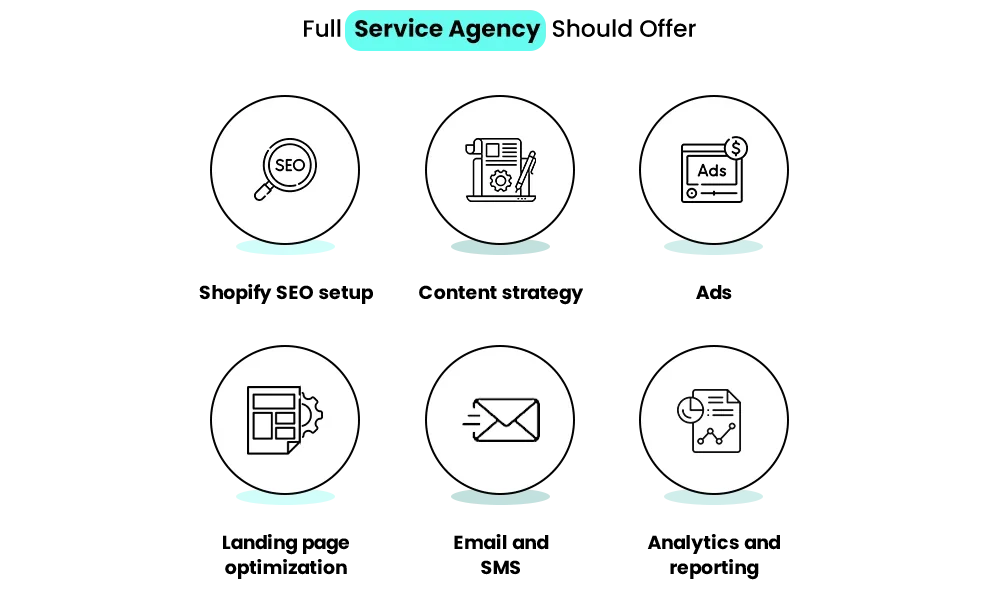
- Shopify SEO setup and technical fixes
- Content strategy and blog creation
- Google Shopping and Meta Ads
- Landing page optimization and CRO
- Email and SMS lifecycle management
- Analytics and reporting
This ensures your store is not only built but also marketed, optimized, and continuously improved for revenue.
Click here to read: Looking for a Shopify Marketing Agency? Here’s Your Checklist for 2026
10. Look for Long-Term Partnership Potential
The best agencies grow with you. A Ecommerce agency for Shopify should not just complete tasks; they should help you plan retail calendars, fix bottlenecks, and scale your product offerings.
Long-term partners:
- Understand your audience deeply
- Improve performance with data
- Recommend new features proactively
- Support as your catalog and markets expand
This removes the need to switch vendors every year and protects your momentum.

What Full-Service Shopify Agencies Offer?
A modern Shopify agency should be able to support your brand from start to scale:
1. Store Design and Development
Responsive themes, custom UX, mobile-first builds, and headless commerce options for advanced brands.
2. Technical SEO and Analytics
Structured data, performance optimization, GA4 setup, and reporting that aligns with business KPIs.
3. Marketing and Growth Services
Content marketing, paid advertising, email and automation, social campaigns, and conversion rate optimization.
4. Ongoing Optimization
Data reviews, UX improvements, A/B testing, and roadmap planning for future features.
When you find a partner that covers all these areas, you reduce risk, drive measurable growth, and get better ROI than trying to piece services together from different vendors.
What to Avoid When Hiring a Shopify Agency?
Here are five important things that you should avoid while hiring a Shopify partner agency or expert.
1. No clear Shopify growth plan
Avoid agencies that focus only on design or development without addressing traffic, conversions, email marketing, cart abandonment, or SEO.
2. Guaranteed results
Be cautious of agencies promising guaranteed rankings or sales numbers. Ecommerce growth depends on multiple factors, and honest agencies set realistic expectations.
3. Poor communication
Slow responses, vague answers, or lack of a clear point of contact are early warning signs. Strong communication is critical for long-term collaboration.
4. One-size-fits-all solutions
Every Shopify store has different goals, products, and customers. Avoid agencies that reuse the same strategy for every client without customization.
5. Limited post-launch involvement
If an agency disappears after launch, growth will stall. Sustainable Shopify store growth requires continuous testing, optimization, and marketing.
Here’s How Mastroke Supports Brands That Want a Long-Term Shopify Partner
At Mastroke, we provide end-to-end Shopify solutions for merchants of all sizes.
From Shopify store setup to Shopify Plus enterprise builds, from Shopify SEO agency services to full-scale marketing campaigns, our team delivers measurable results and strategic guidance.
Whether you are just launching or scaling globally, we handle the technical, creative, and growth aspects of your ecommerce journey.
Ready to grow your Shopify store with expert support?
Contact Mastroke today, and let’s make your ecommerce vision a reality.
Build your dream Shopify store today
Bring your vision to life with Mastroke, an official Shopify Partner. We design and develop high-converting, scalable Shopify stores with clean structure and future-ready features—built to grow with your business.
Conclusion
Choosing an ecommerce agency for Shopify in 2026 is not just a vendor decision; it is a growth decision. The right partner will support your Shopify growth strategy with strong design, performance, marketing, and continuous optimization.
Use this checklist to evaluate capabilities, avoid common red flags, and focus on real business outcomes.
When your agency aligns with your goals, your online store is better positioned for steady traffic, higher conversions, and long-term, scalable growth.
Frequently Asked Questions (FAQs)
1. How to choose a Shopify agency?
Check their Shopify experience, past results, communication style, pricing clarity, and post-launch support. Choose a partner that matches your goals, not just your budget.
2. Is Shopify still worth it in 2026?
Yes. Shopify remains one of the best ecommerce platforms thanks to its performance, security, scalability, and strong app ecosystem.
3. How to run a successful Shopify business in 2026?
Focus on great UX, fast performance, SEO, paid ads, email/SMS, and clear analytics. Growing brands improve conversions and retention, not just traffic.
4. What does a Shopify agency do?
They help build, optimize, and market Shopify stores. Services usually include development, UX design, SEO, ads, email, CRO, and ongoing support.
5. What are the 5 types of agency?
Common types are development, creative/branding, marketing, performance/media, and full-service agencies.
6. Should I hire an expert for Shopify SEO?
Yes. Shopify SEO involves technical fixes, content, keywords, and structured data. An expert helps you get better rankings and long-term organic traffic.