
A focused Shopify growth strategy in Q1 determines how efficiently your store performs for the rest of the year. Once the holiday rush fades, merchants can finally audit their performance, address friction points, and strengthen fundamentals without the pressure of peak-season traffic.
That foundation matters more than ever. Shopify’s latest financial results reinforce a clear message for merchants: performance-first growth works—Shopify reported 27% revenue growth and sustained double-digit free cash flow margins for seven consecutive quarters, proving that speed, efficiency, and optimization drive real results.
With mobile accounting for the majority of ecommerce purchases and AI-driven shopping experiences accelerating, Q1 2026 is no longer just a planning phase. It is where merchants prepare their stores not only for human shoppers, but also for AI shopping agents that increasingly influence discovery, comparison, and purchase decisions.
What Is the Role of Q1 in a Shopify Growth Strategy?
Q1 plays a foundational role in shaping the success of the entire eCommerce year. It is the quarter where merchants decide what deserves focus, what should be paused, and what needs fixing before scale begins. These early decisions directly influence long-term scalability, operational efficiency, profitability, and customer experience during peak demand periods.
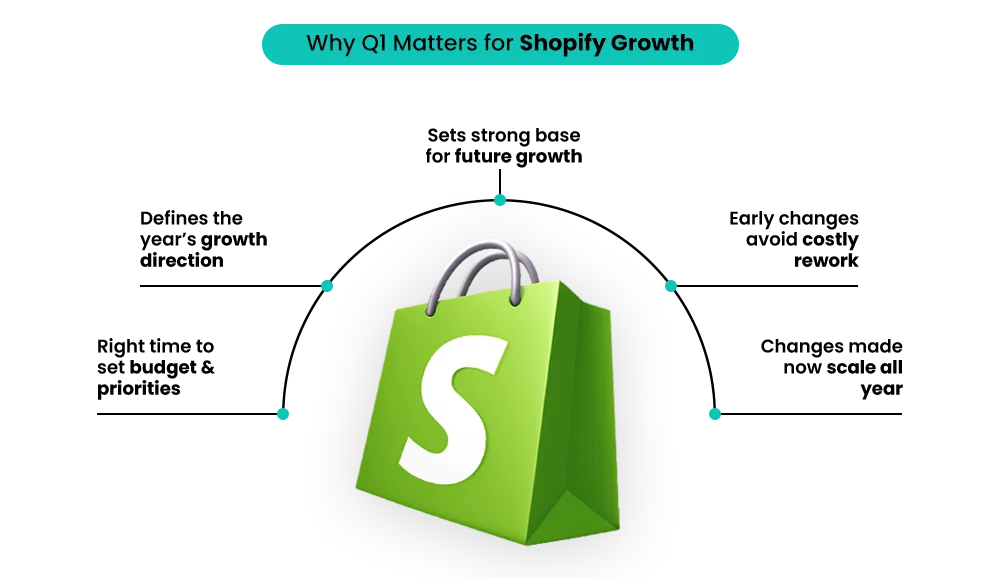
A disciplined Shopify growth strategy treats Q1 as a reset and optimization phase, not an aggressive scaling sprint. When merchants rush into traffic acquisition or expansion without addressing foundational issues, hidden problems—such as slow page speed, confusing navigation, inefficient checkout flows, or excessive apps—resurface later during high-traffic moments. Q1 is the safest and smartest window to strengthen the core of your store so growth later in the year is sustainable, not fragile.
How Is Q1 2026 Different for Shopify Merchants?
Q1 2026 is shaped by two major shifts redefining how commerce works: Agentic Commerce and AEO (Answer Engine Optimization).
Shopify stores are no longer optimized only for human shoppers scrolling product pages. Increasingly, AI-powered shopping agents analyze store speed, structure, product clarity, trust signals, and policies before recommending where purchases should happen. These agents compare stores, summarize options, and influence buying decisions—often before a human ever lands on your site.
A future-ready Shopify growth strategy in Q1 2026 must account for both human behavior and machine evaluation. This means prioritizing clean data structures, fast performance, clear product information, and transparent policies early in the year. Merchants who adapt now will be better positioned as AI-driven commerce becomes mainstream.
What Should Shopify Merchants Focus on First in Q1?
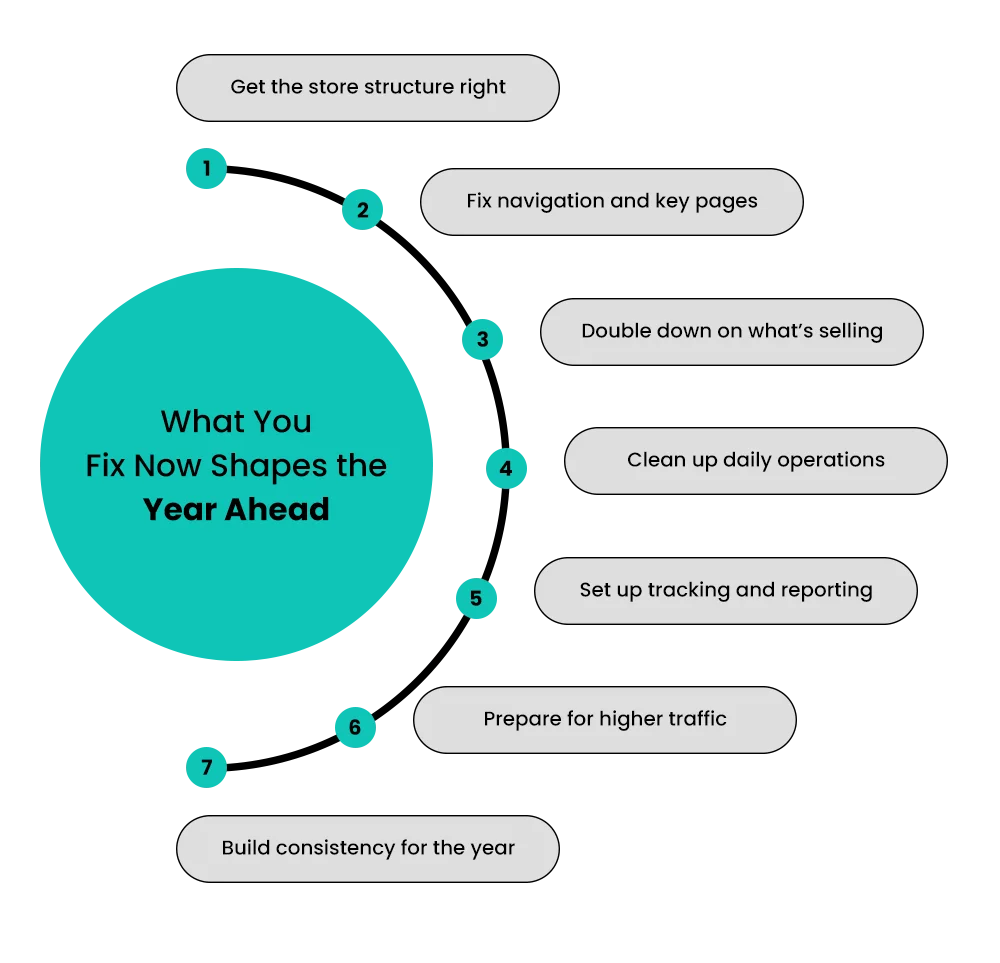
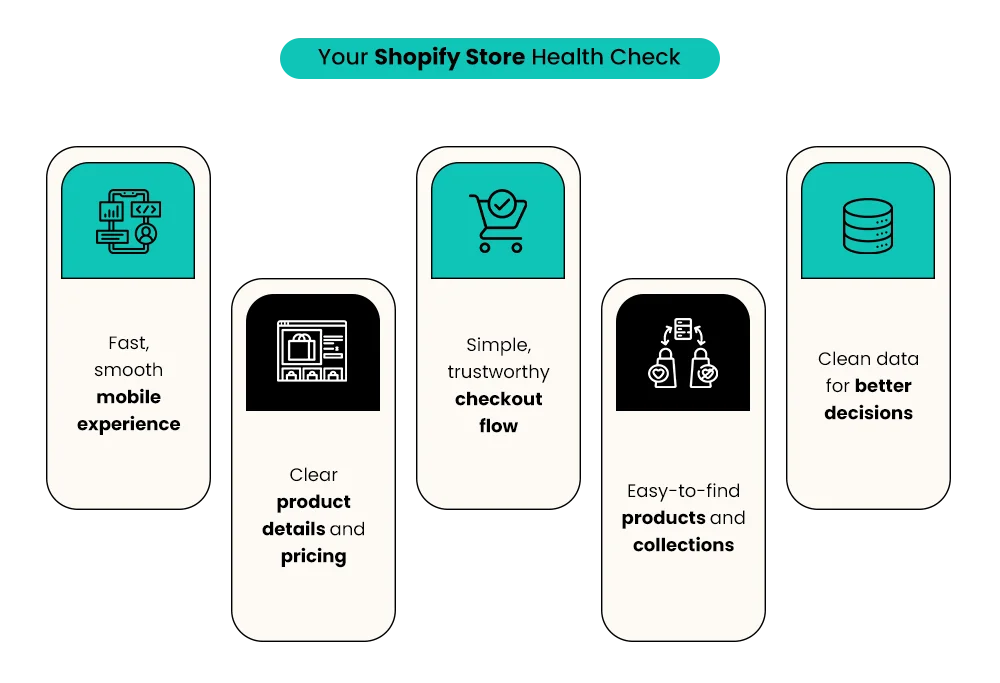
Before chasing traffic or launching new campaigns, merchants should focus on store health. A sustainable Shopify growth strategy begins by fixing conversion blockers before increasing acquisition.
Key questions to answer early:
- Is the store fast and stable on mobile?
- Can visitors understand the product within seconds?
- Is product discovery frictionless?
- Does checkout feel simple and trustworthy?
- Are retention systems in place?
Growth amplifies weaknesses—Q1 is when you remove them.
How to Build a Retention-First Shopify Growth Strategy?
Retention is no longer a secondary metric—it is the foundation of sustainable Shopify growth. As acquisition costs continue to rise and competition intensifies, retaining existing customers delivers more predictable revenue, higher lifetime value, and better profitability. Q1 is the ideal time to strengthen retention systems before scaling traffic.
-
Optimize Post-Purchase Communication and Email Lifecycle Flows
Post-purchase experiences shape whether customers return. Optimizing order confirmations, shipping updates, review requests, and replenishment reminders keeps buyers engaged beyond checkout. Well-timed, personalized email flows build trust, encourage repeat purchases, and turn one-time buyers into long-term customers without increasing acquisition spend.
-
Improve Mobile-First Repeat Purchase Journeys
Most repeat purchases now happen on mobile. Streamlining account access, reordering, saved payments, and personalized recommendations reduces effort for returning customers. A mobile-first repeat purchase journey removes friction, speeds decision-making, and increases the likelihood that customers buy again instead of exploring competitors.
-
Reduce Friction That Turns Buyers Into One-Time Customers
Hidden fees, unclear policies, slow pages, and confusing navigation often prevent repeat purchases. Identifying and removing these friction points in Q1 improves the overall customer experience. When buying feels effortless and predictable, customers are more likely to return, recommend the brand, and stay loyal.
A retention-first Shopify growth strategy compounds results over time—driving higher lifetime value, improving margins, and reducing long-term dependency on paid acquisition.
What Is App Bloat and How Does It Affect Shopify Performance?
App bloat is one of the most common yet overlooked performance issues in Shopify stores. As merchants grow, they add apps for reviews, upsells, analytics, or promotions—but many of these tools stay active long after they stop adding value. Each extra app introduces scripts and background processes that quietly slow down the store.
The impact is most visible on mobile. Heavy app stacks increase load times, delay taps and clicks, and create friction during browsing. This results in higher bounce rates, weaker engagement, and lost conversions, even if the store looks visually polished.
App bloat also harms Core Web Vitals, especially Interaction to Next Paint (INP), which measures how quickly a page responds to user actions like filtering products or adding items to cart. Too many scripts directly worsen INP, making the store feel sluggish.
A smart Shopify growth strategy includes regular app audits focused on:
-
Removing unused or overlapping apps
-
Keeping only lightweight, performance-friendly tools
-
Prioritizing mobile speed and responsiveness
Reducing app bloat improves user experience, strengthens SEO, and ensures your store performs well for search engines and AI shopping agents that increasingly favor fast, efficient Shopify stores.
How to Achieve Frictionless Product Discovery on Shopify?
Product discovery is a direct revenue driver. When shoppers can easily find, compare, and evaluate products, they move confidently toward purchase. Frictionless Product Discovery removes confusion, reduces decision fatigue, and shortens the path from landing page to checkout—especially important as mobile traffic dominates Shopify stores.
-
Build Clear and Logical Collection Structures
Collections should reflect how customers naturally browse, not how internal teams categorize products. Grouping products logically, using intuitive naming, and avoiding overly complex hierarchies helps shoppers understand options quickly and move deeper into the store without frustration or hesitation.
-
Design Predictable and Intuitive Menus
Menus should feel familiar and easy to scan. Predictable navigation reduces cognitive load and helps users know exactly where to click next. When menus are consistent across desktop and mobile, customers spend less time searching and more time evaluating products and purchasing.
-
Optimize On-Site Search and Filtering Experience
Search and filters should help shoppers narrow choices effortlessly. Fast, accurate search results, relevant suggestions, and flexible filters—such as size, price, or category—enable quicker decision-making. Poor search performance often leads to abandonment, even when product demand is strong.
-
Apply Mobile-First Navigation Logic
Most product discovery now happens on mobile devices. Navigation must be thumb-friendly, fast, and uncluttered. Mobile-first logic prioritizes collapsible menus, clear CTAs, and smooth interactions, ensuring shoppers can browse and compare products without friction on smaller screens.
If customers struggle to find the right product quickly, conversion rates decline—regardless of traffic quality, marketing spend, or brand awareness.
What Trust Signals Matter Most for Shopify Conversions?
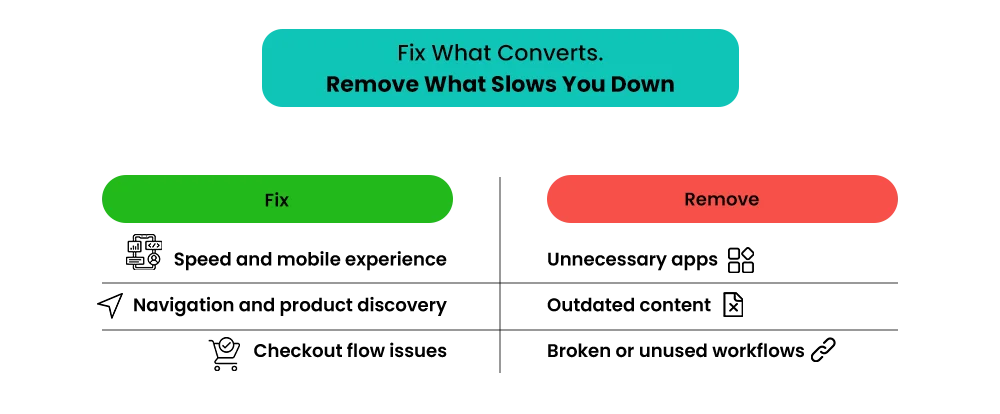
Trust is visual, immediate, and experience-driven. Text reviews still matter, but they are no longer sufficient for high-value or high-consideration purchases. Shoppers want to see real people using products, validating quality, and answering unspoken objections—especially on mobile, where decisions are made quickly.
-
Customer Video Testimonials
Video testimonials feel authentic and harder to fake than written reviews. Seeing real customers explain their experience builds emotional trust, reduces hesitation, and increases confidence. These videos are especially powerful when placed near key decision points such as product descriptions or pricing sections.
-
User-Generated Content (UGC) Product Demos
UGC demos show products in real-world use, helping shoppers visualize ownership. This type of content answers practical questions about fit, quality, and functionality, reducing uncertainty. UGC also increases relatability, making products feel tested, credible, and worth purchasing.
-
Influencer Walkthroughs and Product Explanations
Influencer walkthroughs combine authority with demonstration. When trusted creators explain how a product works, why it’s useful, and who it’s for, shoppers gain clarity faster. This is particularly effective for complex, premium, or new product categories where education drives conversion.
-
Visual Proof Embedded Directly on Product Pages
Trust signals work best when they are embedded within the buying journey, not hidden on separate pages. Placing videos, badges, delivery assurances, and guarantees directly on product pages reinforces confidence at the exact moment customers are deciding to buy.
Trust must be seen to convert, especially on mobile-first Shopify stores where attention spans are short and hesitation leads to drop-offs.
How to Create a Practical Q1 Shopify Planning Checklist?
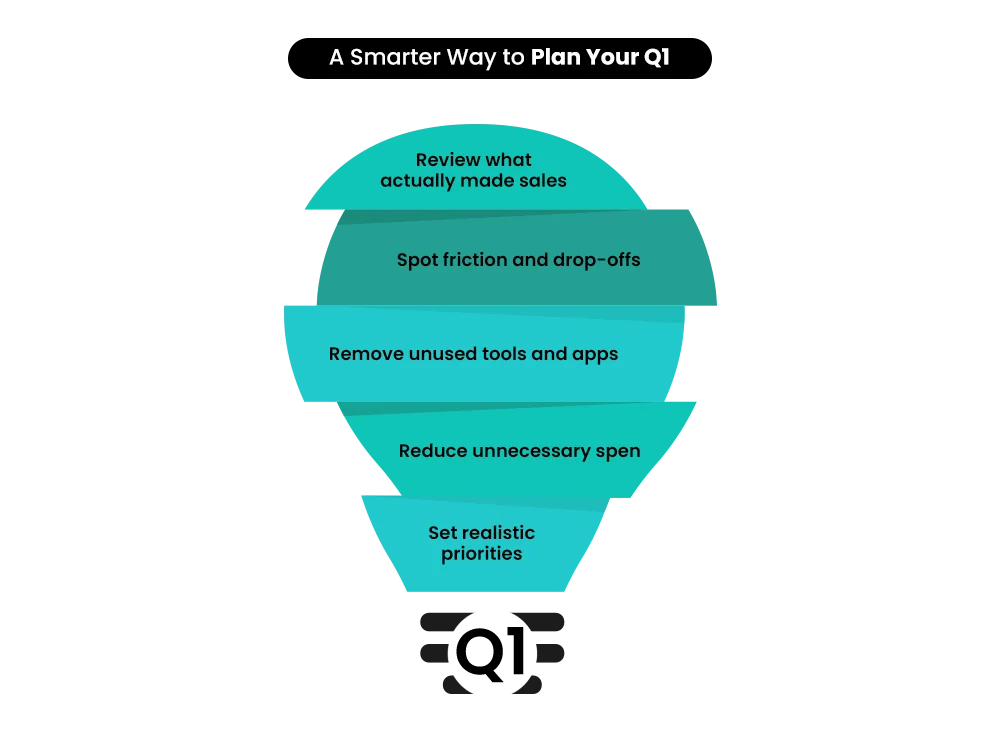
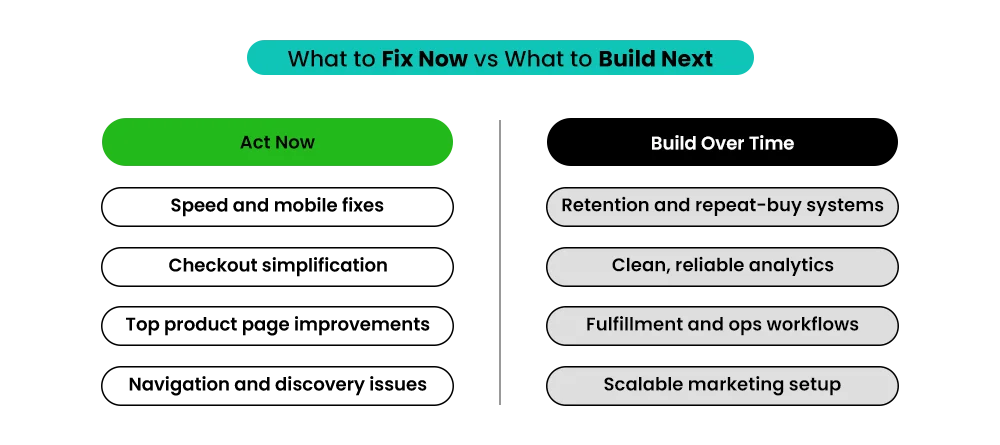
A practical Q1 checklist turns strategy into execution. Instead of reacting to trends or copying competitors, merchants use Q1 to create structure, prioritize impact, and set up systems that support growth throughout the year. A strong Shopify growth strategy ensures every Q1 action contributes to measurable performance gains.
-
Review Q4 Conversion and Retention Data
Q4 data reveals how customers behaved during peak demand. Analyzing conversion rates, repeat purchases, drop-offs, and customer cohorts helps identify what worked and what failed. These insights guide smarter Q1 decisions and prevent repeating inefficiencies.
-
Audit the Full Customer Journey
Evaluating the entire journey—from landing page to repeat purchase—exposes friction points that quietly hurt performance. Audits help uncover issues in navigation, checkout, post-purchase communication, and mobile usability that impact conversions and retention.
-
Clean Up Apps and Integrations
Over time, unused or overlapping apps slow down Shopify stores and increase error risks. Q1 is ideal for removing unnecessary integrations, consolidating tools, and simplifying your tech stack to improve speed, stability, and maintainability.
-
Improve Core Web Vitals and Mobile UX
Performance directly affects conversions, rankings, and AI evaluations. Optimizing metrics like INP, improving mobile responsiveness, and reducing script load ensures smoother interactions and stronger engagement across devices.
-
Pause Low-ROI Ad Spend
Q1 is not the time to force aggressive growth through inefficient ads. Pausing or reducing low-performing campaigns frees up budget to fix conversion issues, improve retention, and prepare for more profitable scaling later.
This approach ensures Q1 efforts lead to meaningful improvements—not busywork.
What Should Shopify Merchants Fix at the Start of the Year?
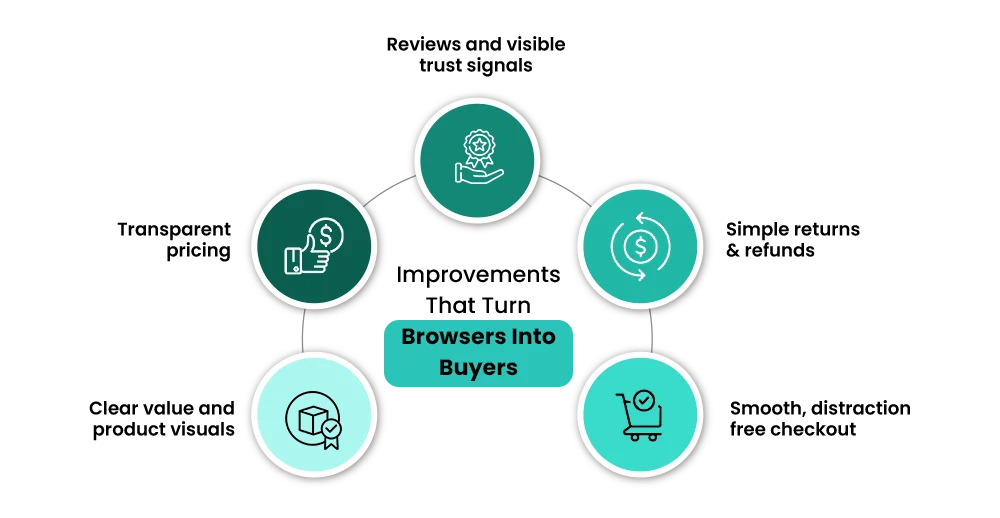
The start of the year offers the best opportunity to fix foundational issues before traffic and demand increase. A performance-led Shopify growth strategy focuses on improvements that quietly unlock higher conversions and smoother scaling.
-
Mobile Speed and INP Optimization
Improving mobile responsiveness ensures faster interactions, smoother browsing, and better Core Web Vitals. Strong INP performance reduces frustration and keeps users engaged throughout the buying journey.
-
Checkout Simplicity
A clear, distraction-free checkout reduces hesitation and abandonment. Simplifying steps, removing unnecessary fields, and improving transparency helps customers complete purchases confidently.
-
Navigation and Product Discovery
Clear menus, logical collections, and strong search functionality make it easy for shoppers to find products. Better discovery directly improves engagement and conversion rates.
-
App Bloat Reduction
Removing redundant or unused apps improves speed, stability, and performance. Lean app stacks benefit users, search engines, and AI shopping agents evaluating store quality.
-
Clear Trust Signals and Policies
Visible shipping details, return policies, guarantees, and authentic social proof reduce hesitation. Trust-building elements are critical for first-time buyers and high-value purchases.
Fixing these early prevents minor issues from becoming costly problems later in the year.
How to Set Realistic Q1 Goals Without Overstretching?
Q1 goals should create momentum, not pressure. An effective Shopify growth strategy balances ambition with sustainability by separating objectives clearly and focusing on execution quality.
- Revenue Goals: Set achievable revenue targets based on existing traffic and conversion improvements rather than aggressive acquisition.
- Profitability and Efficiency Targets: Focus on margins, cost control, and operational efficiency to strengthen financial health before scaling.
- Customer Experience Improvements: Invest in faster performance, clearer journeys, and stronger retention systems that support long-term growth.
Fewer, focused goals consistently outperform aggressive targets that teams cannot maintain.
What Do Successful Shopify Stores Focus on in Q1?
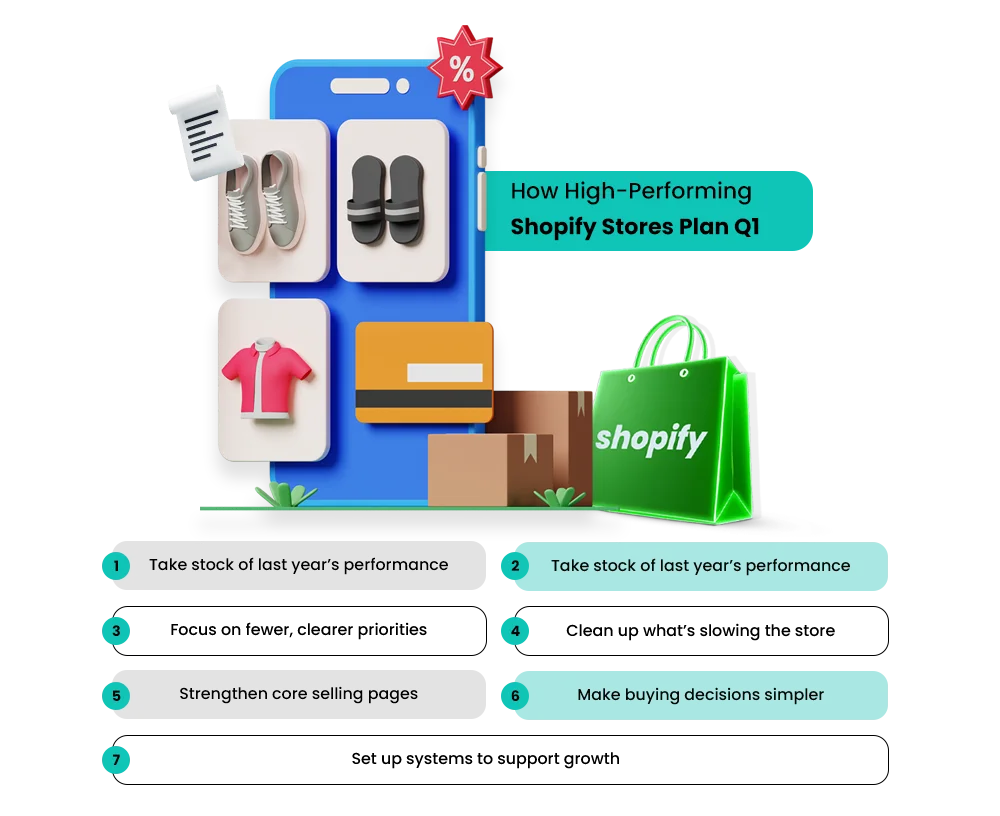
Top-performing Shopify brands treat Q1 as a foundation-building phase rather than a high-pressure growth quarter. Their Shopify growth strategy emphasizes discipline and clarity.
- Simplification Over Expansion: Reducing complexity improves performance and execution speed.
- Data-Led Decision-Making: Insights, not assumptions, guide priorities and investments.
- Retention Before Acquisition: Maximizing existing customers delivers predictable, profitable growth.
- Conversion Optimization Before Traffic Growth: Improving conversion rates ensures future traffic performs better.
This focus allows brands to scale smoothly during high-demand periods.
How to Reset Your Shopify Store for the New Year?
Resetting your Shopify store starts with intention. Q1 is the time to realign effort with impact and eliminate distractions that dilute results.
- Stop Low-Impact Activities: Identify tasks that consume resources without driving measurable growth and remove them.
- Continue Proven Conversion Drivers: Double down on strategies, channels, and experiences that consistently convert.
- Improve High-Impact Areas: Focus on small changes that unlock disproportionate gains in performance, retention, or revenue.
Q1 progress should feel controlled, intentional, and measurable, setting the stage for confident, scalable growth throughout the year.
Bottom Line: Why Q1 Focus Defines Shopify Success?
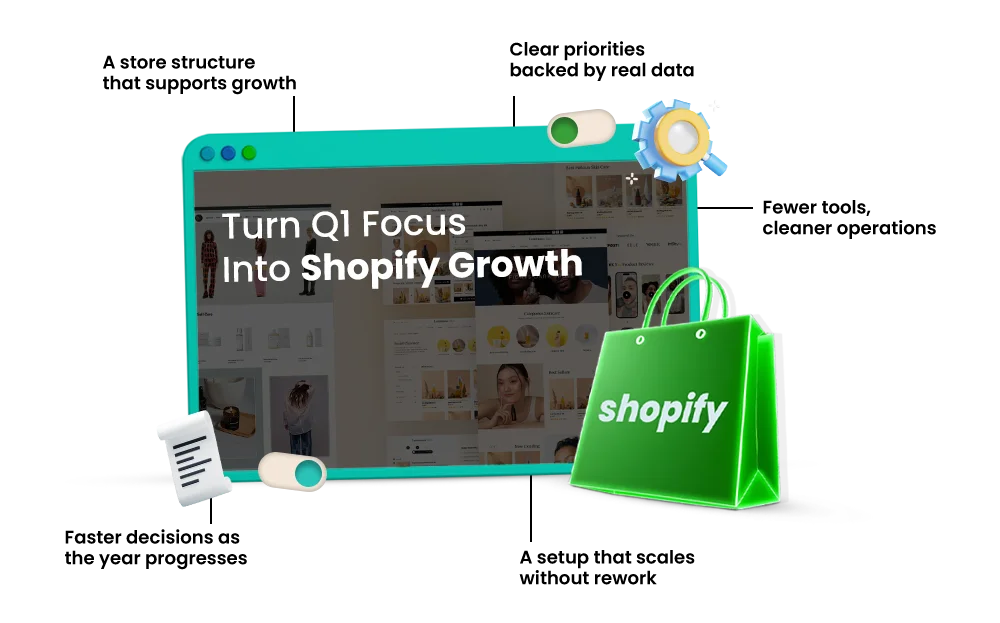
Q1 is not about doing more—it is about doing what matters. Merchants who invest in store health, retention, performance, and trust build momentum that lasts all year. A well-executed Shopify growth strategy turns early discipline into sustainable, scalable growth.
If you’re looking for a partner to execute a data-driven Shopify growth strategy, Mastroke is a trusted Shopify SEO Agency and Shopify Growth Partner. From Shopify store setup to ongoing optimization, Mastroke helps brands improve visibility, increase conversions, and scale with confidence.
Get started with Mastroke and prepare your Shopify store for scalable, AI-ready growth.
FAQs
1. What is a Shopify growth strategy?
A Shopify growth strategy is a structured plan that focuses on improving store health, conversion rates, retention, and performance so a Shopify store can scale sustainably without wasting ad spend.
2. Why is Q1 important for Shopify growth planning?
Q1 is the reset quarter where merchants fix performance issues, improve mobile conversion, reduce app bloat, and strengthen retention—creating the foundation that supports high-traffic periods later in the year.
3. What should Shopify merchants prioritize before scaling ads?
Before increasing ad spend, merchants should optimize store speed, navigation, checkout flow, product discovery, and trust signals to ensure traffic converts efficiently.
4. How does retention fit into a Shopify growth strategy?
Retention reduces dependency on paid acquisition by increasing repeat purchases and lifetime value, making it a core priority in any effective Shopify growth strategy.
5. How does AI and Agentic Commerce affect the Shopify store?
Shopify stores must be optimized not only for human shoppers but also for AI shopping agents, requiring faster performance, clear structure, strong trust signals, and AEO-friendly content.