There’s a reason fast-growing brands talk about Shopify Plus differently. They don’t see it as just a higher plan or a costly upgrade—they see it as the system that keeps their business running smoothly when growth gets serious.
At first glance, Shopify Plus may look familiar. The dashboard feels like regular Shopify, and the store looks similar. But behind the scenes, it’s built to handle scale, speed, and complexity. In 2026, enterprise Shopify strategies aren’t just about launching stores—they’re about running large operations effortlessly, even during traffic spikes or major sales events.
Shopify Plus is built for serious scale, maintaining 99.99% uptime during major global sales and powered by 4,500+ engineers behind the infrastructure. With a partner ecosystem generating $150Cr+, it reflects a platform designed for enterprise-level growth — not beginner stores.
This blog reveals what big brands already know about Shopify Plus, so you can plan growth smarter.
What Shopify Plus Really Is (Beyond the Marketing Definition)
Most people think Shopify Plus is just Shopify with more power and a bigger price tag. Big brands see it very differently. To them, Shopify Plus is not a plan—it’s the system that keeps the business running when things get complex.
In enterprise Shopify 2026 setups, the platform must handle more than products and payments. It must support teams, tools, data, markets, and customers—all at the same time. Shopify Plus works like an operating system that connects everything without slowing the business down.
There’s also a big mindset gap. Some brands use Shopify Plus. Big brands leverage Shopify Plus. Using it means upgrading and continuing the same habits. Leveraging it means redesigning workflows, reducing app overload, and using Shopify Plus features 2026 to simplify daily operations.
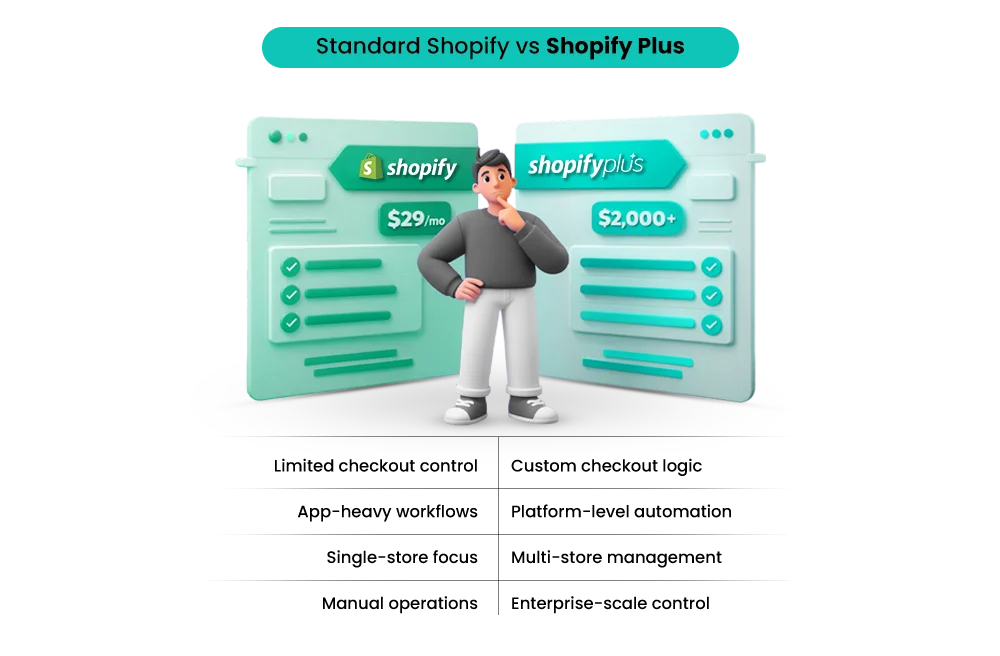
This is where standard Shopify thinking breaks. What works for a growing store often fails at scale—too many apps, limited checkout control, and messy data. Shopify Plus updates 2026 focus on fixing these issues at the platform level, not through workarounds.
That’s why big brands rarely do this alone. A strong Shopify Plus agency helps brands build the right structure early, align with the Shopify Plus roadmap, and turn Shopify Plus into a long-term advantage instead of a short-term upgrade.
Where Standard Shopify Starts to Break
Standard Shopify works extremely well for early growth. The problem isn’t that it’s weak — it’s that success eventually pushes it past its design limits. As brands scale, friction appears in areas that weren’t problems before: checkout control, workflow automation, multi-store management, and operational complexity.
This is the point where Shopify Plus stops being a luxury and starts becoming infrastructure.
Here’s where standard Shopify begins to strain:
- Checkout restrictions: Advanced checkout logic, B2B rules, and personalized flows are limited without Shopify Plus tools
- App overload: Growing brands stack 15–30 apps to fill platform gaps, slowing performance and increasing maintenance risk
- Manual operations: Repetitive tasks require staff time instead of automation, creating operational bottlenecks
- Multi-store chaos: Managing regions, currencies, and catalogs becomes fragmented without centralized control
- Scaling risk: Traffic spikes during major sales can expose system and workflow weaknesses
- Limited B2B structure: Wholesale pricing and catalogs require workarounds instead of native workflows
Shopify Plus removes these pressure points by replacing patches and workarounds with built-in enterprise architecture. Brands don’t upgrade because Shopify fails — they upgrade because growth exposes structural limits.
ROI: How Shopify Plus Pays for Itself
The biggest misconception about Shopify Plus is that it’s a cost upgrade. Enterprise brands treat it as an efficiency investment. The ROI doesn’t come from the subscription alone — it comes from the systems it replaces, the labor it reduces, and the revenue it unlocks.
Shopify Plus often pays for itself through operational leverage:
- Higher conversion rates: Checkout optimization and faster performance increase completed purchases
- Reduced app spend: Native features replace expensive third-party tools
- Automation savings: Shopify Flow and Launchpad eliminate hours of manual work
- Faster campaign launches: Teams execute sales and experiments in hours instead of weeks
- Lower development overhead: Fewer custom patches and emergency fixes
- Improved B2B revenue: Structured wholesale pricing unlocks new customer segments
- Scalable infrastructure: Prevents revenue loss during peak traffic events
For high-growth brands, the math becomes simple: if Shopify Plus increases conversion, reduces operational cost, and accelerates execution, it becomes a profit multiplier — not an expense.
That’s why big brands evaluate Shopify Plus in terms of total business impact, not monthly subscription price.
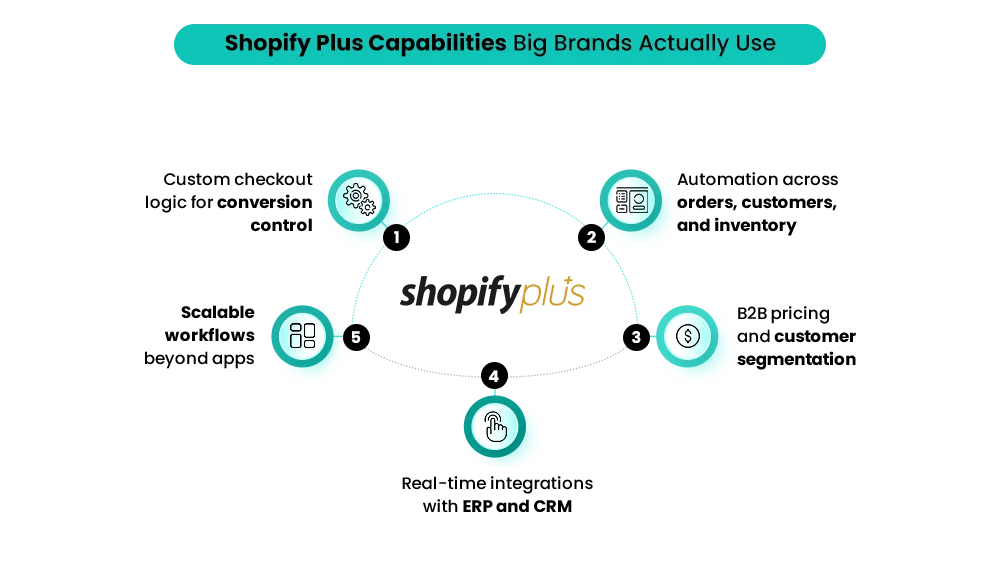
Shopify Plus Features 2026: What Big Brands Actually Use
Shopify Plus isn’t just a “bigger Shopify.” Big brands choose it because it solves real-world scaling challenges. From checkout customization to global store management, these Shopify Plus features 2026 are built for growth, not hype.
- Checkout That Converts – Using Shopify Functions, brands run automatic discounts, personalized upsells, and custom fields based on buyer type. Brands report up to 50% faster checkout using Shopify Functions compared to older Scripts.
- Automation & Smart Workflows – Shopify Flow and Launchpad handle repetitive tasks like inventory updates, alerts, and seasonal campaigns, freeing teams to focus on strategy.
- API & System Integrations – Connect ERP, CRM, analytics, and marketing tools in real-time to streamline operations and reporting.
- Global & Multi-Store Control – Manage up to 10 stores, multi-currency checkout, and consistent pricing across regions.
- B2B + D2C Hybrid Selling – Custom pricing, catalogs, and automated workflows let brands sell seamlessly to both wholesale and retail customers.
With these tools, big brands scale without chaos and stay ahead in 2026
Shopify Plus Pricing 2026: What Big Brands Pay
Shopify Plus is designed for enterprise and high-growth businesses. Plans start at $2,300/month (3-year term) or $2,500/month (1-year term), plus a small percentage of sales for very high-volume stores. All plans include unlimited staff accounts, multi-store management, and 24/7 priority support.
| Plan / Term | Cost | What You Get |
| 1-Year Plan | $2,500/month + 0.4% of D2C revenue, 0.18% of B2B revenue (minimum $2,500) | Unlimited staff accounts, up to 200 inventory locations, 9 expansion stores, up to 100 themes, 200 POS Pro locations, 24/7 priority support |
| 3-Year Plan | $2,300/month + 0.35% of monthly sales volume (minimum $2,300) | Unlimited staff accounts, up to 200 inventory locations, 9 expansion stores, up to 100 themes, 200 POS Pro locations, 24/7 priority support |
| Custom Pricing | Negotiated based on revenue, business model, and growth | Tailored terms for very high-volume or complex businesses |
Compared to Shopify Advanced ($299/month), Shopify Plus is a significant investment—but it provides enterprise-grade features like multi-store dashboards, global checkout, and B2B pricing.
Shopify Plus pricing is flexible. High-volume brands often negotiate custom deals to maximize ROI and align costs with growth plans.
What’s New in Shopify Plus for 2026 (Updates + Roadmap + Trends)
2026 is all about evolution, and Shopify Plus is leading the charge. Big brands aren’t just upgrading—they’re leveraging the latest Shopify Plus updates 2026 to stay competitive. The platform is shifting from feature expansion to infrastructure maturity, helping enterprise brands scale without operational friction.
Smart companies aren’t chasing upgrades. They’re aligning with a roadmap designed to future-proof growth.
Checkout Transformation: Shopify Functions Replace Scripts
The biggest architectural change is the checkout overhaul. Shopify Scripts is being replaced by Shopify Functions, unlocking advanced customization without fragile code.
Brands can now run:
- Dynamic discounts and tiered pricing
- Personalized shipping logic
- Smarter upsells and cross-sells
- Customer-specific checkout experiences
This shift turns checkout into a performance engine while reducing maintenance risk and app dependency.
B2B & Hybrid Commerce Expansion
Shopify Plus is strengthening wholesale and hybrid selling capabilities so brands can manage D2C and B2B inside one ecosystem.
New enterprise features include:
- Automated B2B workflows
- Custom pricing tiers and catalogs
- Multi-location inventory visibility
- Centralized multi-store dashboards
- Automated approvals and account rules
Complex commerce operations become simpler, faster, and easier to scale.
Infrastructure, Performance & Security Upgrades
On the infrastructure side, Shopify Plus continues to raise enterprise standards. The platform now delivers:
- 10,000+ transactions per minute capacity
- 99.99% uptime during traffic spikes
- Real-time fraud detection
- PCI DSS Level 1 compliance
- International privacy and compliance updates
These upgrades protect revenue while supporting global expansion.
Automation, APIs & Platform Architecture
Shopify Plus is moving toward a modular, API-first infrastructure built for composable commerce.
Key advancements include:
- Enhanced Shopify Flow automation
- Cross-store campaign orchestration
- Deeper ERP and CRM integrations
- Reduced app-heavy workarounds
- Flexible composable architecture
This evolution lowers operational complexity and increases execution speed.
Shopify Plus Roadmap Signals for 2026
Big brands aren’t just using Shopify Plus—they’re betting on its long-term roadmap. The direction is clear:
- Checkout personalization at scale using Shopify Functions
- Automation expansion across global operations
- API-first integrations replacing custom development
- Centralized multi-store global control
- Security + performance future-proofing
- Advanced hybrid B2B + D2C infrastructure
Brands following this roadmap reduce platform risk and build predictable growth systems.
Trends Defining Enterprise Shopify in 2026
Market leaders are already aligning with platform-wide trends:
- Composable commerce ecosystems replacing rigid stacks
- Unified B2B + D2C experiences under one dashboard
- AI-driven personalization and merchandising
- Rapid experimentation cycles for faster testing
- Data-first decision infrastructure
- Headless & API-first storefront expansion
Brands adopting these trends scale faster, convert better, and expand globally with less friction.
Why This Matters?
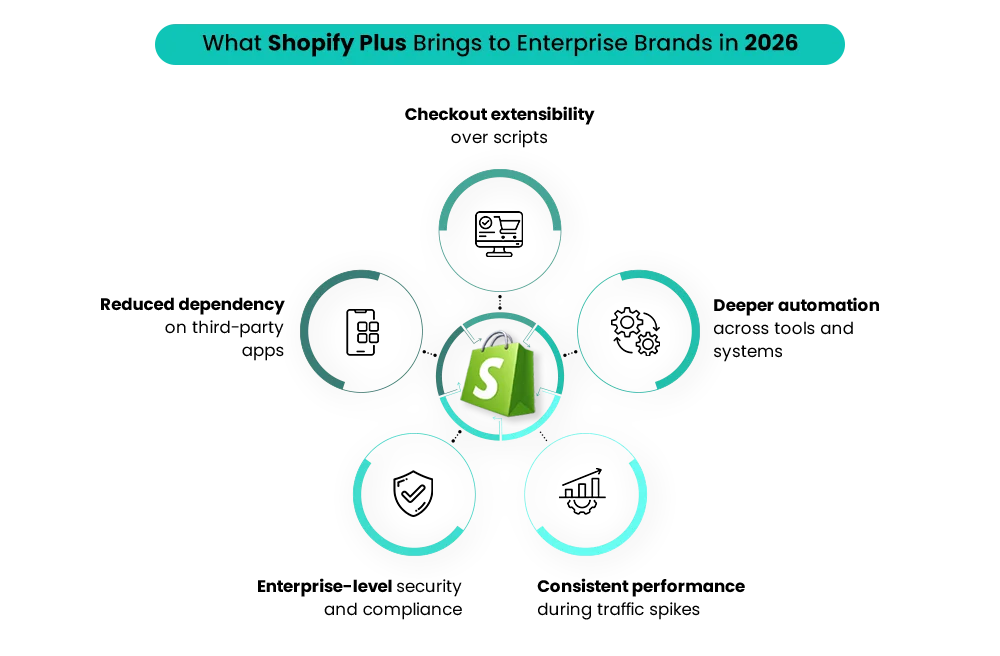
Shopify Plus in 2026 isn’t just improving — it’s positioning itself as long-term enterprise infrastructure. Brands aligning with these updates aren’t reacting to change; they’re building systems designed to absorb growth.
Following the roadmap turns platform investment into a predictable advantage. Smart brands don’t see features. They see signals of where commerce is heading — and they move early.
Enterprise Shopify 2026 – Why Shopify Plus Wins Against Legacy Platforms
For large online businesses, older platforms like Magento, Salesforce Commerce Cloud, or complex custom builds often become slow and difficult to manage. Enterprise Shopify in 2026, powered by Shopify Plus, changes that by giving brands a faster, more flexible system built for growth.
Big brands choose Shopify Plus for speed, flexibility, and cost efficiency:
- Speed to Market: Launch new products, campaigns, and global storefronts in days, not months.
- Lower Total Cost of Ownership: No heavy infrastructure or constant developer maintenance.
- Flexibility with Innovation: Full control over checkout, APIs, and integrations without being locked into rigid frameworks.
- Performance & Reliability: As per some sources, it handles 10,000+ transactions per minute with 99.99% uptime.
- Rapid Experimentation: Test promotions, layouts, and workflows instantly across multiple markets.
In short, Shopify Plus gives enterprise brands a growth engine, while legacy platforms often become bottlenecks. For enterprise Shopify 2026, speed, agility, and scalability aren’t optional—they’re survival tools.
What Big Brands Know About Shopify Plus Agencies?
Big brands don’t just adopt Shopify Plus for the sake of it. They partner with Shopify Plus agencies to unlock its full potential and scale efficiently. These agencies don’t simply build a store—they design a strategy around performance, growth, and automation. With a Shopify Plus agency, brands can manage complex operations, integrate multiple tools, and streamline workflows without losing speed or reliability.
Unlike a standard developer who only creates features, a Shopify Plus agency focuses on turning the platform into a growth engine. They ensure smooth multi-store management, advanced checkout customizations, and high conversion experiences, all while keeping operations scalable. Big brands rely on this expertise to maximize ROI, minimize operational headaches, and stay ahead of competitors.
In short, a Shopify Plus agency transforms the platform from a software solution into a business advantage that actually drives results.
Is Shopify Plus Right for You—or Too Early?
Deciding on Shopify Plus isn’t just about revenue—it’s about readiness. If your business handles high traffic, multiple stores, complex checkout needs, or B2B operations, Shopify Plus can streamline growth and improve efficiency.
However, for smaller stores or brands still finding their footing, upgrading too soon can be costly and unnecessary. Timing matters more than size; the right moment is when your operations, sales volume, and growth ambitions demand advanced automation, scalability, and customization.
Choosing Shopify Plus at the right time ensures you leverage its full power without overpaying or overcomplicating your store.
Shopify Plus Drawbacks: What You Should Consider
Shopify Plus is powerful, but big brands need to be aware of some hidden challenges:
- Managing multiple brands can be tricky, as multi-store setups aren’t native. Third-party apps help centralize inventory and reporting.
- Customization is limited compared to open-source platforms, and recent API updates (July 2024) require ongoing maintenance.
- Many advanced features like custom checkout, analytics, and B2B tools depend on external apps, adding cost and complexity.
- For complex B2B operations, built-in tools may fall short, requiring ERP or specialized integrations.
Knowing these limitations helps brands plan upgrades strategically and scale smoothly.
Key Takeaways: What Big Brands Know That Changes Everything
Shopify Plus isn’t just a platform—it’s a growth engine. Big brands leverage it for advanced customization, multi-store control, B2B capabilities, and seamless global expansion. Timing matters: upgrading too early can waste resources, but the right moment unlocks efficiency and revenue. Automation, analytics, and integrations give enterprise merchants a clear edge.
Partnering with the right Shopify Plus agency, like Mastroke, ensures strategy drives results, not just code. Ultimately, Shopify Plus empowers brands to scale smarter, faster, and with confidence.
Ready to see what Mastroke can do for your store? Not sure if it’s time to upgrade to Shopify Plus? Schedule a strategy audit with Mastroke and find out.
FAQs
Q1: What hidden features of Shopify Plus do big brands actually use?
Enterprise merchants leverage advanced checkout customization, multi-store management, global B2B pricing, automated workflows with Shopify Flow, and ERP/CRM system integrations—tools most small stores never explore.
Q2: How do enterprise brands use Shopify Plus differently from small stores?
Big brands treat Shopify Plus as a growth engine, centralizing operations across multiple regions, automating repetitive tasks, and integrating tools for data-driven decisions, rather than just “upgrading Shopify.”
Q3: What limitations of regular Shopify push brands toward Shopify Plus?
Standard Shopify struggles with high traffic, multi-store management, complex B2B workflows, advanced checkout customizations, and scalability—triggering the move to Shopify Plus.