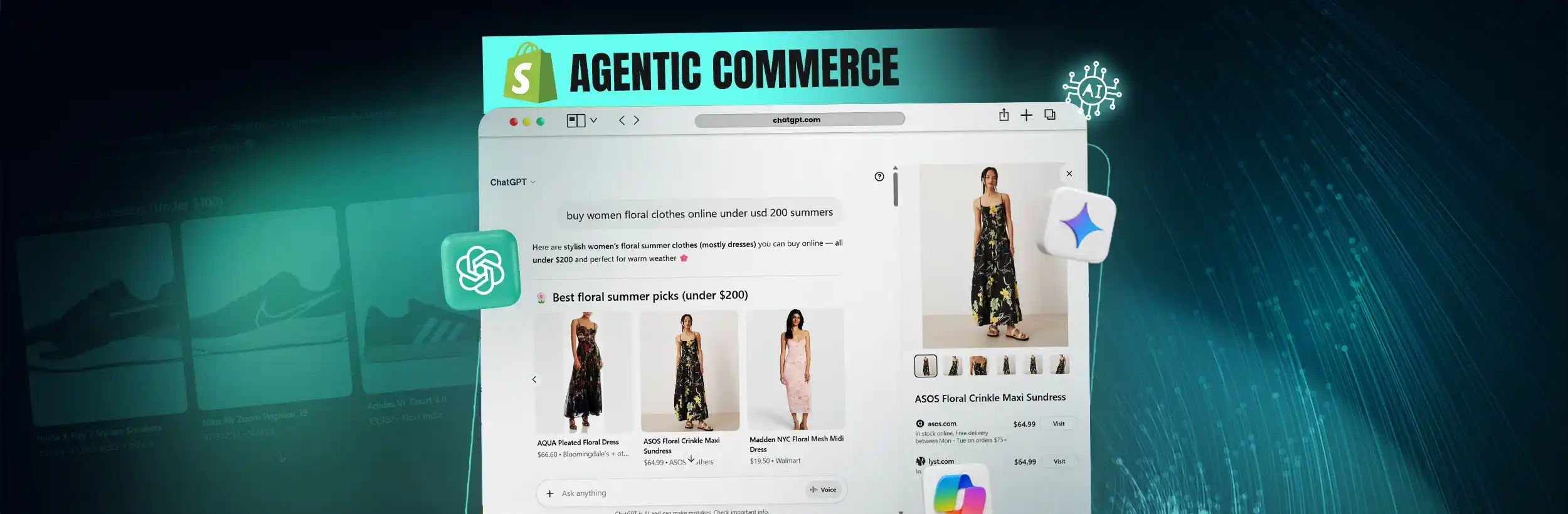
Imagine a customer telling their AI assistant, “Find me a waterproof hiking boot under $150 and buy it using my saved shipping info.” Until now, this was impossible. AI could only search the web. It couldn’t actually finish the transaction for you.
Every website speaks its own language, creating a digital wall that AI agents couldn’t climb. This is where the Universal Commerce Protocol (UCP) changes everything. By creating a standard language for buying and selling, UCP finally makes commerce programmable. It acts like a bridge between your store’s inventory and the AI tools your customers use every day.
Shopify has already begun pushing this transformation toward AI commerce at scale, where AI systems can interact directly with merchant stores. This means your products aren’t just sitting on a page anymore. They are now living data points that AI can find, recommend, and sell instantly.
By adopting this new standard, you can sell directly inside AI interfaces like Google Gemini or ChatGPT. You no longer have to wait for a customer to click a link to your site. The “buy button” is now everywhere.
What Is Universal Commerce Protocol (UCP)?
The Universal Commerce Protocol (UCP) is a new open-source standard. It was co-developed by Google and Shopify, along with other retail leaders. Think of it as the “TCP/IP” for online shopping. This protocol creates a shared language for the internet. It allows different systems to communicate without needing custom code for every connection.
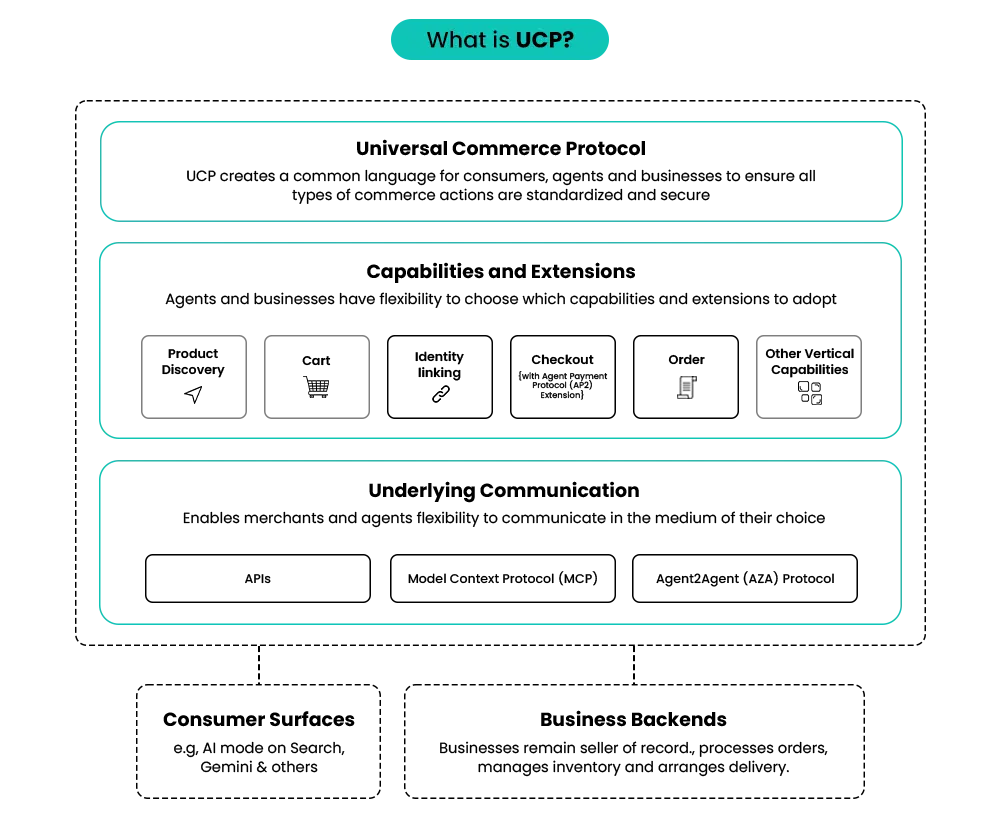
The main purpose of the Shopify Universal Commerce Protocol is to streamline the entire shopping journey. It lets AI agents and platforms talk to merchant systems easily. They can handle product discovery, price negotiation, and secure checkout. It even covers post-purchase tasks like tracking orders or processing returns. Instead of building one-off integrations, everyone uses this single, standard dialect.
UCP acts as a universal abstraction layer for the web. It is not a marketplace like Amazon or a middleman. It doesn’t “own” the customer or the transaction. Instead, it provides the “plumbing” that connects buyers and sellers. Merchants stay the Merchant of Record. They keep full control over their branding, data, and customer relationships.
This technology is the backbone of AI-driven commerce. Shopify’s latest updates around agentic storefronts show how AI agents will soon interact with ecommerce stores to discover and complete purchases. This means AI assistants can perform complex shopping tasks for you. A user can tell an AI to find and buy a specific item. The AI then uses UCP to talk to stores and finish the job. For Shopify merchants, this means your store is ready for a future where robots do the shopping.
– Also Read: AI SEO for Ecommerce: Top Strategies to Rank in ChatGPT in 2026
Drive high-intent traffic from ChatGPT, Google AI, Gemini & Copilot
We help your Shopify products get discovered across ChatGPT, Google AI, Gemini, and Copilot—bringing in high-intent buyers, boosting conversions, and driving more revenue.
How UCP Works Behind the Scenes?
Behind the scenes, the Universal Commerce Protocol (UCP) works like a digital handshake between your store and an AI. It moves away from the old way of building custom bridges for every single app.
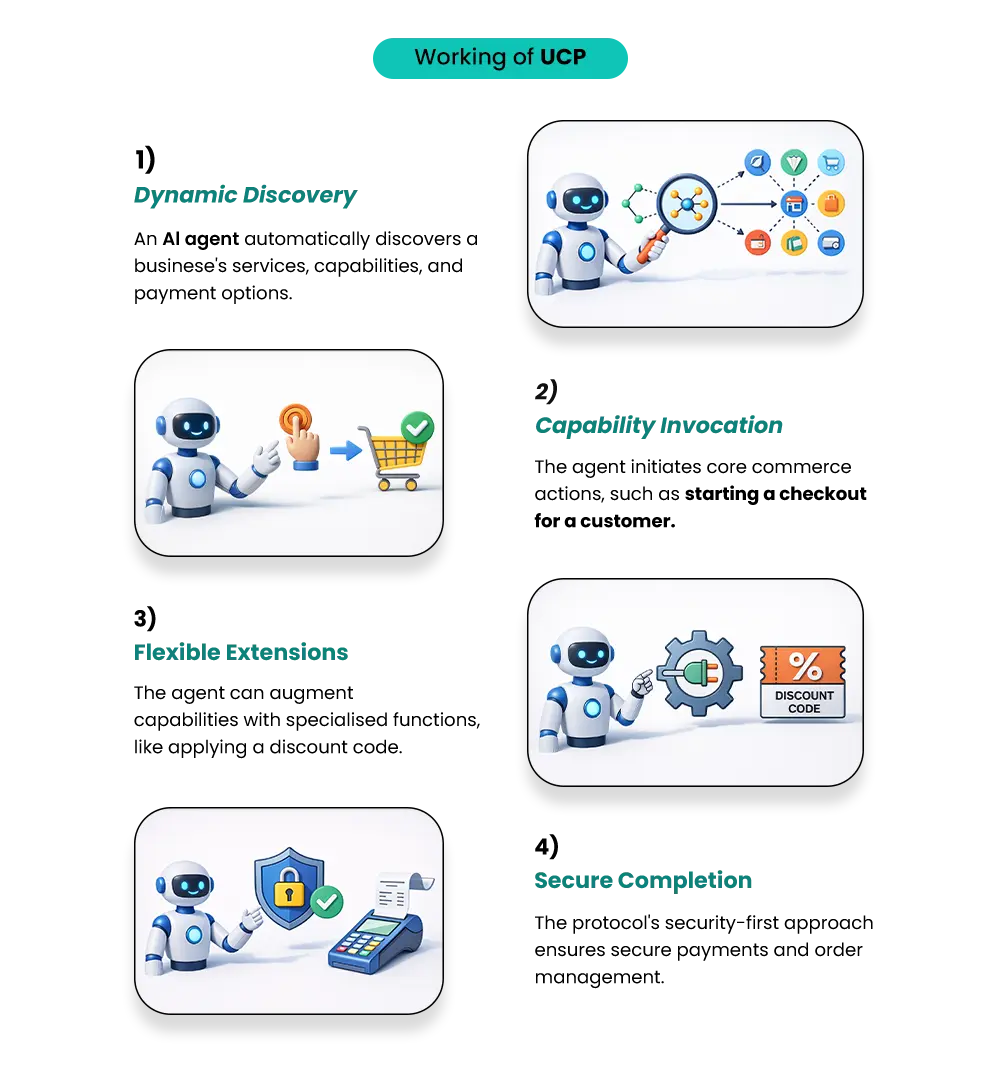
Instead, it uses a standardized process that allows AI agents in ecommerce to understand your store instantly. The technical flow follows three simple steps:
- Discovery: Your store publishes a “manifest” file at a public link (like yourstore.com/.well-known/ucp). This file tells the AI exactly what your store can do.
- Capability Negotiation: The AI agent reads your manifest to see what features you support. It checks for things like loyalty points, specific shipping zones, or discount codes. The two systems “negotiate” to find a common ground for the transaction.
- Transaction Flow: Once they agree on the rules, the agent handles the heavy lifting. It creates a secure checkout session, applies the right taxes, and uses the open commerce protocol to finish the payment.
Traditional Integration vs. UCP
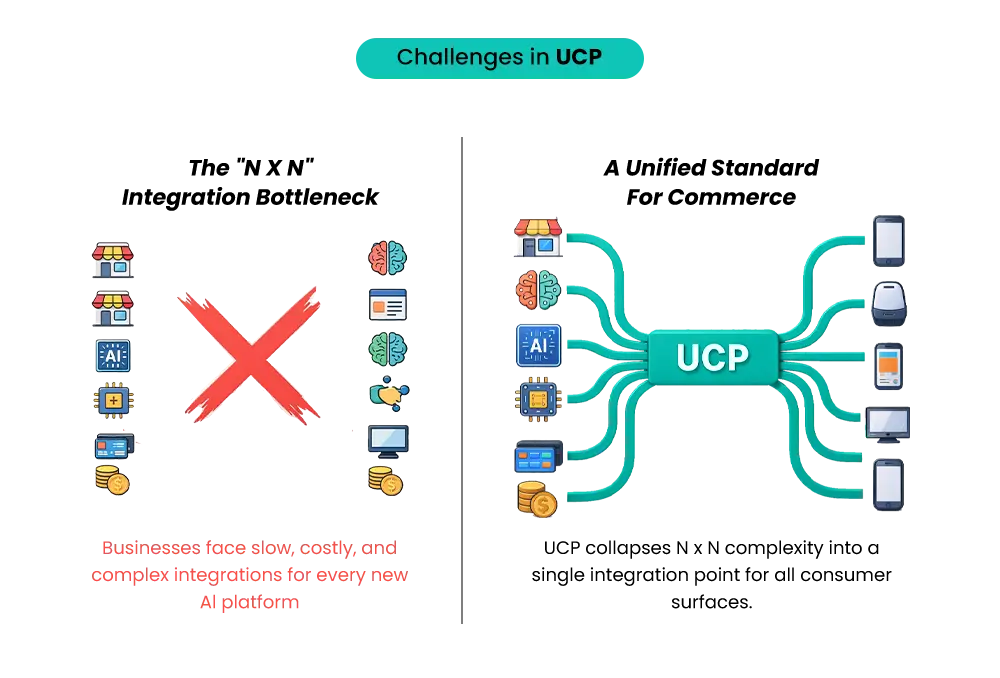
In the past, if you wanted to sell on a new platform, you had to build a custom API connection. If there were ten platforms, you needed ten different setups. This was slow and expensive.
With UCP, you integrate once. Because the language is standardized, any AI agent—from Google Gemini to a niche shopping bot—can talk to your Shopify store using the same “grammar.”
UCP and AI-Driven Commerce — A New Shopping Paradigm
The Universal Commerce Protocol (UCP) is the foundation for a new era called agentic commerce. In this world, AI agents like Google Gemini or ChatGPT act as personal shopping assistants. These agents don’t just search for links. They carry out complex tasks on your behalf.
The partnership between Shopify and Google UCP allows these agents to talk directly to a store’s backend. This creates a hands-off shopping flow where the AI handles the hard work. It can find products, compare prices across different stores, and finish the purchase in seconds.
This new paradigm offers several major advantages for both shoppers and brands:
- Instant Discovery: AI agents find the exact product that matches a user’s specific constraints or preferences.
- In-Conversation Buying: Customers can complete a checkout without ever leaving their chat window or voice assistant.
- Zero Navigation: There is no need to click through multiple pages, menus, or confusing web interfaces to find a “Buy” button.
By using UCP, Shopify is moving beyond being a simple website builder. It is becoming a global protocol for automated trade. This shift reduces the friction of traditional web browsing. It turns every AI interaction into a potential point of sale for your business. For merchants, this means being present exactly where the customer is already talking.
What UCP Means for Shopify Merchants?
For Shopify merchants, the Universal Commerce Protocol (UCP) is more than just a technical update. It is a fundamental shift in how your business reaches customers. It turns your store into a high-speed data node that can sell anywhere an AI assistant exists.
A). Increased Discovery Across Platforms
UCP makes your products discoverable by AI systems, not just traditional search engines. In the old world, you fought for a spot in “ten blue links.” In the new world of AI discovery and purchase, your product data is surfaced directly in AI chat contexts.
- Semantic Search: AI understands the “why” behind a customer’s query, matching your products to complex needs.
- Google & Gemini Integration: Your catalog appears natively in Google’s “AI Mode,” placing you where the most modern shopping happens.
- Real-Time Accuracy: UCP ensures AI agents see live inventory and pricing, so you never lose a sale to stale data.
B). AI-Native Checkout Experiences
The biggest win for UCP Shopify users is the death of the “click-through.” Customers can now finish a purchase without ever visiting your website.
- Conversational Buying: Agentic shopping allows a user to say “buy it,” and the AI handles the rest using UCP.
- Embedded Logic: Discount codes, loyalty rewards, and subscriptions work perfectly within these AI flows.
- Reduced Friction: By removing the need to navigate five different pages, UCP helps slash cart abandonment rates.
C). Broader Reach Beyond Shopify Hosted Stores
Shopify is opening the door for everyone through this AI commerce protocol. Even brands that don’t use Shopify for their main website can join the ecosystem.
- Shopify Catalog Access: Non-Shopify merchants can use the new “Agentic Plan” to list products in the global Shopify Catalog.
- Standardized Presence: This allows any brand to gain a presence in ChatGPT, Microsoft Copilot, and other future AI tools.
- One Connection, Everywhere: You sync your data once and gain access to millions of customers across every major AI platform.
– Also Read: AI SEO For Shopify Stores: Best Practices Every Merchant Needs in 2026
Benefits and Strategic Advantages
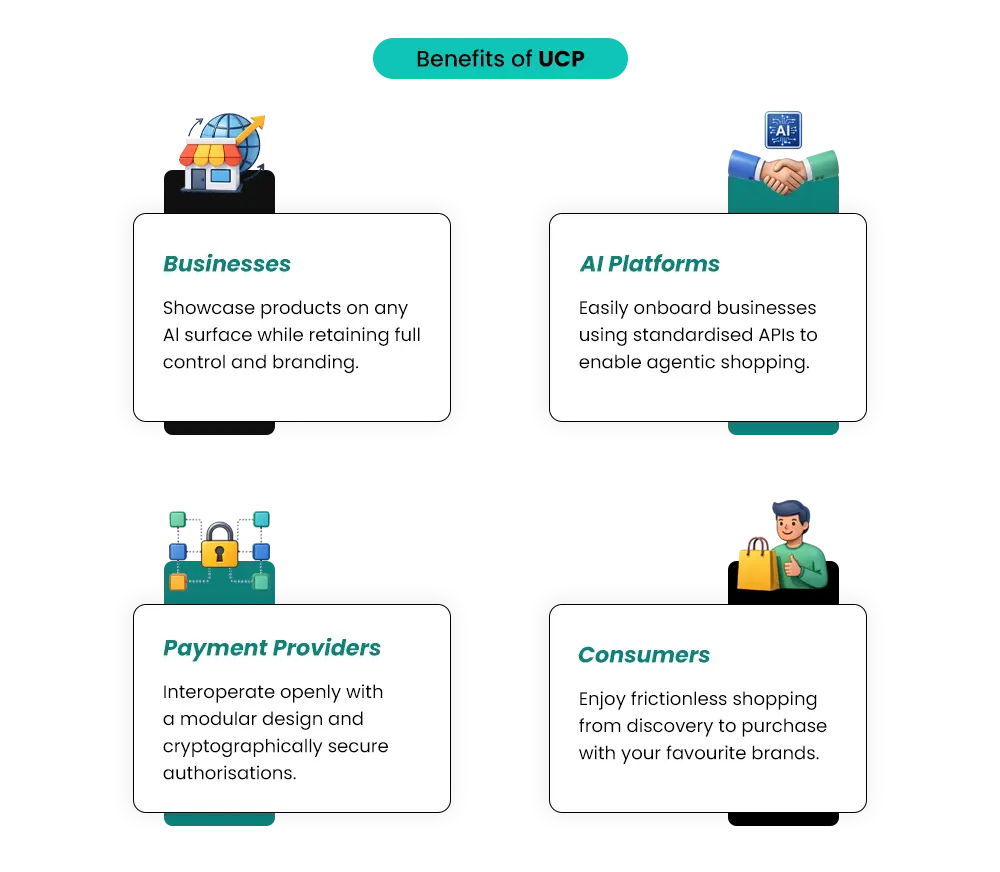
The Universal Commerce Protocol (UCP) is a game-changer for the future of ecommerce. It moves us away from messy, manual setups toward a streamlined, open commerce protocol. This shift creates huge strategic benefits for brands and developers alike.
Key Strategic Advantages:
- Higher Conversion Potential: UCP removes the friction between finding a product and buying it. AI agents can now handle checkouts instantly. This keeps shoppers from dropping off during complex payment steps.
- Improved Relevance: AI agents use this protocol to match a buyer’s intent with exact product data. This means customers see what they actually want, leading to more sales and less browsing fatigue.
- A Massive Competitive Edge: Early adopters can win big in new AI commerce ecosystems. Being “AI-ready” ensures your products appear where the next generation of shoppers is looking.
- Lower Technical Barriers: Instead of building custom connectors for every app, UCP standardizes how agents talk to stores. It simplifies the backend so you can focus on growth.
By embracing this standard, merchants stop managing static links and start running dynamic systems. This protocol allows agents and humans to collaborate smoothly on every transaction.
It ensures that commerce remains flexible and scalable as technology evolves. Using an open standard means you are never locked into one single platform. You are building a store that is ready for any AI-driven future.
– Also Read: Top 10 AI SEO Tools for Shopify Stores in 2026
Potential Challenges and What Shopify Merchants Should Prepare For
While UCP opens new doors, it also brings a few hurdles that Shopify merchants need to tackle early. Moving from a traditional store to an AI-driven one isn’t just a simple toggle. It requires a shift in how you organize your business data.
Main Challenges in UCP:
- Data Quality: AI agents need structured, high-quality product data to function. If your descriptions are messy or details are missing, the AI won’t recommend your products.
- Logic Readiness: Merchants must define clear logic for things like complex discounts and fulfillment. Machines need to understand these rules perfectly to complete a sale without human help.
- New Ecosystems: AI shopping channels are still emerging. This means traffic patterns may shift slowly as shoppers get used to buying through “agents” instead of websites.
- Privacy and Security: Handling payment security in a machine-to-machine world is critical. You must ensure customer data stays safe while moving between different AI services.
Preparation is key to staying ahead. Start by auditing your current product feed for accuracy. Focus on making your backend “machine-readable,” so AI can navigate your store easily. Staying compliant with the latest security standards will also build trust as this technology grows. Early adopters who fix these gaps now will have a huge advantage.
Future Outlook — What Comes After UCP
The Universal Commerce Protocol (UCP) is just the beginning of a massive shift in how we buy things. In the future of ecommerce, shopping will move from a “search and click” model to a “talk and get” model. AI commerce will likely become the default way people shop daily.
Future Trends After UCP:
- AI as the Default Channel: Shopping will happen inside chats, not just websites. Most Shopify merchants will see AI agents act as the primary storefront for their brands.
- Voice-First Shopping: Standardized protocols will allow you to buy products using only your voice. You can simply tell an assistant what you need while driving or cooking.
- Total Interoperability: UCP will work across different interfaces like smart glasses and car dashboards. This creates a seamless experience where your cart follows you everywhere.
- Agent Collaboration: Different AI protocols will soon talk to each other. One agent might find a deal while another handles the UCP ecommerce checkout securely.
As these technologies mature, the friction of online shopping will almost disappear. This evolution will force brands to focus more on data accuracy than flashy web design. The goal is to be “machine-discoverable” so your products show up in every digital conversation.
– Also Read: How to Optimize Your Shopify Store for Better UX and Retention?
Conclusion
The Universal Commerce Protocol (UCP) is a huge leap forward. It prepares merchants for a world where AI agents do the heavy lifting. By adopting this standard, you ensure your products are ready for the next generation of buyers.
The goal is to make your business “discoverable” in an AI-first world. Don’t wait for these shopping channels to become mainstream before you act. Start refining your product feed now to lock in your competitive edge. Building a solid foundation today will lead to more sales tomorrow.
Whether you’re starting small or dreaming big, your journey begins with one step—launching your online Shopify store the smart way with Mastroke Experts!
Show your Shopify products in AI search and turn visibility into sales
We make your Shopify products show up in AI search—so you get more high-intent traffic, better conversions, and more sales.
FAQs-
1. What is Universal Commerce Protocol (UCP)?
Universal Commerce Protocol (UCP) is an open commerce standard that allows AI agents to discover products, negotiate terms, and complete purchases directly with merchants across platforms.
2. How does UCP affect Shopify merchants?
UCP allows Shopify merchants to be discovered and sold through AI assistants, search agents, and conversational commerce channels without relying only on traditional storefront browsing.
3. Is UCP replacing Shopify stores or marketplaces?
No. UCP does not replace Shopify stores or marketplaces. It acts as a protocol layer that connects AI systems with existing merchant stores and checkout systems.
4. Do Shopify merchants need Shopify Plus to use UCP?
Shopify Plus is not mandatory for UCP, but larger merchants benefit more due to automation, advanced checkout logic, and complex fulfillment support.
5. How does UCP support AI-driven shopping experiences?
UCP enables AI agents to understand product data, pricing rules, shipping options, and checkout logic, allowing users to shop and buy within AI conversations.
6. How does UCP support AI-driven shopping experiences?
UCP enables AI agents to understand product data, pricing rules, shipping options, and checkout logic, allowing users to shop and buy within AI conversations.
7. What is AI commerce in Shopify?
Agentic commerce refers to AI systems (like ChatGPT or AI assistants) that can discover, recommend, and even purchase products on behalf of users, transforming ecommerce from manual browsing to automated decision-making.
8. Will AI replace traditional ecommerce websites?
AI won’t fully replace websites but will change how users interact with them. Instead of browsing, customers may rely on AI assistants to find and buy products, making structured data and AI visibility critical.
9. What role does SEO play in AI commerce?
SEO is evolving into AI Search Optimization (AISO). Instead of just keywords, AI prioritizes structured data, context, and intent-based content to recommend products.
10. How can I sell products through ChatGPT or AI platforms?
To sell through AI platforms like ChatGPT or Gemini, merchants need to ensure their products are AI-discoverable. This includes structured product data, optimized product descriptions, strong SEO, and integration with platforms like Shopify that support AI-ready feeds. AI tools pull data from trusted sources to recommend products.
11. Can AI platforms drive sales directly?
Yes, AI platforms can influence purchase decisions by recommending products and directing users to your store. In the future, AI may even complete purchases directly within conversations.
12. Why should Shopify merchants care about AI commerce now?
Because early adopters gain a competitive advantage. Optimizing for AI today ensures your products are visible when AI-driven shopping becomes mainstream.
13. Can Mastroke list my products directly on ChatGPT or Gemini?
Yes, absolutely. Mastroke enables your products to appear across AI platforms like ChatGPT and Gemini by building an AI-ready ecosystem—optimizing your product data, content, and visibility so AI tools can discover and recommend your products to the right audience.
👉 Let’s connect with our experts and quickly schedule a meeting to get started.