This blog post explains why WooCommerce stores eventually hit performance and maintenance limitations as they grow, and how migrating to Shopify can solve these issues. It presents the case for migration by highlighting the operational burden of managing WooCommerce's plugins, hosting, and infrastructure versus Shopify's managed platform approach.
Every WooCommerce store hits a wall at some point. Maybe your store slows down during sales events and you spend Black Friday refreshing your server monitor instead of watching orders come in. Maybe a plugin update breaks your checkout — again.
Maybe your developer bills keep climbing just to keep things running and you’re starting to wonder:
“Is this platform working for me — or am I working for it?”
These aren’t random problems. They’re signs that WooCommerce has reached its limit for your business at its current stage of growth.
Conversion Increase
Research shows that a 1-second improvement in page load speed can increase conversions by up to 7%.
Mobile Users Leave
53% of mobile users abandon pages that take longer than 3 seconds to load.
Annual GMV
Shopify now processes $378 billion in annual GMV, making it one of the largest commerce infrastructures globally.
For WooCommerce stores dependent on hosting quality and plugin performance for speed, every traffic spike becomes a gamble.
Shopify was built differently.
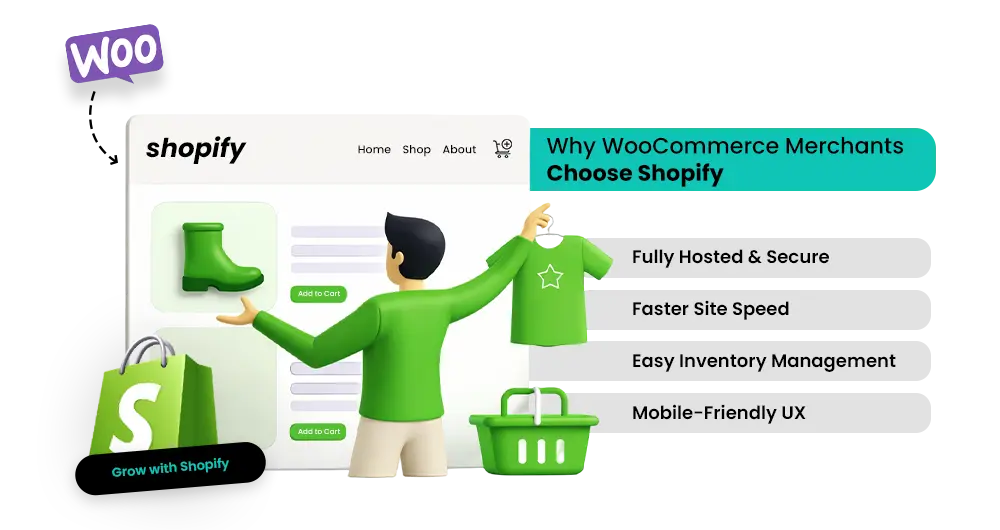
- Hosting, security, and updates are handled automatically
- Checkout is optimized and battle-tested at scale
- Infrastructure is designed for high-growth ecommerce businesses
- Performance stays stable during traffic spikes and sales events
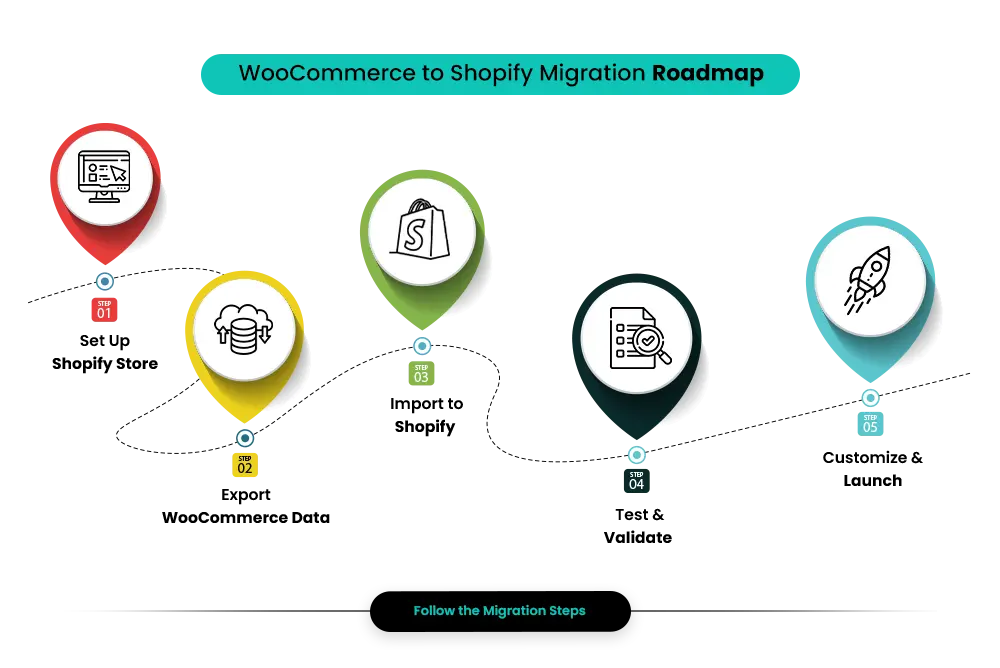
This guide walks you through the complete WooCommerce to Shopify migration process:
- What to do before you touch anything
- How to migrate products, customers, and orders safely
- How to protect your SEO rankings during migration
- The mistakes that cost merchants traffic and revenue
- How to launch Shopify without downtime or checkout issues
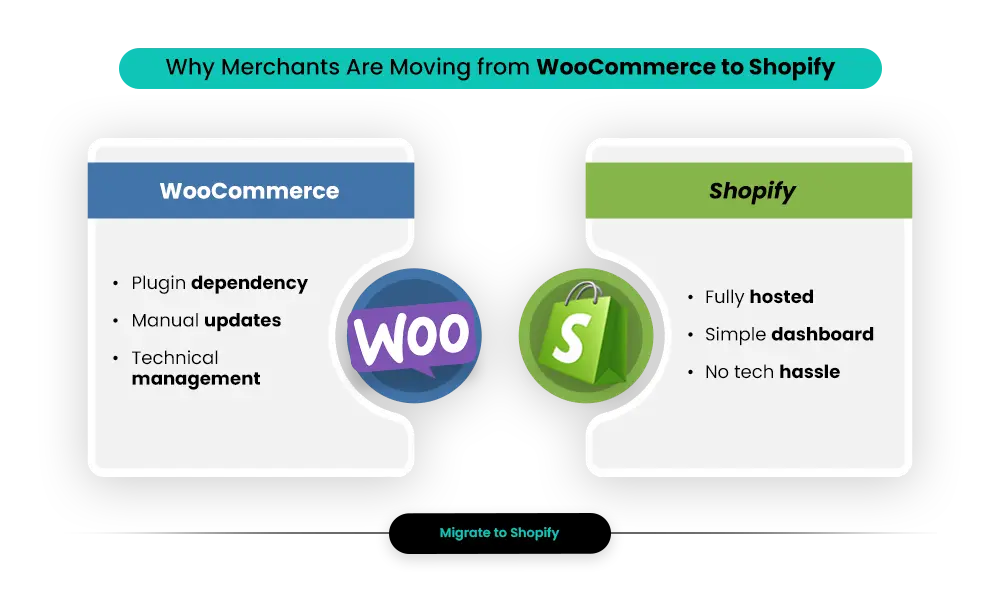
Why Merchants Are Moving from WooCommerce to Shopify
Nowadays, the pattern is consistent.
A merchant starts on WooCommerce because it’s free and flexible. Then the plugins start piling up — SEO plugins, security tools, shipping integrations, review systems, checkout customizations, backup tools, performance optimizers.
Average Plugins Per WooCommerce Store
According to StudioWombat’s 2026 WooCommerce report, the average WooCommerce store runs on around 30 plugins.
Each plugin becomes a dependency. Each update becomes a risk. And every plugin conflict becomes another debugging session.
As the business grows, the maintenance overhead grows with it.
What started as a “free platform” slowly becomes a full-time operational burden — where the team spends more time maintaining the store than growing the business.
Planning a WooCommerce to Shopify Migration?
Mastroke helps brands migrate from WooCommerce to Shopify without losing SEO rankings, customer data, or store performance. From redirects and integrations to theme setup and post-launch support, we handle the migration properly from start to finish.
Why WooCommerce Merchants Migrate to Shopify
1. Server & Hosting Management
WooCommerce runs entirely on your hosting infrastructure.
Traffic spikes, server scaling, PHP compatibility, database optimization, caching layers, backups, SSL certificates, and security patches all become your responsibility.
Shopify handles infrastructure, hosting, performance optimization, and security automatically at the platform level.
2. Plugin Conflicts & Maintenance Tax
Every WooCommerce plugin is built and maintained by a separate developer operating on a different update schedule.
When plugins conflict, stores break — often during the worst possible moment.
- Checkout failures
- Broken payment gateways
- Theme conflicts
- Database errors
- Slow admin performance
Shopify replaces much of this complexity with native features and a curated ecosystem of over 8,000 apps.
3. Performance During Traffic Spikes
WooCommerce stores often require manual scaling before major campaigns or high-traffic events.
Merchants frequently spend Black Friday monitoring servers instead of managing growth opportunities.
Shopify Handles Scale Automatically
Shopify’s infrastructure handles Black Friday traffic the same way it handles a normal Tuesday — without manual intervention.
4. Checkout Conversion Performance
Shopify’s checkout is one of the most extensively optimized checkout systems in ecommerce.
Higher Mobile Conversion
Independent analysis shows Shopify checkout can improve mobile conversion rates by 15–17% compared to WooCommerce equivalents.
Shop Pay Advantage
Shop Pay accelerated checkout provides additional conversion lift for returning customers with stored payment details.
What Migration Data Shows
Migration Satisfaction
92% of merchants report satisfaction after migrating away from WooCommerce.
Choose Shopify
Shopify is the destination platform for 60.8% of WooCommerce migrations.
Operational Savings
Merchants typically reduce operational overhead by 20–30% after moving to Shopify’s managed infrastructure.
Signs It’s Time to Migrate to Shopify
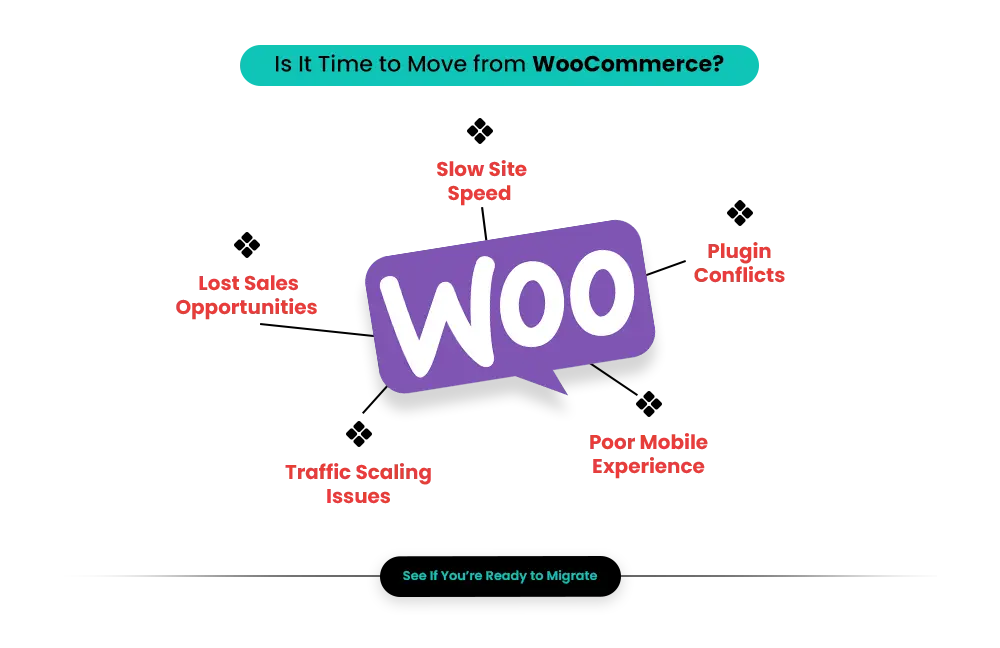
If any of these describe your current WooCommerce experience, migration has moved from “eventually” to “now”.
- Your store consistently loads in more than 3 seconds on mobile
- A plugin update broke something in the last six months and required developer intervention
- You dread Black Friday or major launches because your hosting can’t reliably handle traffic spikes
- Your team spends meaningful time every month on maintenance instead of growth
- You’ve experienced a security issue or are uncertain about your current security posture
- Adding channels like wholesale, international selling, or social commerce has become operationally difficult
-
 Experts
Advanced Tips: Maximizing Your Shopify Store After Migration
Migrate to Shopify Without Losing SEO or Sales
Start Your Shopify Migration
From URL redirects and SEO preservation to checkout setup and integration migration, Mastroke helps WooCommerce brands move to Shopify with a clean, scalable, and conversion-focused setup built for long-term growth.
FAQs
1. How long does WooCommerce to Shopify migration take?
Migration timelines depend on your store size and complexity. Small stores with fewer than 500 products usually take 1–2 weeks. Medium stores with 500–5,000 products typically require 2–4 weeks. Large stores with complex integrations, heavy SEO traffic, or custom functionality can take 4–12 weeks. Most migration time goes into testing, SEO validation, and quality checks rather than the data transfer itself.
2. Will my SEO rankings drop after migrating to Shopify?
SEO rankings do not necessarily drop if the migration is handled correctly. The biggest SEO risk comes from URL changes, since WooCommerce uses /product/item-name/ while Shopify uses /products/item-name/. Every old URL requires a proper 301 redirect. Meta titles, descriptions, image alt text, schema markup, and internal links must also be preserved manually to avoid ranking losses.
3. What data cannot be migrated from WooCommerce to Shopify?
Customer passwords cannot be migrated due to security restrictions, so customers must reset their passwords after launch. WooCommerce themes also cannot transfer because Shopify uses a completely different templating system called Liquid. Historical orders can be imported, but they appear as archived records rather than active orders.
4. How much does WooCommerce to Shopify migration cost?
Costs vary depending on store size and migration method. Automated migration tools generally cost between $100–$500+, while freelance Shopify experts typically charge $75–$200+ per hour. Agency-led migrations cost more but include SEO protection, integrations, testing, and post-launch support. In most cases, fixing a poor migration costs significantly more than doing it correctly the first time.
5. Do WooCommerce themes work on Shopify?
No. WooCommerce themes are built on WordPress and PHP architecture, while Shopify uses its own Liquid framework. Themes are not transferable between the platforms. Most merchants choose a Shopify theme and customize it to match their branding while improving performance and mobile experience.
6. Can I migrate customer accounts and order history to Shopify?
Yes. Customer records and historical order data can be migrated to Shopify. Customers can still access previous orders inside their accounts after launch. However, passwords must be reset because they cannot be transferred securely between platforms.
7. Should I use a migration tool or hire a Shopify expert?
Automated migration tools are suitable for smaller stores with simple catalogs and limited SEO dependency. Stores with strong organic traffic, complex integrations, custom WooCommerce functionality, or high revenue dependency should consider hiring a Shopify migration expert or agency to reduce the risk of SEO loss, downtime, or checkout errors.
8. Why are 301 redirects so important during WooCommerce to Shopify migration?
Shopify forces a different URL structure than WooCommerce, meaning every product URL changes during migration. Without proper 301 redirects, old URLs become 404 errors and lose their accumulated SEO authority. Redirect mapping is one of the most critical technical steps in the entire migration process.